QUESTION IMAGE
Question
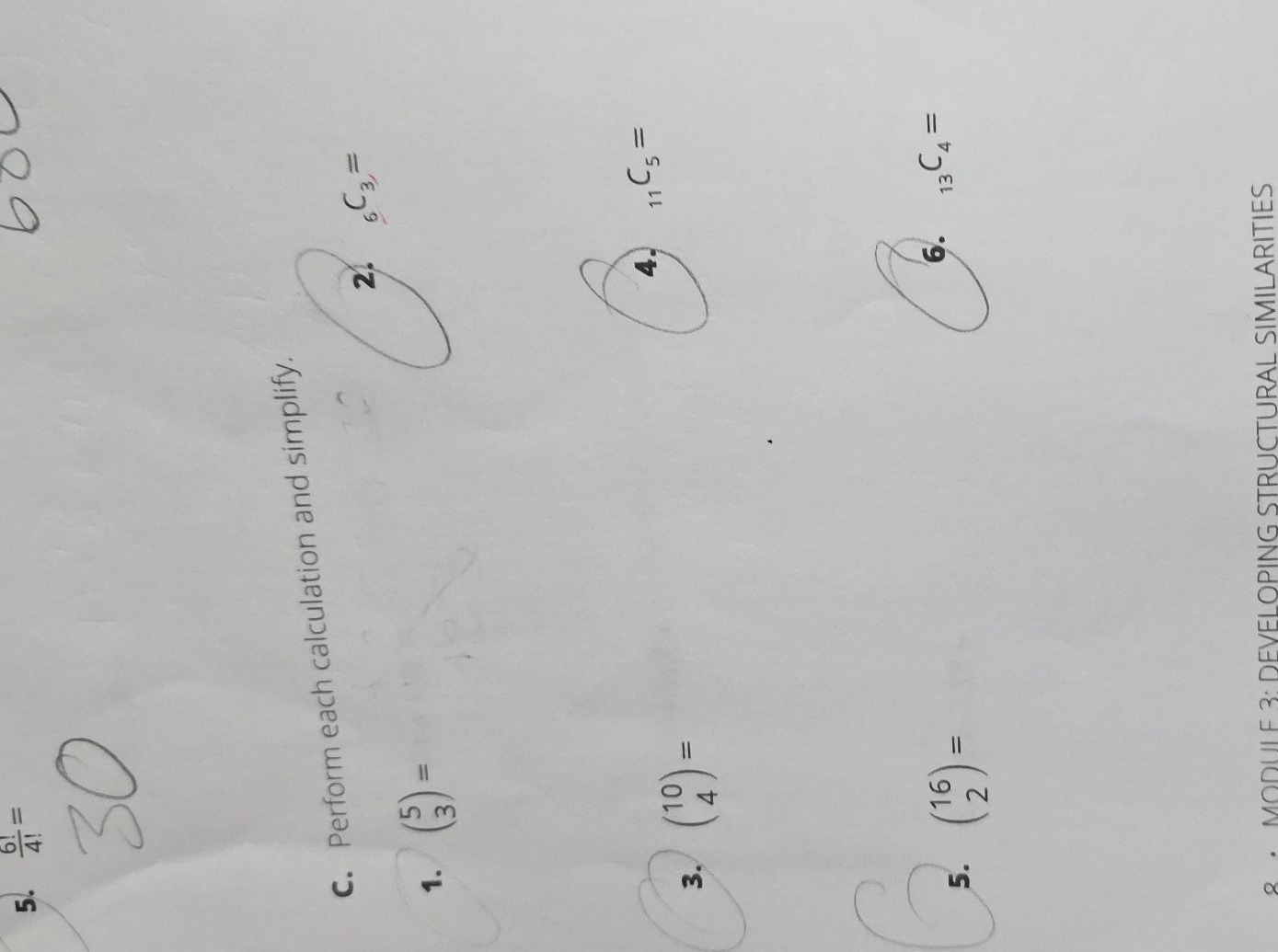
c. perform each calculation and simplify.
- $\dbinom{5}{3} =$
- $_{6}c_{3} =$
- $\dbinom{10}{4} =$
- $_{11}c_{5} =$
- $\dbinom{16}{2} =$
- $_{13}c_{4} =$
To solve these combination problems, we use the formula for combinations:
$$\binom{n}{k} = C(n, k) = \frac{n!}{k!(n - k)!}$$
where \( n! = n \times (n - 1) \times \dots \times 1 \) (and \( 0! = 1 \)).
1. \(\boldsymbol{\binom{5}{3}}\)
Step 1: Apply the combination formula
Using \( n = 5 \) and \( k = 3 \):
$$\binom{5}{3} = \frac{5!}{3!(5 - 3)!} = \frac{5!}{3! \cdot 2!}$$
Step 2: Expand the factorials
\( 5! = 5 \times 4 \times 3! \) and \( 2! = 2 \times 1 \). Substitute these in:
$$\frac{5 \times 4 \times 3!}{3! \cdot 2 \times 1}$$
Step 3: Simplify
Cancel \( 3! \) from numerator and denominator:
$$\frac{5 \times 4}{2 \times 1} = \frac{20}{2} = 10$$
2. \(\boldsymbol{C(6, 3)}\)
Step 1: Apply the combination formula
Using \( n = 6 \) and \( k = 3 \):
$$C(6, 3) = \frac{6!}{3!(6 - 3)!} = \frac{6!}{3! \cdot 3!}$$
Step 2: Expand the factorials
\( 6! = 6 \times 5 \times 4 \times 3! \). Substitute:
$$\frac{6 \times 5 \times 4 \times 3!}{3! \cdot 3!}$$
Step 3: Simplify
Cancel \( 3! \) from numerator and denominator:
$$\frac{6 \times 5 \times 4}{3 \times 2 \times 1} = \frac{120}{6} = 20$$
3. \(\boldsymbol{\binom{10}{4}}\)
Step 1: Apply the combination formula
Using \( n = 10 \) and \( k = 4 \):
$$\binom{10}{4} = \frac{10!}{4!(10 - 4)!} = \frac{10!}{4! \cdot 6!}$$
Step 2: Expand the factorials
\( 10! = 10 \times 9 \times 8 \times 7 \times 6! \). Substitute:
$$\frac{10 \times 9 \times 8 \times 7 \times 6!}{4! \cdot 6!}$$
Step 3: Simplify
Cancel \( 6! \) from numerator and denominator. Expand \( 4! = 4 \times 3 \times 2 \times 1 \):
$$\frac{10 \times 9 \times 8 \times 7}{4 \times 3 \times 2 \times 1} = \frac{5040}{24} = 210$$
4. \(\boldsymbol{C(11, 5)}\)
Step 1: Apply the combination formula
Using \( n = 11 \) and \( k = 5 \):
$$C(11, 5) = \frac{11!}{5!(11 - 5)!} = \frac{11!}{5! \cdot 6!}$$
Step 2: Expand the factorials
\( 11! = 11 \times 10 \times 9 \times 8 \times 7 \times 6! \). Substitute:
$$\frac{11 \times 10 \times 9 \times 8 \times 7 \times 6!}{5! \cdot 6!}$$
Step 3: Simplify
Cancel \( 6! \) from numerator and denominator. Expand \( 5! = 5 \times 4 \times 3 \times 2 \times 1 \):
$$\frac{11 \times 10 \times 9 \times 8 \times 7}{5 \times 4 \times 3 \times 2 \times 1} = \frac{55440}{120} = 462$$
5. \(\boldsymbol{\binom{16}{2}}\)
Step 1: Apply the combination formula
Using \( n = 16 \) and \( k = 2 \):
$$\binom{16}{2} = \frac{16!}{2!(16 - 2)!} = \frac{16!}{2! \cdot 14!}$$
Step 2: Expand the factorials
\( 16! = 16 \times 15 \times 14! \). Substitute:
$$\frac{16 \times 15 \times 14!}{2! \cdot 14!}$$
Step 3: Simplify
Cancel \( 14! \) from numerator and denominator. Expand \( 2! = 2 \times 1 \):
$$\frac{16 \times 15}{2 \times 1} = \frac{240}{2} = 120$$
6. \(\boldsymbol{C(13, 4)}\)
Step 1: Apply the combination formula
Using \( n = 13 \) and \( k = 4 \):
$$C(13, 4) = \frac{13!}{4!(13 - 4)!} = \frac{13!}{4! \cdot 9!}$$
Step 2: Expand the factorials
\( 13! = 13 \times 12 \times 11 \times 10 \times 9! \). Substitute:
$$\frac{13 \times 12 \times 11 \times 10 \times 9!}{4! \cdot 9!}$$
Step 3: Simplify
Cancel \( 9! \) from numerator and denominator. Expand \( 4! = 4 \times 3 \times 2 \times 1 \):
$$\frac{13 \times 12 \times 11 \times 10}{4 \times 3 \times 2 \times 1} = \frac{17160}{24} = 715$$
Final Answers:
- \(\boldsymbol{\binom{5}{3} = 10}\)
- \(\boldsymbol{C(6, 3) = 20}\)
- \(\boldsymbol{\binom{10}{4} = 210}\)
- \(\boldsymbol{C(11, 5) = 462}\)
- \(\boldsymbol{\binom{16}{2} = 120}\)
- \(\boldsymbol{C(13, 4) = 715}\)

Snap & solve any problem in the app
Get step-by-step solutions on Sovi AI
Photo-based solutions with guided steps
Explore more problems and detailed explanations
To solve these combination problems, we use the formula for combinations:
$$\binom{n}{k} = C(n, k) = \frac{n!}{k!(n - k)!}$$
where \( n! = n \times (n - 1) \times \dots \times 1 \) (and \( 0! = 1 \)).
1. \(\boldsymbol{\binom{5}{3}}\)
Step 1: Apply the combination formula
Using \( n = 5 \) and \( k = 3 \):
$$\binom{5}{3} = \frac{5!}{3!(5 - 3)!} = \frac{5!}{3! \cdot 2!}$$
Step 2: Expand the factorials
\( 5! = 5 \times 4 \times 3! \) and \( 2! = 2 \times 1 \). Substitute these in:
$$\frac{5 \times 4 \times 3!}{3! \cdot 2 \times 1}$$
Step 3: Simplify
Cancel \( 3! \) from numerator and denominator:
$$\frac{5 \times 4}{2 \times 1} = \frac{20}{2} = 10$$
2. \(\boldsymbol{C(6, 3)}\)
Step 1: Apply the combination formula
Using \( n = 6 \) and \( k = 3 \):
$$C(6, 3) = \frac{6!}{3!(6 - 3)!} = \frac{6!}{3! \cdot 3!}$$
Step 2: Expand the factorials
\( 6! = 6 \times 5 \times 4 \times 3! \). Substitute:
$$\frac{6 \times 5 \times 4 \times 3!}{3! \cdot 3!}$$
Step 3: Simplify
Cancel \( 3! \) from numerator and denominator:
$$\frac{6 \times 5 \times 4}{3 \times 2 \times 1} = \frac{120}{6} = 20$$
3. \(\boldsymbol{\binom{10}{4}}\)
Step 1: Apply the combination formula
Using \( n = 10 \) and \( k = 4 \):
$$\binom{10}{4} = \frac{10!}{4!(10 - 4)!} = \frac{10!}{4! \cdot 6!}$$
Step 2: Expand the factorials
\( 10! = 10 \times 9 \times 8 \times 7 \times 6! \). Substitute:
$$\frac{10 \times 9 \times 8 \times 7 \times 6!}{4! \cdot 6!}$$
Step 3: Simplify
Cancel \( 6! \) from numerator and denominator. Expand \( 4! = 4 \times 3 \times 2 \times 1 \):
$$\frac{10 \times 9 \times 8 \times 7}{4 \times 3 \times 2 \times 1} = \frac{5040}{24} = 210$$
4. \(\boldsymbol{C(11, 5)}\)
Step 1: Apply the combination formula
Using \( n = 11 \) and \( k = 5 \):
$$C(11, 5) = \frac{11!}{5!(11 - 5)!} = \frac{11!}{5! \cdot 6!}$$
Step 2: Expand the factorials
\( 11! = 11 \times 10 \times 9 \times 8 \times 7 \times 6! \). Substitute:
$$\frac{11 \times 10 \times 9 \times 8 \times 7 \times 6!}{5! \cdot 6!}$$
Step 3: Simplify
Cancel \( 6! \) from numerator and denominator. Expand \( 5! = 5 \times 4 \times 3 \times 2 \times 1 \):
$$\frac{11 \times 10 \times 9 \times 8 \times 7}{5 \times 4 \times 3 \times 2 \times 1} = \frac{55440}{120} = 462$$
5. \(\boldsymbol{\binom{16}{2}}\)
Step 1: Apply the combination formula
Using \( n = 16 \) and \( k = 2 \):
$$\binom{16}{2} = \frac{16!}{2!(16 - 2)!} = \frac{16!}{2! \cdot 14!}$$
Step 2: Expand the factorials
\( 16! = 16 \times 15 \times 14! \). Substitute:
$$\frac{16 \times 15 \times 14!}{2! \cdot 14!}$$
Step 3: Simplify
Cancel \( 14! \) from numerator and denominator. Expand \( 2! = 2 \times 1 \):
$$\frac{16 \times 15}{2 \times 1} = \frac{240}{2} = 120$$
6. \(\boldsymbol{C(13, 4)}\)
Step 1: Apply the combination formula
Using \( n = 13 \) and \( k = 4 \):
$$C(13, 4) = \frac{13!}{4!(13 - 4)!} = \frac{13!}{4! \cdot 9!}$$
Step 2: Expand the factorials
\( 13! = 13 \times 12 \times 11 \times 10 \times 9! \). Substitute:
$$\frac{13 \times 12 \times 11 \times 10 \times 9!}{4! \cdot 9!}$$
Step 3: Simplify
Cancel \( 9! \) from numerator and denominator. Expand \( 4! = 4 \times 3 \times 2 \times 1 \):
$$\frac{13 \times 12 \times 11 \times 10}{4 \times 3 \times 2 \times 1} = \frac{17160}{24} = 715$$
Final Answers:
- \(\boldsymbol{\binom{5}{3} = 10}\)
- \(\boldsymbol{C(6, 3) = 20}\)
- \(\boldsymbol{\binom{10}{4} = 210}\)
- \(\boldsymbol{C(11, 5) = 462}\)
- \(\boldsymbol{\binom{16}{2} = 120}\)
- \(\boldsymbol{C(13, 4) = 715}\)