QUESTION IMAGE
Question
period 2nd
unit 2
motion
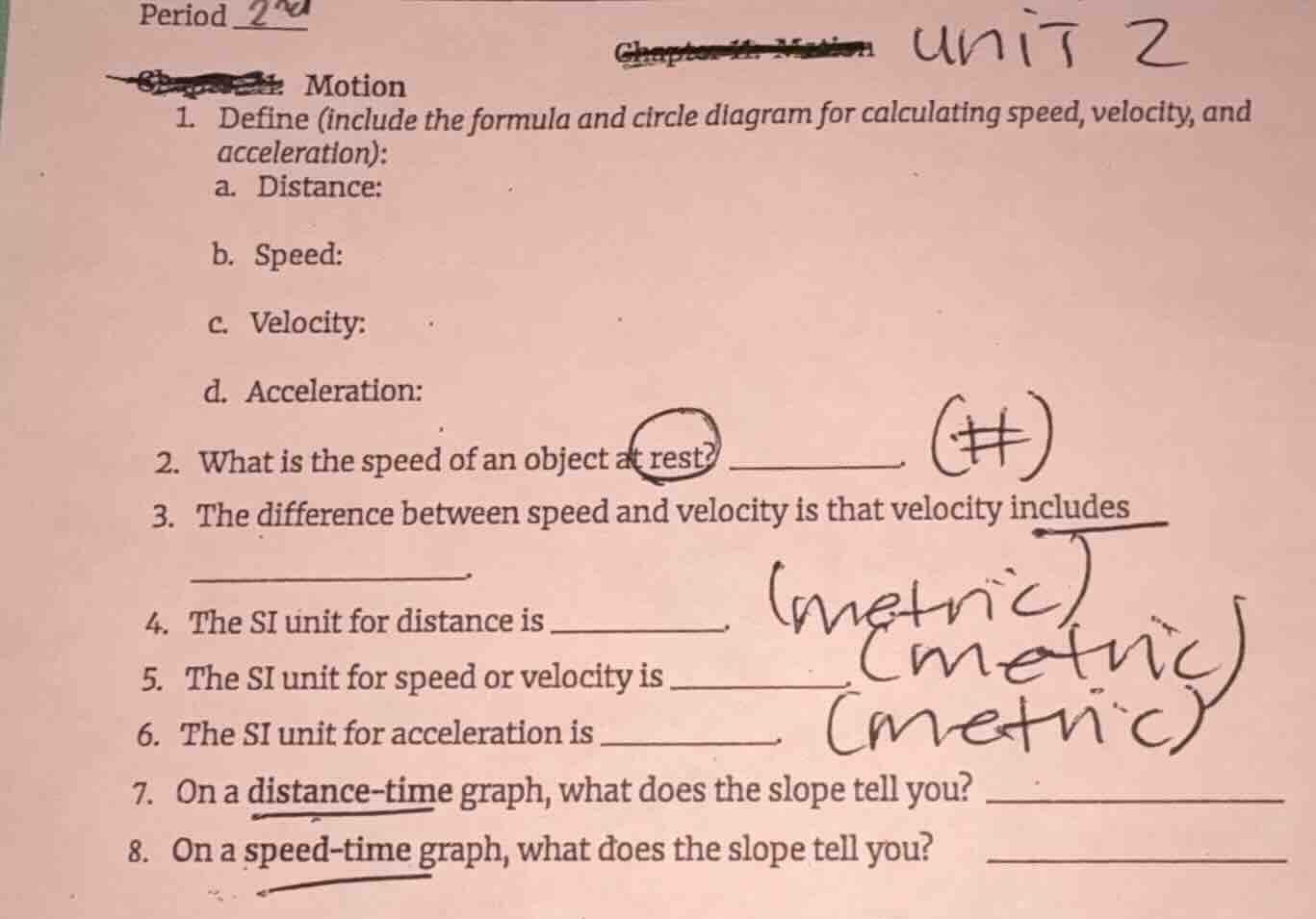
- define (include the formula and circle diagram for calculating speed, velocity, and
acceleration):
a. distance:
b. speed:
c. velocity:
d. acceleration:
- what is the speed of an object at rest? ______
- the difference between speed and velocity is that velocity includes ______
- the si unit for distance is ______
- the si unit for speed or velocity is ______
- the si unit for acceleration is ______
- on a distance - time graph, what does the slope tell you? ______
- on a speed - time graph, what does the slope tell you? ______
- a. Distance: Total path length traveled by an object, scalar quantity.
b. Speed: Rate of distance covered, scalar. Formula: $speed = \frac{\text{total distance}}{\text{total time}}$. Circle diagram: Center = Speed, top = Distance, bottom = Time.
c. Velocity: Rate of displacement change, vector (includes direction). Formula: $\text{velocity} = \frac{\text{displacement}}{\text{time}}$. Circle diagram: Center = Velocity, top = Displacement, bottom = Time.
d. Acceleration: Rate of velocity change, vector. Formula: $\text{acceleration} = \frac{\text{change in velocity}}{\text{time}} = \frac{v_f - v_i}{t}$. Circle diagram: Center = Acceleration, top = $\Delta v$, bottom = Time.
- An object at rest has no distance covered over time, so speed is 0.
- Speed only measures magnitude; velocity is a vector with magnitude + direction.
- The standard SI unit for distance is the meter.
- Speed/velocity are distance over time, so SI unit is meters per second.
- Acceleration is velocity over time, so SI unit is meters per second squared.
- Slope on distance-time graph is rise over run = distance over time, which is speed.
- Slope on speed-time graph is rise over run = change in speed over time, which is acceleration.

Snap & solve any problem in the app
Get step-by-step solutions on Sovi AI
Photo-based solutions with guided steps
Explore more problems and detailed explanations
- a. Distance: The total path length traveled by an object (scalar quantity, no formula for basic definition; circle diagram: center = Distance, derived from speed × time)
b. Speed: The rate at which an object covers distance (scalar). Formula: $s = \frac{d}{t}$ (where $s$ = speed, $d$ = total distance, $t$ = total time). Circle diagram:
        d
       ---
    s |   | t
       ---
c. Velocity: The rate of change of an object's position, including direction (vector). Formula: $\vec{v} = \frac{\Delta \vec{x}}{t}$ (where $\vec{v}$ = velocity, $\Delta \vec{x}$ = displacement, $t$ = time). Circle diagram:
        Δx
       ---
    v |   | t
       ---
d. Acceleration: The rate of change of an object's velocity (vector). Formula: $a = \frac{\vec{v}_f - \vec{v}_i}{t} = \frac{\Delta \vec{v}}{t}$ (where $a$ = acceleration, $\vec{v}_f$ = final velocity, $\vec{v}_i$ = initial velocity, $t$ = time). Circle diagram:
        Δv
       ---
    a |   | t
---- 0
- direction
- meter (m)
- meters per second ($\frac{m}{s}$)
- meters per second squared ($\frac{m}{s^2}$)
- The object's speed
- The object's acceleration