QUESTION IMAGE
Question
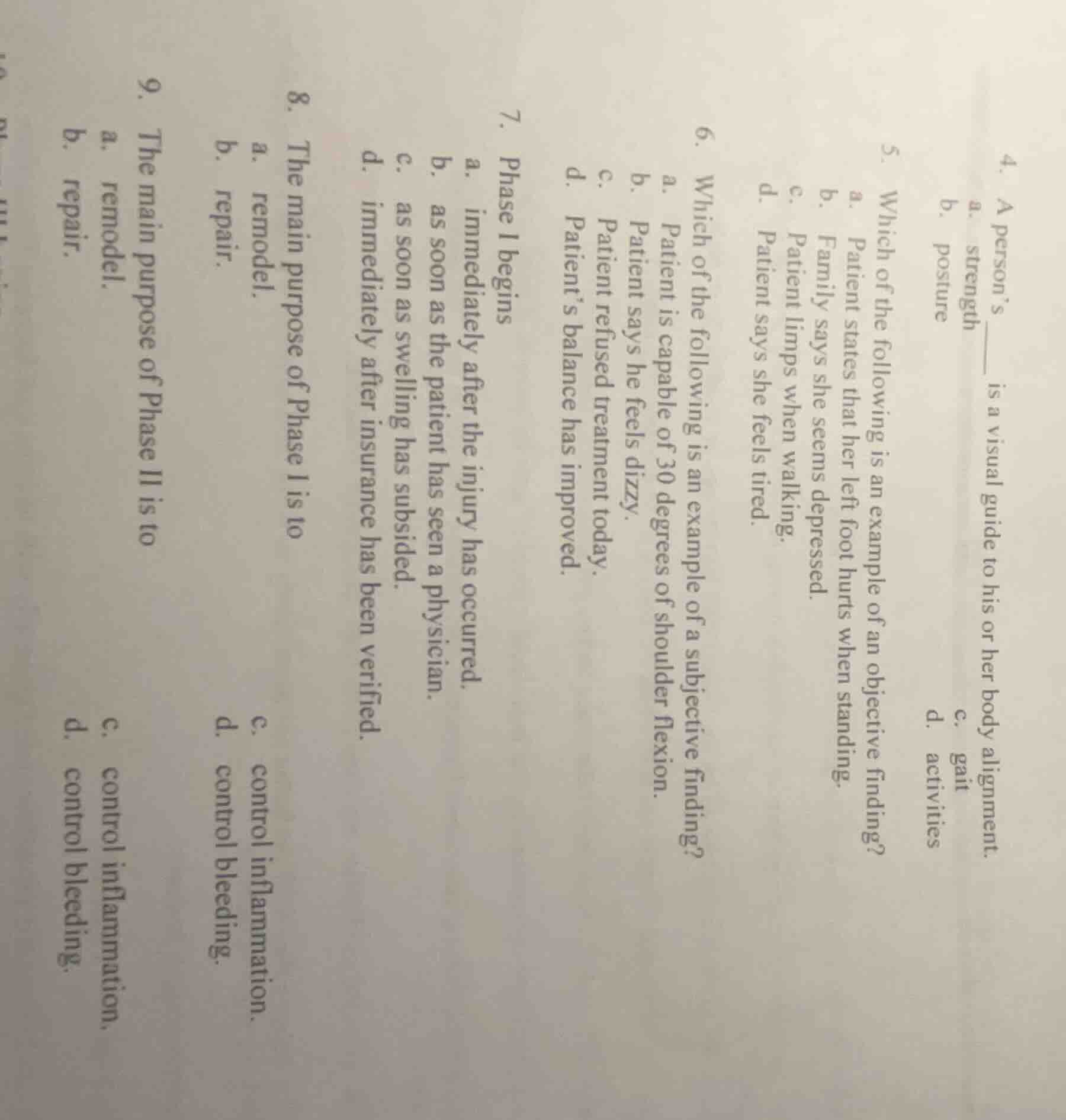
- a person’s
a. strength
b. posture
c. gait
d. activities
is a visual guide to his or her body alignment.
- which of the following is an example of an objective finding?
a. patient states that her left foot hurts when standing.
b. family says she seems depressed.
c. patient limps when walking.
d. patient says she feels tired.
- which of the following is an example of a subjective finding?
a. patient is capable of 30 degrees of shoulder flexion.
b. patient says he feels dizzy.
c. patient refused treatment today.
d. patient’s balance has improved.
- phase i begins
a. immediately after the injury has occurred.
b. as soon as the patient has seen a physician.
c. as soon as swelling has subsided.
d. immediately after insurance has been verified.
- the main purpose of phase i is to
a. remodel.
b. repair.
c. control inflammation.
d. control bleeding.
- the main purpose of phase ii is to
a. remodel.
b. repair.
c. control inflammation.
d. control bleeding.
- Posture refers to the visible alignment of the body, serving as a visual guide for body positioning.
- Objective findings are measurable or observable; a limp during walking can be directly observed by a clinician.
- Subjective findings are based on the patient's self-report; dizziness is a patient's personal sensation.
- Phase I (the inflammatory phase) of tissue healing starts right after an injury occurs.
- Phase I (inflammatory phase) focuses on controlling bleeding and initial inflammation, with the core immediate goal of controlling bleeding.
- Phase II (proliferative/repair phase) centers on repairing damaged tissue to restore structure.

Snap & solve any problem in the app
Get step-by-step solutions on Sovi AI
Photo-based solutions with guided steps
Explore more problems and detailed explanations
- b. posture
- c. Patient limps when walking.
- b. Patient says he feels dizzy.
- a. immediately after the injury has occurred.
- d. control bleeding.
- b. repair.