QUESTION IMAGE
Question
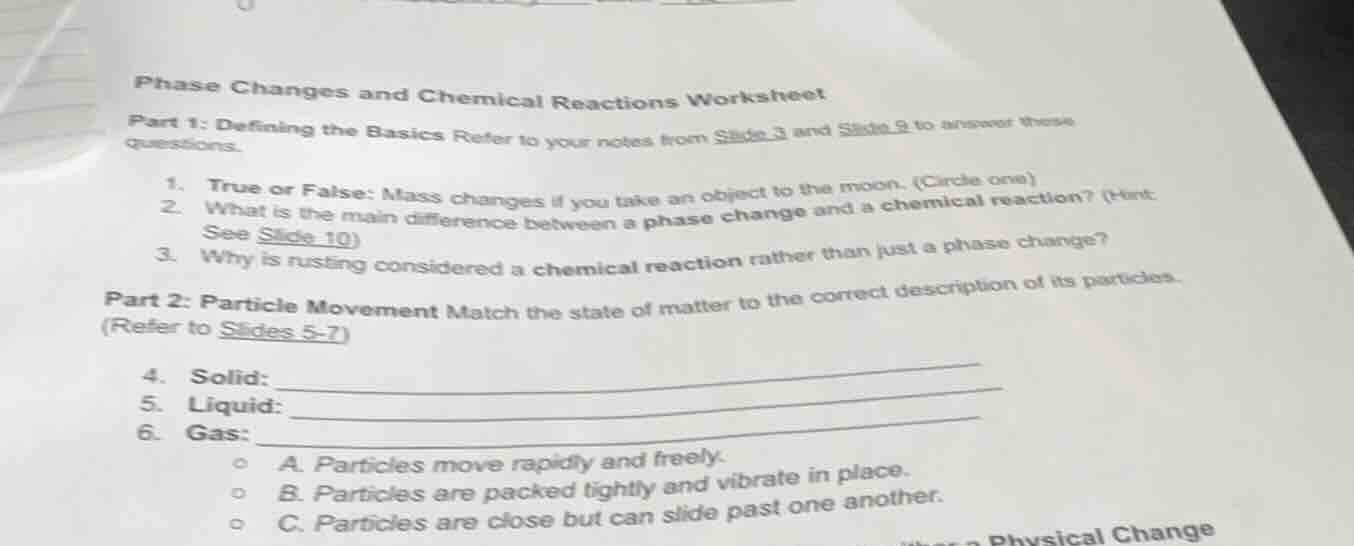
phase changes and chemical reactions worksheet
part 1: defining the basics refer to your notes from slide 3 and slide 9 to answer these questions.
- true or false: mass changes if you take an object to the moon. (circle one)
- what is the main difference between a phase change and a chemical reaction? (hint: see slide 10)
- why is rusting considered a chemical reaction rather than just a phase change?
part 2: particle movement match the state of matter to the correct description of its particles. (refer to slides 5 - 7)
- solid:
- liquid:
- gas:
a. particles move rapidly and freely.
b. particles are packed tightly and vibrate in place.
c. particles are close but can slide past one another.
Brief Explanations
- Mass is an intrinsic property, not affected by location/gravity.
- Phase changes only alter physical state; chemical reactions form new substances.
- Rusting creates a new substance (iron oxide) from iron.
- Solids have tightly packed, vibrating particles.
- Liquids have close particles that slide past each other.
- Gases have fast, freely moving particles.

Snap & solve any problem in the app
Get step-by-step solutions on Sovi AI
Photo-based solutions with guided steps
Explore more problems and detailed explanations
- False
- A phase change is a physical change that only alters the state of matter without forming new substances, while a chemical reaction breaks and forms chemical bonds to create entirely new substances with different properties.
- Rusting is a chemical reaction because it converts iron (Fe) into a new substance, iron oxide (rust, $\text{Fe}_2\text{O}_3$), through a chemical bond rearrangement, rather than just changing the physical state of iron.
- B. Particles are packed tightly and vibrate in place.
- C. Particles are close but can slide past one another.
- A. Particles move rapidly and freely.