QUESTION IMAGE
Question
physical & chemical weathering, and soil formation quiz
earth and space science / per: ____
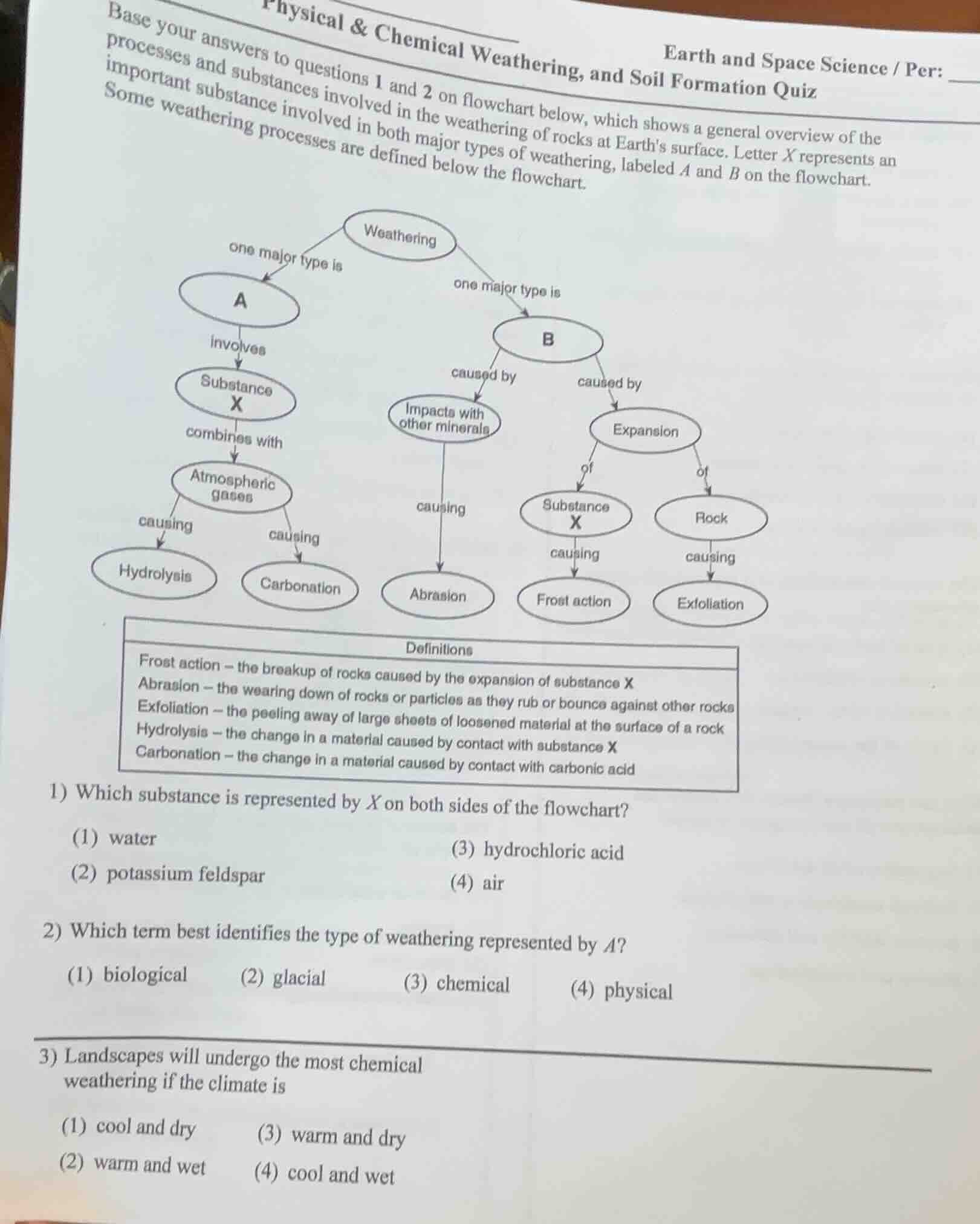
base your answers to questions 1 and 2 on flowchart below, which shows a general overview of the processes and substances involved in the weathering of rocks at earth’s surface. letter x represents an important substance involved in both major types of weathering, labeled a and b on the flowchart. some weathering processes are defined below the flowchart.
(flowchart omitted)
definitions
frost action – the breakup of rocks caused by the expansion of substance x
abrasion – the wearing down of rocks or particles as they rub or bounce against other rocks
exfoliation – the peeling away of large sheets of loosened material at the surface of a rock
hydrolysis – the change in a material caused by contact with substance x
carbonation – the change in a material caused by contact with carbonic acid
- which substance is represented by x on both sides of the flowchart?
(1) water
(3) hydrochloric acid
(2) potassium feldspar
(4) air
- which term best identifies the type of weathering represented by a?
(1) biological
(2) glacial
(3) chemical
(4) physical
- landscapes will undergo the most chemical weathering if the climate is
(1) cool and dry
(3) warm and dry
(2) warm and wet
(4) cool and wet
- For question 1: Frost action relies on water expanding when it freezes to break rocks, and hydrolysis is a chemical reaction involving water. These match the definitions linked to Substance X.
- For question 2: Type A leads to chemical processes (hydrolysis, carbonation) which are chemical weathering reactions that alter rock composition.
- For question 3: Chemical weathering requires water for reactions and warm temperatures to speed up chemical reactions, making warm and wet climates ideal.

Snap & solve any problem in the app
Get step-by-step solutions on Sovi AI
Photo-based solutions with guided steps
Explore more problems and detailed explanations
- (1) water
- (3) chemical
- (2) warm and wet