QUESTION IMAGE
Question
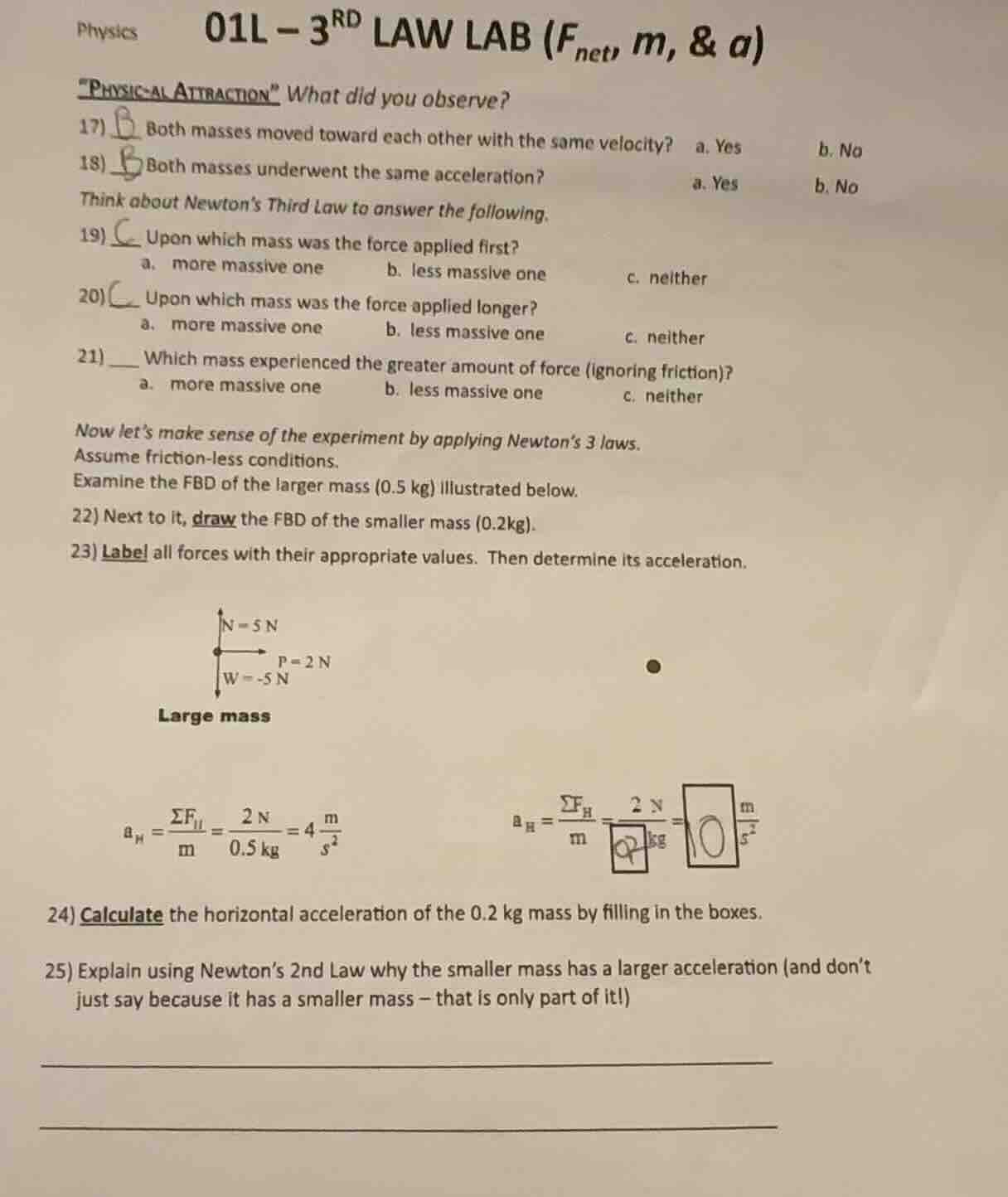
physics 01l – 3$^{rd}$ law lab ($f_{net}$, $m$, & $a$)
\physical attraction\ what did you observe?
- b both masses moved toward each other with the same velocity? a. yes b. no
- b both masses underwent the same acceleration? a. yes b. no
think about newton’s third law to answer the following.
- c upon which mass was the force applied first?
a. more massive one b. less massive one c. neither
- c upon which mass was the force applied longer?
a. more massive one b. less massive one c. neither
- ___ which mass experienced the greater amount of force (ignoring friction)?
a. more massive one b. less massive one c. neither
now let’s make sense of the experiment by applying newton’s 3 laws.
assume friction - less conditions.
examine the fbd of the larger mass (0.5 kg) illustrated below.
- next to it, draw the fbd of the smaller mass (0.2kg).
- label all forces with their appropriate values. then determine its acceleration.
large mass
$a_{h}=\frac{\sigma f_{h}}{m}=\frac{2\\ n}{0.5\\ kg}=4\\ \frac{m}{s^{2}}$ $a_{h}=\frac{\sigma f_{h}}{m}=\frac{2\\ n}{\square kg}=\square \frac{m}{s^{2}}$
- calculate the horizontal acceleration of the 0.2 kg mass by filling in the boxes.
- explain using newton’s 2nd law why the smaller mass has a larger acceleration (and don’t just say because it has a smaller mass – that is only part of it!)
_________________________________________
_________________________________________
Step1: Answer observation questions
- b. No (Different masses will have different velocities if forces are equal, as $v=at$ and $a$ differs)
- b. No (Acceleration differs for different masses under equal force)
- c. neither (Forces in Newton's 3rd Law act simultaneously)
- c. neither (Forces act for the same duration)
- c. neither (Newton's 3rd Law states action-reaction forces are equal)
Step2: Draw small mass FBD
The smaller mass has:
- Upward normal force $N=2\ \text{N}$ (balances weight $W=mg=0.2\ \text{kg} \times 10\ \text{m/s}^2=2\ \text{N}$ downward)
- Horizontal force $P=-2\ \text{N}$ (opposite direction to the large mass's applied force, per Newton's 3rd Law)
Step3: Calculate small mass acceleration
Use Newton's 2nd Law $a_H=\frac{\sum F_H}{m}$.
$\sum F_H = -2\ \text{N}$, $m=0.2\ \text{kg}$
$a_H=\frac{-2\ \text{N}}{0.2\ \text{kg}}=-10\ \frac{\text{m}}{\text{s}^2}$ (negative sign indicates direction opposite to large mass)
Step4: Explain acceleration difference
Newton's 2nd Law is $\sum F = ma$, rearranged to $a=\frac{\sum F}{m}$. For the two masses, the magnitude of the net horizontal force $\sum F$ is equal (Newton's 3rd Law). Since acceleration is inversely proportional to mass when force is constant, the smaller mass will have a larger magnitude of acceleration.

Snap & solve any problem in the app
Get step-by-step solutions on Sovi AI
Photo-based solutions with guided steps
Explore more problems and detailed explanations
- b. No
- b. No
- c. neither
- c. neither
- c. neither
- (Free Body Diagram for 0.2 kg mass: upward arrow labeled $N=2\ \text{N}$, downward arrow labeled $W=-2\ \text{N}$, leftward arrow labeled $P=-2\ \text{N}$)
- Forces labeled as above; acceleration magnitude is $10\ \text{m/s}^2$ (direction opposite to large mass)
- First box: $0.2$, Second box: $-10$
- Per Newton's 2nd Law $a=\frac{\sum F}{m}$, the two masses experience equal magnitude horizontal forces (Newton's 3rd Law). Since acceleration is inversely proportional to mass for a constant force, the smaller 0.2 kg mass has a larger acceleration magnitude than the 0.5 kg mass.