QUESTION IMAGE
Question
physics honors
chapter 11.2 – heat transfer a
name: miranda e
period: 6
score:
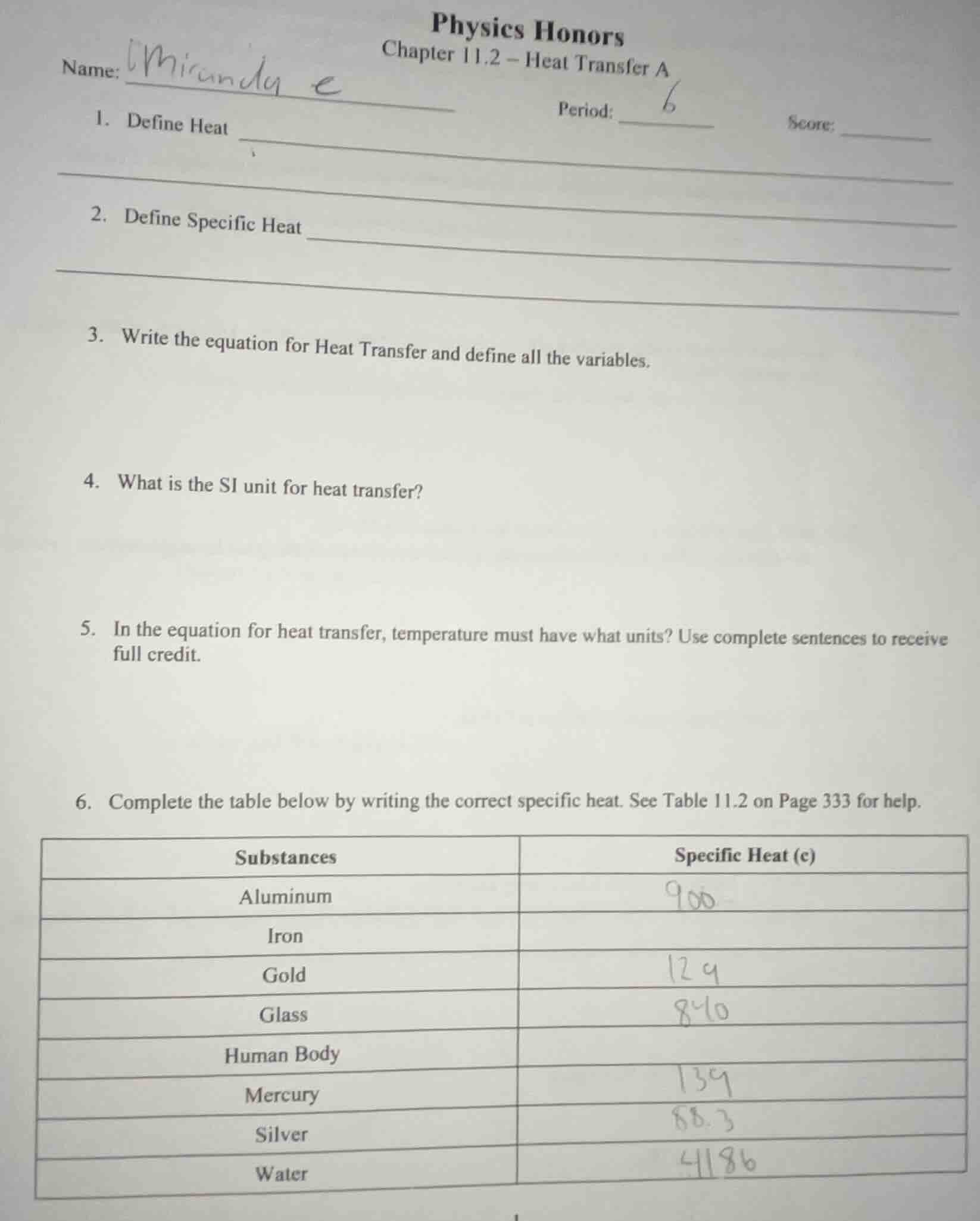
- define heat
- define specific heat
- write the equation for heat transfer and define all the variables.
- what is the si unit for heat transfer?
- in the equation for heat transfer, temperature must have what units? use complete sentences to receive full credit.
- complete the table below by writing the correct specific heat. see table 11.2 on page 333 for help.
substances | specific heat (c)
aluminum | 900
iron |
gold | 129
glass | 840
human body |
mercury | 139
silver | 88.3
water | 4186
Brief Explanations
- Heat is defined as thermal energy transferred between objects due to a temperature difference.
- Specific heat is the amount of heat required to raise the temperature of 1 kilogram of a substance by 1 Kelvin (or Celsius).
- The standard heat transfer equation relates heat, mass, specific heat, and temperature change, with each variable representing a key property in the transfer.
- The SI unit for heat (a form of energy transfer) is the joule.
- In the heat transfer equation, temperature values must be in Kelvin (or Celsius, since the change is equivalent) to ensure consistent, unit-correct calculations.
- Specific heat values are taken from standard physics reference tables for common substances.

Snap & solve any problem in the app
Get step-by-step solutions on Sovi AI
Photo-based solutions with guided steps
Explore more problems and detailed explanations
- Heat is the transfer of thermal energy between systems or objects due to a temperature difference.
- Specific heat is the amount of thermal energy required to raise the temperature of 1 kilogram of a substance by 1 Kelvin (or 1 degree Celsius).
- Heat transfer equation: $Q = mc\Delta T$
- $Q$: Heat energy transferred (in joules, J)
- $m$: Mass of the substance (in kilograms, kg)
- $c$: Specific heat capacity of the substance (in J/(kg·K) or J/(kg·°C))
- $\Delta T$: Change in temperature ($\Delta T = T_{final} - T_{initial}$, in Kelvin K or degrees Celsius °C)
- The SI unit for heat transfer is the joule (J).
- In the heat transfer equation, temperature must be measured in Kelvin (K) or degrees Celsius (°C). The unit choice does not affect the calculation because we use the change in temperature, and a 1-degree change in Celsius is equal to a 1-degree change in Kelvin.
6.
| Substances | Specific Heat (c) (J/(kg·K)) |
|---|---|
| Iron | 450 |
| Gold | 129 |
| Glass | 840 |
| Human Body | 3500 |
| Mercury | 139 |
| Silver | 88.3 |
| Water | 4186 |