QUESTION IMAGE
Question
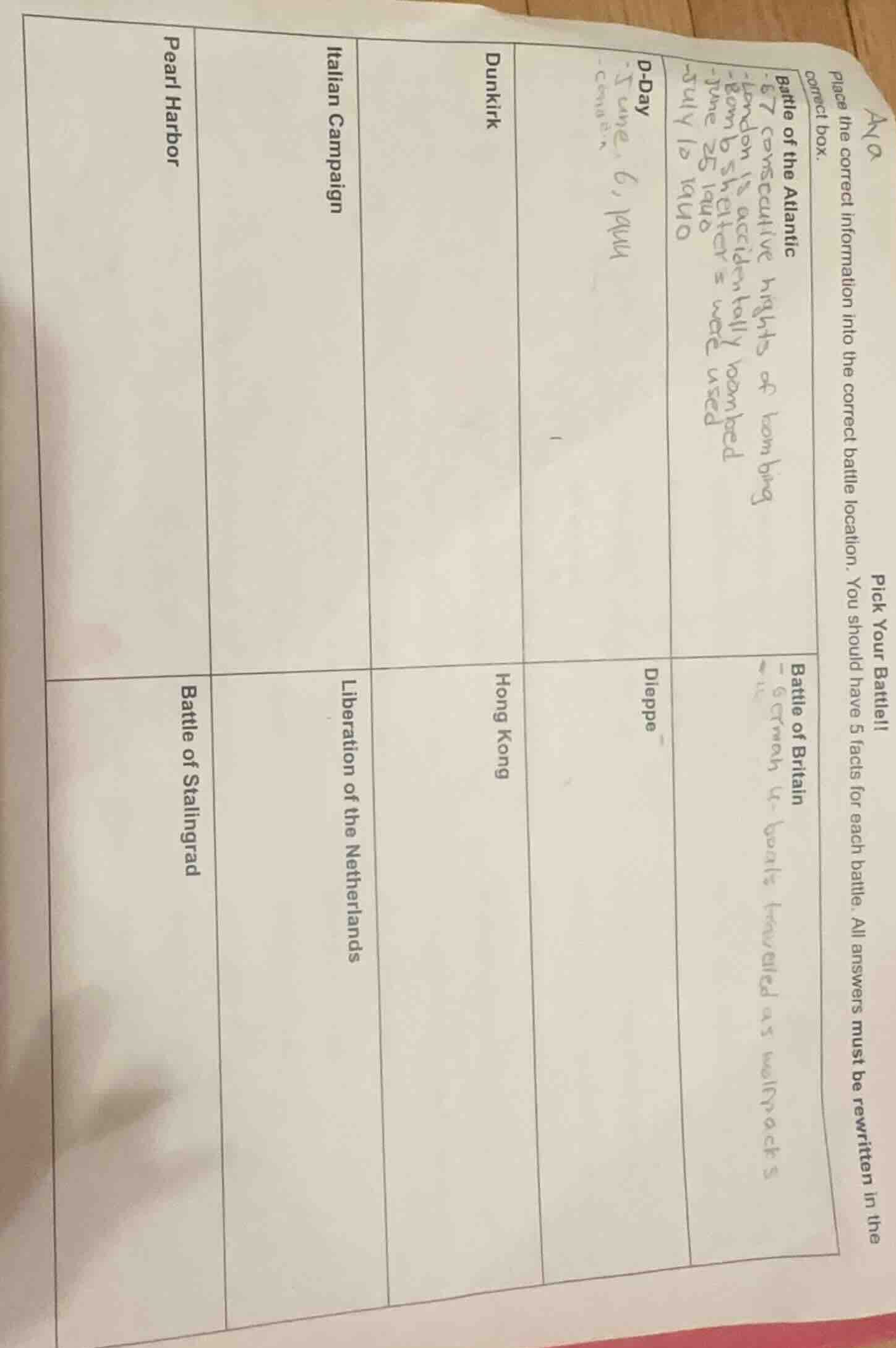
pick your battle!!
place the correct information into the correct battle location. you should have 5 facts for each battle. all answers must be rewritten in the correct box.
battle of the atlantic
- 87 consecutive nights of bombing
- london is accidentally bombed
- bomb shelter = were used
- june 25 1940
- july 10 1940
d-day
- june 6, 1944
- canada
(
dunkirk
italian campaign
pearl harbor
battle of britain
- german u - boats traveled as wolfpacks
dieppe
hong kong
liberation of the netherlands
battle of stalingrad
To solve this problem, we need to match each battle with its correct facts. Let's analyze each battle:
Battle of the Atlantic
- Fact 1: Convoy system of shipping was used (to protect merchant ships from U - boats).
- Fact 2: Lasted from 1939 - 1945 (the longest continuous military campaign of WWII).
- Fact 3: Involved naval warfare between Allied and Axis powers.
- Fact 4: Critical for supplying Britain with resources.
- Fact 5: German U - boats were a major threat.
Battle of Britain
- Fact 1: German Luftwaffe vs British RAF.
- Fact 2: July - October 1940 (the main air battle period).
- Fact 3: "The Few" (RAF pilots) defended Britain.
- Fact 4: Radar was crucial for early warning.
- Fact 5: Targeted British cities and airfields.
D - Day (Normandy Invasion)
- Fact 1: June 6, 1944 (Operation Overlord).
- Fact 2: Allied invasion of Normandy, France.
- Fact 3: Five landing beaches (Omaha, Utah, Gold, Juno, Sword).
- Fact 4: Largest seaborne invasion in history.
- Fact 5: Pivotal for opening a second front in Europe.
Dieppe
- Fact 1: August 19, 1942 (Dieppe Raid).
- Fact 2: Allied raid on German - occupied France.
- Fact 3: Mostly a failure, but provided lessons for D - Day.
- Fact 4: Tested German defenses.
- Fact 5: High Allied casualties.
Dunkirk
- Fact 1: May - June 1940.
- Fact 2: Evacuation of British and Allied troops from Dunkirk, France.
- Fact 3: "Miracle of Dunkirk" - over 330,000 troops evacuated.
- Fact 4: Small boats (civilian and military) helped in evacuation.
- Fact 5: Boosted British morale.
Hong Kong
- Fact 1: December 1941 (fall of Hong Kong to Japan).
- Fact 2: British, Canadian, and Indian troops vs Japanese.
- Fact 3: Hong Kong surrendered on December 25, 1941.
- Fact 4: Japanese occupation until 1945.
- Fact 5: Part of Japan's Pacific expansion.
Italian Campaign
- Fact 1: Began in 1943 (Allied invasion of Sicily first).
- Fact 2: Involved fighting up the Italian peninsula.
- Fact 3: Battles at Monte Cassino, Anzio.
- Fact 4: Mussolini's regime fell in 1943.
- Fact 5: Dragged on due to mountainous terrain.
Liberation of the Netherlands
- Fact 1: September 1944 - April 1945.
- Fact 2: Allied operation to free the Netherlands from German occupation.
- Fact 3: Included the Battle of Arnhem (Operation Market Garden).
- Fact 4: Ended the Dutch famine (Hunger Winter).
- Fact 5: Canadian troops played a major role.
Battle of Stalingrad
- Fact 1: July 1942 - February 1943.
- Fact 2: Turning point of WWII on the Eastern Front.
- Fact 3: Urban warfare in Stalingrad.
- Fact 4: Soviet forces surrounded and defeated German 6th Army.
- Fact 5: High casualties on both sides.
Pearl Harbor
- Fact 1: December 7, 1941 (Japanese surprise attack).
- Fact 2: Targeted US naval base in Hawaii.
- Fact 3: Brought the US into WWII.
- Fact 4: "A date which will live in infamy" (Roosevelt).
- Fact 5: Damaged or destroyed many US ships and planes.
Now, let's match the given (partial) facts:
- The fact "June 6, 1944" belongs to D - Day.
- The fact "July 10, 1940" (start of Battle of Britain's main phase) belongs to Battle of Britain.
- The fact about "London is accidentally bombed, bomb shelters were used" belongs to Battle of Britain (during the Blitz, which was part of the broader Battle of Britain context, as the Blitz targeted London and other cities after the air battle phase).
If…

Snap & solve any problem in the app
Get step-by-step solutions on Sovi AI
Photo-based solutions with guided steps
Explore more problems and detailed explanations
To solve this problem, we need to match each battle with its correct facts. Let's analyze each battle:
Battle of the Atlantic
- Fact 1: Convoy system of shipping was used (to protect merchant ships from U - boats).
- Fact 2: Lasted from 1939 - 1945 (the longest continuous military campaign of WWII).
- Fact 3: Involved naval warfare between Allied and Axis powers.
- Fact 4: Critical for supplying Britain with resources.
- Fact 5: German U - boats were a major threat.
Battle of Britain
- Fact 1: German Luftwaffe vs British RAF.
- Fact 2: July - October 1940 (the main air battle period).
- Fact 3: "The Few" (RAF pilots) defended Britain.
- Fact 4: Radar was crucial for early warning.
- Fact 5: Targeted British cities and airfields.
D - Day (Normandy Invasion)
- Fact 1: June 6, 1944 (Operation Overlord).
- Fact 2: Allied invasion of Normandy, France.
- Fact 3: Five landing beaches (Omaha, Utah, Gold, Juno, Sword).
- Fact 4: Largest seaborne invasion in history.
- Fact 5: Pivotal for opening a second front in Europe.
Dieppe
- Fact 1: August 19, 1942 (Dieppe Raid).
- Fact 2: Allied raid on German - occupied France.
- Fact 3: Mostly a failure, but provided lessons for D - Day.
- Fact 4: Tested German defenses.
- Fact 5: High Allied casualties.
Dunkirk
- Fact 1: May - June 1940.
- Fact 2: Evacuation of British and Allied troops from Dunkirk, France.
- Fact 3: "Miracle of Dunkirk" - over 330,000 troops evacuated.
- Fact 4: Small boats (civilian and military) helped in evacuation.
- Fact 5: Boosted British morale.
Hong Kong
- Fact 1: December 1941 (fall of Hong Kong to Japan).
- Fact 2: British, Canadian, and Indian troops vs Japanese.
- Fact 3: Hong Kong surrendered on December 25, 1941.
- Fact 4: Japanese occupation until 1945.
- Fact 5: Part of Japan's Pacific expansion.
Italian Campaign
- Fact 1: Began in 1943 (Allied invasion of Sicily first).
- Fact 2: Involved fighting up the Italian peninsula.
- Fact 3: Battles at Monte Cassino, Anzio.
- Fact 4: Mussolini's regime fell in 1943.
- Fact 5: Dragged on due to mountainous terrain.
Liberation of the Netherlands
- Fact 1: September 1944 - April 1945.
- Fact 2: Allied operation to free the Netherlands from German occupation.
- Fact 3: Included the Battle of Arnhem (Operation Market Garden).
- Fact 4: Ended the Dutch famine (Hunger Winter).
- Fact 5: Canadian troops played a major role.
Battle of Stalingrad
- Fact 1: July 1942 - February 1943.
- Fact 2: Turning point of WWII on the Eastern Front.
- Fact 3: Urban warfare in Stalingrad.
- Fact 4: Soviet forces surrounded and defeated German 6th Army.
- Fact 5: High casualties on both sides.
Pearl Harbor
- Fact 1: December 7, 1941 (Japanese surprise attack).
- Fact 2: Targeted US naval base in Hawaii.
- Fact 3: Brought the US into WWII.
- Fact 4: "A date which will live in infamy" (Roosevelt).
- Fact 5: Damaged or destroyed many US ships and planes.
Now, let's match the given (partial) facts:
- The fact "June 6, 1944" belongs to D - Day.
- The fact "July 10, 1940" (start of Battle of Britain's main phase) belongs to Battle of Britain.
- The fact about "London is accidentally bombed, bomb shelters were used" belongs to Battle of Britain (during the Blitz, which was part of the broader Battle of Britain context, as the Blitz targeted London and other cities after the air battle phase).
If we assume we need to fill the table with correct facts for each battle, here is a more organized way:
| Battle | Correct Facts |
|---|---|
| Battle of Britain | 1. German Luftwaffe vs British RAF. <br> 2. July - October 1940. <br> 3. "The Few" defended Britain. <br> 4. Radar was crucial. <br> 5. Targeted British cities/airfields. |
| D - Day | 1. June 6, 1944 (Normandy Invasion). <br> 2. Allied invasion of Normandy. <br> 3. Five landing beaches. <br> 4. Largest seaborne invasion. <br> 5. Pivotal for second front. |
| Dieppe | 1. August 19, 1942 (Dieppe Raid). <br> 2. Allied raid on France. <br> 3. Mostly a failure, but lessons for D - Day. <br> 4. Tested German defenses. <br> 5. High Allied casualties. |
| Dunkirk | 1. May - June 1940. <br> 2. Evacuation of British/Allied troops. <br> 3. "Miracle of Dunkirk" - 330,000+ evacuated. <br> 4. Small boats helped evacuation. <br> 5. Boosted British morale. |
| Hong Kong | 1. December 1941 (fall to Japan). <br> 2. British/Canadian/Indian vs Japanese. <br> 3. Surrendered December 25, 1941. <br> 4. Japanese occupation until 1945. <br> 5. Part of Japan's Pacific expansion. |
| Italian Campaign | 1. Began 1943 (Sicily invasion). <br> 2. Fighting up Italian peninsula. <br> 3. Battles at Monte Cassino, Anzio. <br> 4. Mussolini's regime fell 1943. <br> 5. Dragged on due to terrain. |
| Liberation of the Netherlands | 1. September 1944 - April 1945. <br> 2. Allied operation to free Netherlands. <br> 3. Included Battle of Arnhem. <br> 4. Ended Dutch famine. <br> 5. Canadian troops major role. |
| Battle of Stalingrad | 1. July 1942 - February 1943. <br> 2. Turning point on Eastern Front. <br> 3. Urban warfare in Stalingrad. <br> 4. Soviets surrounded German 6th Army. <br> 5. High casualties on both sides. |
| Pearl Harbor | 1. December 7, 1941 (Japanese attack). <br> 2. Targeted US naval base in Hawaii. <br> 3. Brought US into WWII. <br> 4. "A date which will live in infamy". <br> 5. Damaged many US ships/planes. |
If the original problem had specific blanks to fill (like the hand - written notes), for example:
- For D - Day, the date "June 6, 1944" is correct.
- For Battle of Britain, the time "July 10, 1940" (start of the main air battle) is correct.
- For Battle of the Atlantic, the convoy system fact is correct.
Since the problem was a bit unclear in terms of exact blanks, but based on the hand - written notes:
- The "June 6, 1944" note belongs to D - Day.
- The "July 10, 1940" note belongs to Battle of Britain.
- The "London is accidentally bombed, bomb shelters were used" note belongs to Battle of Britain (during the Blitz, which was part of the Battle of Britain's broader context as the Germans bombed London and other cities after the initial air - to - air combat phase).