QUESTION IMAGE
Question
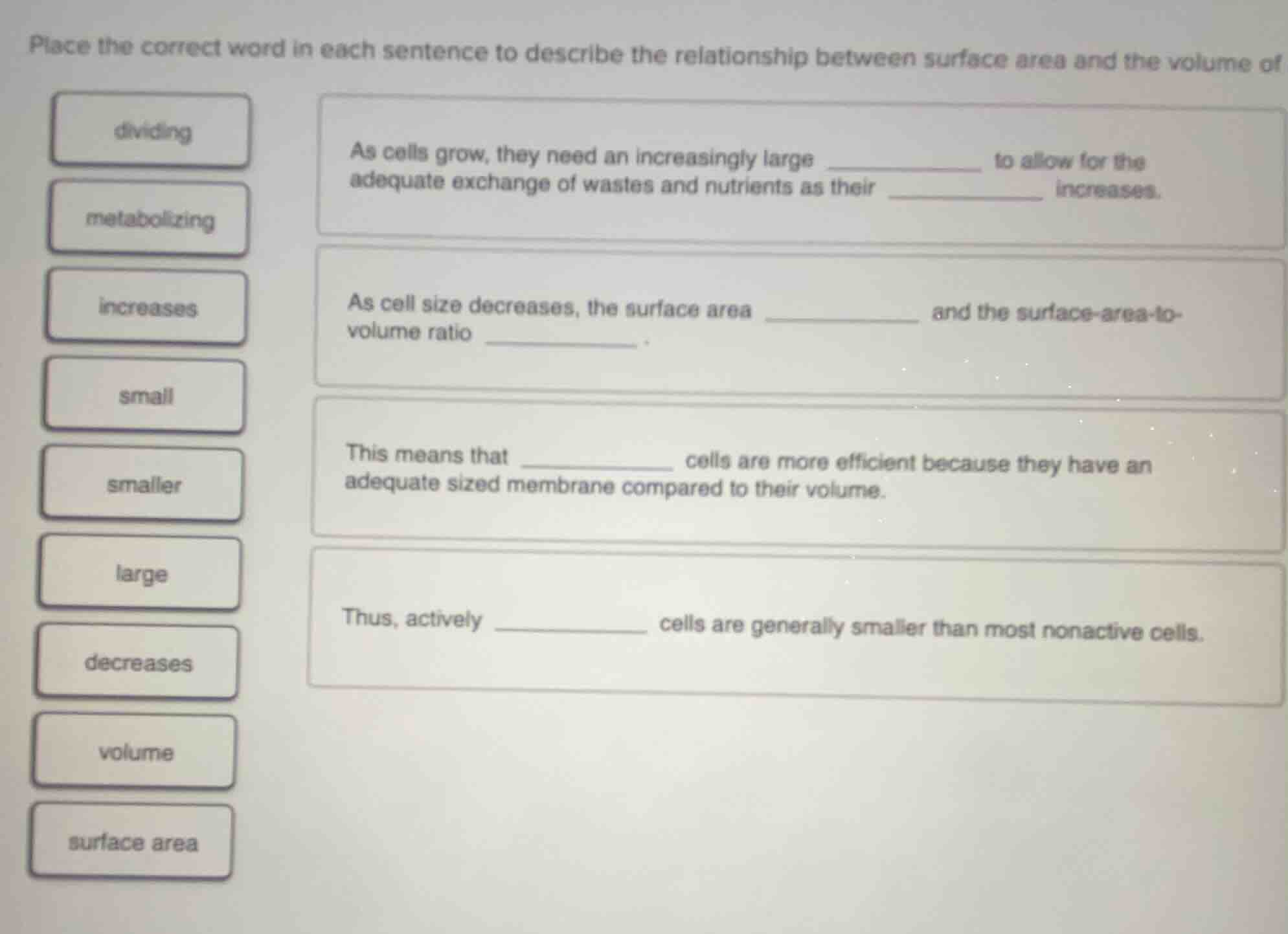
place the correct word in each sentence to describe the relationship between surface area and the volume of
dividing
as cells grow, they need an increasingly large __________ to allow for the
adequate exchange of wastes and nutrients as their __________ increases.
metabolizing
as cell size decreases, the surface area __________ and the surface - area - to -
volume ratio __________.
increases
this means that __________ cells are more efficient because they have an
small
adequate sized membrane compared to their volume.
smaller
thus, actively __________ cells are generally smaller than most nonactive cells.
large
decreases
volume
surface area
First Sentence:
- For the first blank: Cells need a large "surface area" for exchange (since surface area is related to the membrane for exchange). For the second blank: As cells grow, their "volume" increases (relating to the surface - area - to - volume ratio concept).
Second Sentence:
- As cell size decreases, the surface area "decreases" (because surface area is related to the size of the cell). And the surface - area - to - volume ratio "increases" (since when both surface area and volume decrease, the ratio of surface area to volume increases as the volume decreases more relatively or the surface area decreases less relatively, and smaller cells have a higher surface - area - to - volume ratio).
Third Sentence:
- "Smaller" cells are more efficient (because smaller cells have a higher surface - area - to - volume ratio, which is good for exchange).
Fourth Sentence:
- Actively "metabolizing" cells are generally smaller (since metabolizing cells need more efficient exchange, so they are smaller to have a good surface - area - to - volume ratio).
So the filled sentences are:
- As cells grow, they need an increasingly large $\boldsymbol{\text{surface area}}$ to allow for the adequate exchange of wastes and nutrients as their $\boldsymbol{\text{volume}}$ increases.
- As cell size decreases, the surface area $\boldsymbol{\text{decreases}}$ and the surface - area - to - volume ratio $\boldsymbol{\text{increases}}$.
- This means that $\boldsymbol{\text{smaller}}$ cells are more efficient because they have an adequate sized membrane compared to their volume.
- Thus, actively $\boldsymbol{\text{metabolizing}}$ cells are generally smaller than most non - active cells.

Snap & solve any problem in the app
Get step-by-step solutions on Sovi AI
Photo-based solutions with guided steps
Explore more problems and detailed explanations
First Sentence:
- For the first blank: Cells need a large "surface area" for exchange (since surface area is related to the membrane for exchange). For the second blank: As cells grow, their "volume" increases (relating to the surface - area - to - volume ratio concept).
Second Sentence:
- As cell size decreases, the surface area "decreases" (because surface area is related to the size of the cell). And the surface - area - to - volume ratio "increases" (since when both surface area and volume decrease, the ratio of surface area to volume increases as the volume decreases more relatively or the surface area decreases less relatively, and smaller cells have a higher surface - area - to - volume ratio).
Third Sentence:
- "Smaller" cells are more efficient (because smaller cells have a higher surface - area - to - volume ratio, which is good for exchange).
Fourth Sentence:
- Actively "metabolizing" cells are generally smaller (since metabolizing cells need more efficient exchange, so they are smaller to have a good surface - area - to - volume ratio).
So the filled sentences are:
- As cells grow, they need an increasingly large $\boldsymbol{\text{surface area}}$ to allow for the adequate exchange of wastes and nutrients as their $\boldsymbol{\text{volume}}$ increases.
- As cell size decreases, the surface area $\boldsymbol{\text{decreases}}$ and the surface - area - to - volume ratio $\boldsymbol{\text{increases}}$.
- This means that $\boldsymbol{\text{smaller}}$ cells are more efficient because they have an adequate sized membrane compared to their volume.
- Thus, actively $\boldsymbol{\text{metabolizing}}$ cells are generally smaller than most non - active cells.