QUESTION IMAGE
Question
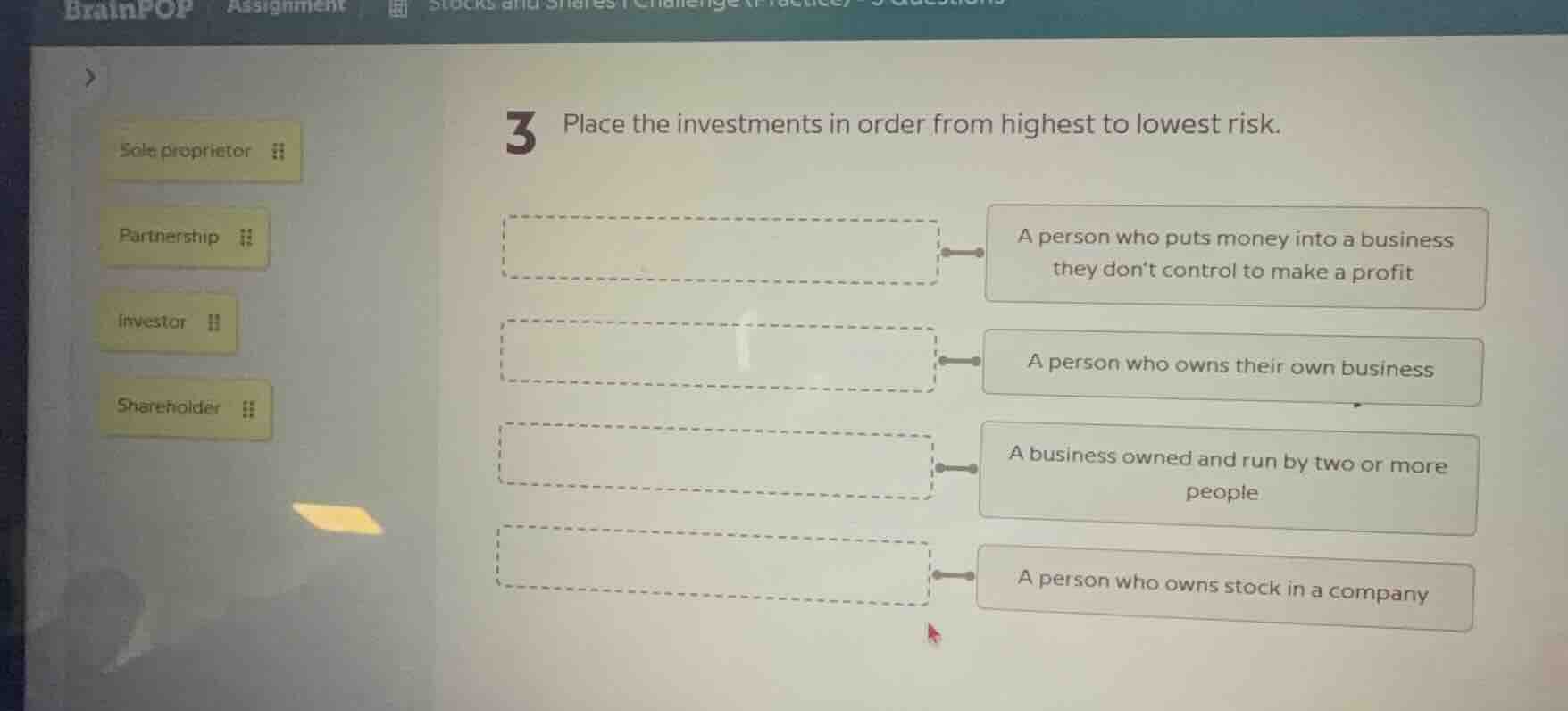
3 place the investments in order from highest to lowest risk.
a person who puts money into a business they dont control to make a profit
a person who owns their own business
a business owned and run by two or more people
a person who owns stock in a company
Brief Explanations
- First, match the terms with their definitions:
- "A person who puts money into a business they don't control to make a profit" describes an Investor.
- "A person who owns their own business" describes a Sole proprietor.
- "A business owned and run by two or more people" describes a Partnership.
- "A person who owns stock in a company" describes a Shareholder.
- Now, consider the risk levels:
- Sole proprietor: The owner has full control but also bears all the risk of the business, which is relatively high as they are solely responsible for losses, debts, etc.
- Partnership: Risk is shared among partners, but each partner can be liable for the actions and debts of the other partners, still a high - risk but maybe slightly less than sole proprietorship in some aspects (but generally, sole proprietor has more personal risk as one person). Wait, actually, when ranking from highest to lowest risk for the investment types (the entities here are the types of business ownership/investment roles):
- Sole proprietor: The individual's personal assets are at risk, and the entire business risk is on one person.
- Partnership: Risk is shared among partners, but each partner's personal assets can be at risk for the partnership's debts (unlimited liability in general partnership), but with more people, the risk per person might be less, but the overall business risk is still high.
- Shareholder: In a corporation, shareholders have limited liability (their loss is limited to the amount of their investment in the stock), so lower risk than sole proprietor and partnership.
- Investor (the general investor who puts money into a business they don't control): If it's a debt investment, the risk is lower, but if it's an equity investment in a small business, but generally, compared to sole proprietor and partnership, the investor (if it's a passive investor) has less personal risk as they don't have operational control and in many cases, limited liability - but wait, the initial matching was wrong. Wait, no, the first step is to match the terms correctly. Let's re - match:
- "A person who puts money into a business they don't control to make a profit" → Investor
- "A person who owns their own business" → Sole proprietor
- "A business owned and run by two or more people" → Partnership
- "A person who owns stock in a company" → Shareholder
Now, for risk from highest to lowest:
- Sole proprietor: The owner is fully liable, personal assets at stake, high risk.
- Partnership: Partners are liable (in general partnership), personal assets at stake, but risk shared among partners, so slightly less than sole proprietor.
- Investor: If it's a risky investment (like in a startup), but if it's a passive investment, the risk is limited to the investment amount. But compared to sole proprietor and partnership (where the owners have operational control and more liability), the investor (passive) has less risk.
- Shareholder: In a corporation, shareholders have limited liability (losses limited to investment), so lowest risk among these.
Wait, maybe the intended order is based on the level of personal liability and control:
- Sole proprietor (highest risk as one person, full liability)
- Partnership (next, as multiple people but still personal liability)
- Investor (if it's an equity investment in a non - corporate entity, but if it's a corporate investment, maybe similar to shareholder, but the "investor" here is defined as putting money into a business they don't contr…

Snap & solve any problem in the app
Get step-by-step solutions on Sovi AI
Photo-based solutions with guided steps
Explore more problems and detailed explanations
- First match:
- "A person who puts money into a business they don't control to make a profit" → Investor
- "A person who owns their own business" → Sole proprietor
- "A business owned and run by two or more people" → Partnership
- "A person who owns stock in a company" → Shareholder
- Order from highest to lowest risk:
- Sole proprietor
- Partnership
- Investor
- Shareholder