QUESTION IMAGE
Question
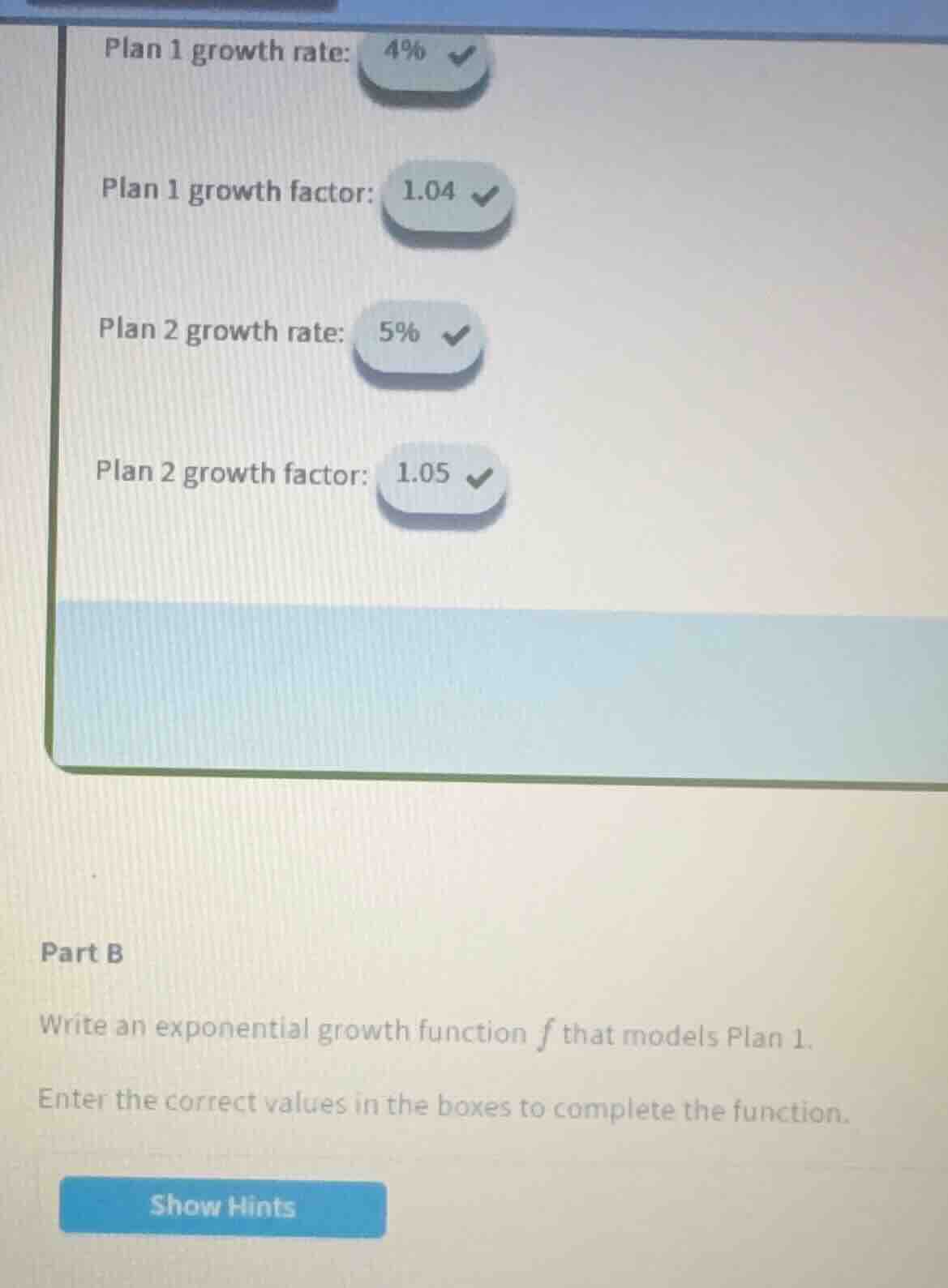
plan 1 growth rate: 4% ✔️
plan 1 growth factor: 1.04 ✔️
plan 2 growth rate: 5% ✔️
plan 2 growth factor: 1.05 ✔️
part b
write an exponential growth function ( f ) that models plan 1.
enter the correct values in the boxes to complete the function.
show hints
Step1: Recall exponential growth formula
The general form of an exponential growth function is \( f(t) = a(1 + r)^t \), where \( a \) is the initial amount, \( r \) is the growth rate (in decimal), and \( t \) is time. For Plan 1, the growth rate \( r = 4\%= 0.04 \), so the growth factor \( 1 + r = 1.04 \). Assuming the initial amount \( a \) (though not given, typically if not specified, sometimes \( a = 1 \) or it's a general form with \( a \) as initial value, but since the problem is to write the function with the given growth factor, we use the formula. Wait, actually, the standard exponential growth function is \( f(t)=a\cdot b^t \), where \( b \) is the growth factor. Here, for Plan 1, growth factor \( b = 1.04 \), and if we assume initial amount \( a \) (but since it's not given, maybe the function is in terms of \( t \) with \( a \) as initial, but the problem says "write an exponential growth function \( f \) that models Plan 1". So the function would be \( f(t)=a(1.04)^t \), but if we consider the general form with the growth factor, or maybe if the initial amount is 1 (but usually, we need to know, but since the growth factor is 1.04, the function is \( f(t)=a\cdot(1.04)^t \), where \( a \) is the initial quantity. However, maybe the problem expects the function with the growth factor, so if we assume the initial amount is, say, \( a \) (could be any initial value, but the key is the growth factor). Wait, maybe the problem is missing the initial amount, but since in the given data, we have growth factor 1.04, so the exponential growth function is \( f(t)=a(1.04)^t \), where \( a \) is the initial amount and \( t \) is time. But if we consider the function with the given growth factor, and assuming the initial value is, for example, if it's a general function, maybe \( f(t) = a \cdot 1.04^t \), where \( a \) is the initial quantity. But since the problem doesn't specify the initial amount, maybe it's a general form, so the function is \( f(t)=a(1.04)^t \), or if we take \( a = 1 \) (unit initial amount), then \( f(t)=1.04^t \), but usually, the initial amount is included. Wait, maybe the problem is expecting the function as \( f(t) = a(1.04)^t \), where \( a \) is the initial value, and the growth factor is 1.04. So putting it together, the exponential growth function for Plan 1 is \( f(t)=a(1.04)^t \), or if we consider the standard form with the growth rate converted to growth factor, so the function is \( f(t) = a \times 1.04^t \), where \( a \) is the initial amount and \( t \) is the time variable.
Step2: Construct the function
Using the exponential growth formula \( f(t)=a\cdot b^t \), where \( b \) is the growth factor (1.04 for Plan 1) and \( a \) is the initial amount. So the function is \( f(t)=a(1.04)^t \), where \( a \) is the initial quantity and \( t \) represents time. If we assume the initial amount is, say, \( P_0 \) (principal, if it's a financial growth, but the problem is about growth plans), then \( f(t)=P_0(1.04)^t \). But since the problem doesn't specify the initial amount, the general form with the growth factor is \( f(t)=a(1.04)^t \), where \( a \) is the initial value and \( t \) is time.

Snap & solve any problem in the app
Get step-by-step solutions on Sovi AI
Photo-based solutions with guided steps
Explore more problems and detailed explanations
The exponential growth function for Plan 1 is \( \boldsymbol{f(t) = a(1.04)^t} \) (where \( a \) is the initial amount and \( t \) is time) or if the initial amount is considered as a variable, the function can be written as \( f(t) = a \cdot 1.04^t \). If we assume the initial amount is 1 (for a unit initial quantity), it would be \( f(t) = 1.04^t \), but typically, the initial amount \( a \) is included. However, based on the given growth factor (1.04), the exponential growth function is \( f(t) = a(1.04)^t \).