QUESTION IMAGE
Question
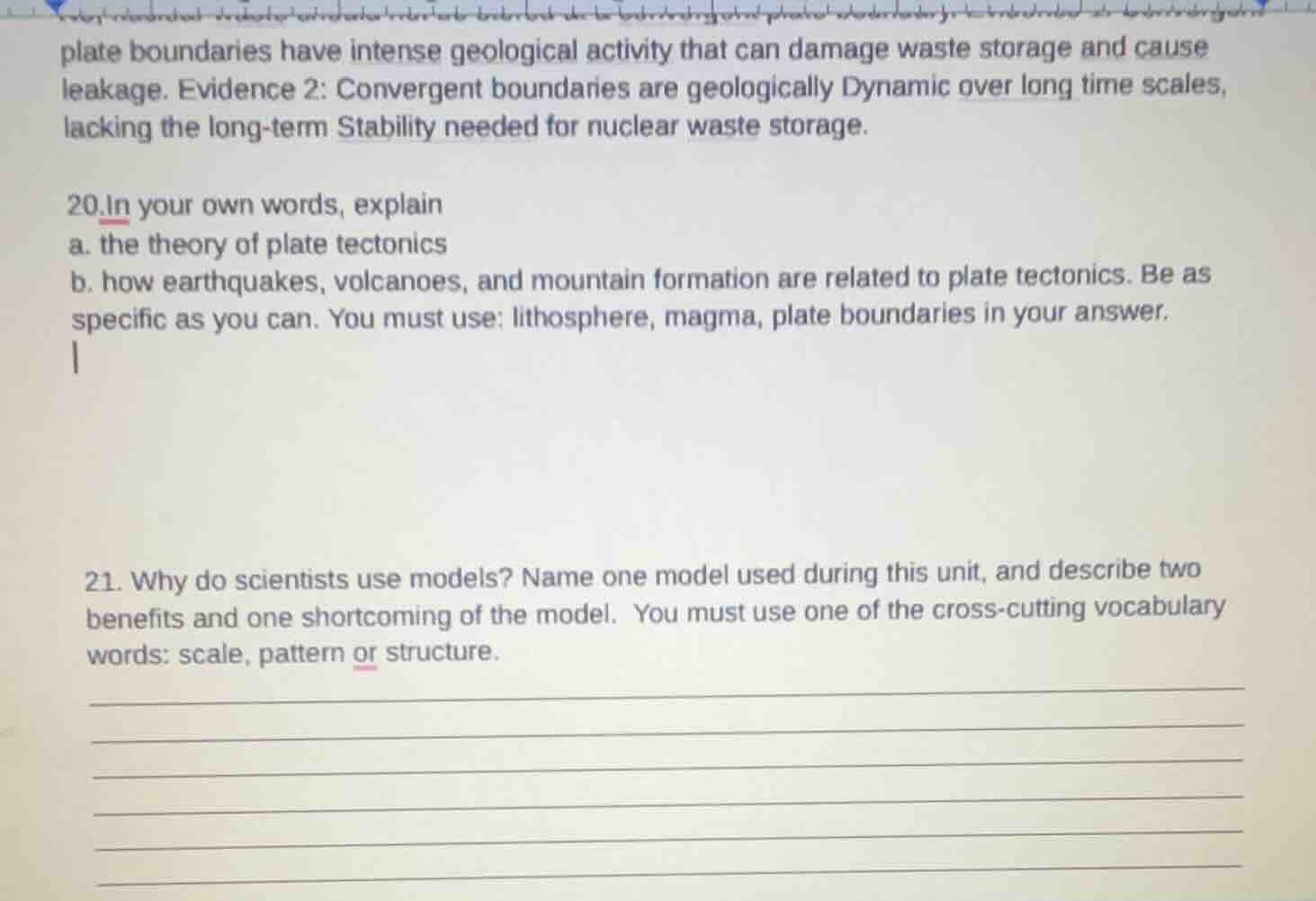
plate boundaries have intense geological activity that can damage waste storage and cause leakage. evidence 2: convergent boundaries are geologically dynamic over long time scales, lacking the long - term stability needed for nuclear waste storage.
- in your own words, explain
a. the theory of plate tectonics
b. how earthquakes, volcanoes, and mountain formation are related to plate tectonics. be as specific as you can. you must use: lithosphere, magma, plate boundaries in your answer.
- why do scientists use models? name one model used during this unit, and describe two benefits and one shortcoming of the model. you must use one of the cross - cutting vocabulary words: scale, pattern or structure.
20a
The theory of plate tectonics states that the Earth's lithosphere (the rigid outer layer) is divided into several large and small tectonic plates. These plates float on the semi - molten asthenosphere below. The plates are in constant motion, moving at very slow rates (a few centimeters per year). This movement is driven by convection currents in the Earth's mantle. The interactions between these plates at their boundaries (divergent, convergent, or transform) lead to various geological phenomena such as earthquakes, volcanic eruptions, and mountain building.
- Earthquakes: At plate boundaries, the lithospheric plates interact. At transform boundaries, plates slide past each other. The friction between them builds up stress. When the stress exceeds the strength of the rocks, the rocks break, releasing energy in the form of seismic waves, which causes an earthquake. At convergent or divergent boundaries, the movement of plates (either colliding, moving apart, or subducting) can also cause stress to build up in the crust, leading to earthquakes.
- Volcanoes: At divergent boundaries (e.g., mid - ocean ridges), as plates move apart, magma from the mantle rises to fill the gap. This magma can erupt onto the surface, forming new oceanic crust and volcanic activity. At convergent boundaries, when an oceanic plate subducts (dives) under a continental or another oceanic plate, the subducting plate melts due to high pressure and temperature, forming magma. This magma rises through the overlying plate and can erupt at the surface, creating volcanoes (e.g., the Pacific Ring of Fire).
- Mountain formation: At convergent boundaries, when two continental plates collide, neither plate subducts easily because they are both less dense. Instead, the plates crumple and fold, and the lithosphere thickens. Over time, this compression and folding lead to the formation of large mountain ranges (e.g., the Himalayas, formed by the collision of the Indian and Eurasian plates). At convergent boundaries where an oceanic plate subducts under a continental plate, the subduction can also cause the overlying continental plate to buckle and form mountain ranges along the coast (e.g., the Andes).
- Why scientists use models: Scientists use models to represent complex natural phenomena or systems that are difficult to study directly. Models can simplify the system, highlight important features, and help in making predictions. They also allow scientists to test hypotheses in a controlled way (either physically or conceptually) without having to manipulate the actual large - scale or dangerous system.
- Example of a model (e.g., plate tectonics model using a globe with movable plates):
- Benefits:
- Scale: The model can represent the Earth's plates at a manageable scale. It allows students or scientists to see the relative positions and movements of plates, which is difficult to perceive on the actual Earth's surface. For example, the model can show the entire Earth's plate system in a small, table - top size, making it easy to handle and study the pattern of plate boundaries.
- Structure: The model clearly shows the structure of the lithosphere (represented by the plates) and how they interact at boundaries. It can show the different types of plate boundaries (divergent, convergent, transform) and their structural relationships, helping to visualize how plates move and interact.
- Shortcoming: The model cannot accurately represent the actual thickness of the lithosphere or the asthenosphere. The relative thicknesses of the plates and the underlying layers are often distorted in the model. Also, the model cannot show the actual convection currents in the mantle that drive plate movement, as it is a static or only partially dynamic representation.

Snap & solve any problem in the app
Get step-by-step solutions on Sovi AI
Photo-based solutions with guided steps
Explore more problems and detailed explanations
The theory of plate tectonics proposes that the Earth's lithosphere is split into multiple tectonic plates. These plates, which rest on the semi - fluid asthenosphere, move slowly. Their movements and interactions at boundaries (divergent, convergent, transform) cause geological events like quakes, volcanoes, and mountain formation.