QUESTION IMAGE
Question
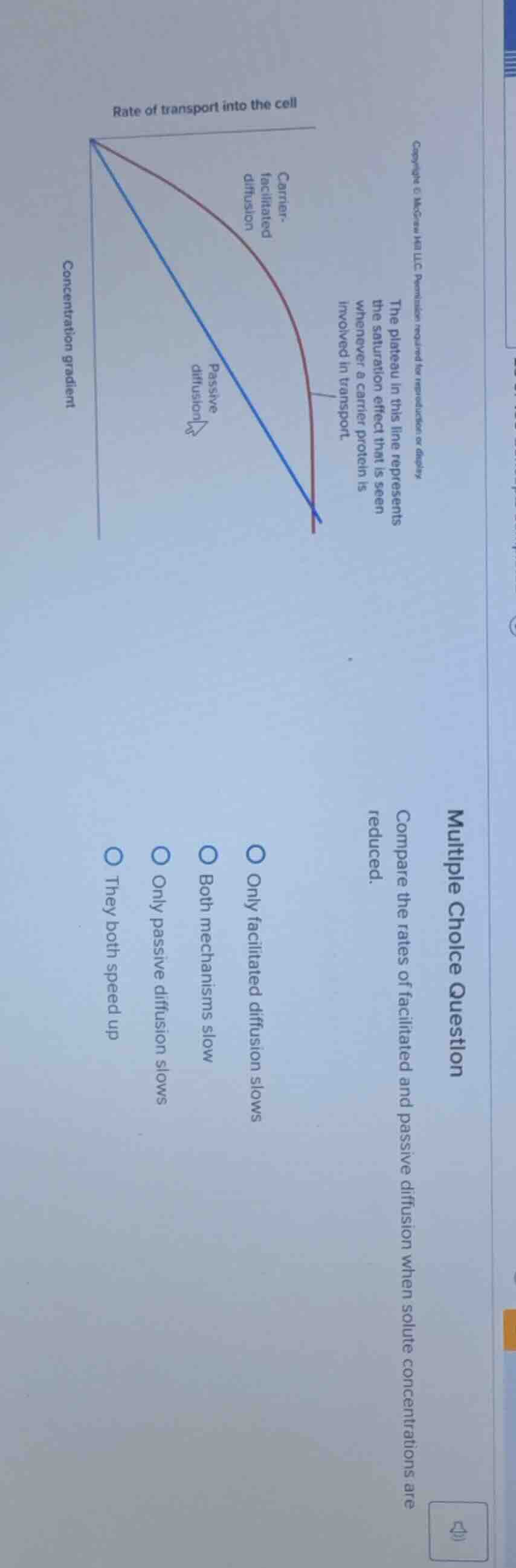
the plateau in this line represents the saturation effect that is seen whenever a carrier protein is involved in transport. multiple choice question compare the rates of facilitated and passive diffusion when solute concentrations are reduced. only facilitated diffusion slows both mechanisms slow only passive diffusion slows they both speed up
To solve this, we analyze the two diffusion mechanisms:
- Passive diffusion: Rate is directly proportional to the concentration gradient (linear graph). As solute concentration (gradient) reduces, the rate of passive diffusion slows because the driving force (concentration difference) decreases.
- Facilitated diffusion: Uses carrier proteins. When solute concentration is reduced, the number of solute molecules available to bind to carriers decreases, so its rate also slows (the curved graph plateaus when carriers are saturated, but with lower concentration, carriers are less occupied, slowing the rate).
Wait, no—wait, the question is "when solute concentrations are reduced". Wait, passive diffusion’s rate depends on concentration gradient (higher gradient = faster). If solute concentration (gradient) is reduced, passive diffusion rate slows. Facilitated diffusion: carriers have a maximum rate (saturation), but if solute concentration (substrate) is reduced, the rate of facilitated diffusion (which depends on substrate concentration until saturation) will also slow, because there’s less solute to bind to carriers. Wait, but the options:
Option 1: Only facilitated diffusion slows—no, passive should too.
Option 2: Both mechanisms slow—because lower solute concentration means lower gradient for passive (slowing it) and lower substrate for facilitated (slowing it, as carriers have less solute to transport). Wait, but wait the graph: passive diffusion is linear (rate ∝ gradient), facilitated is curved (rate increases with gradient until saturation). If solute concentration (gradient) is reduced, both rates should decrease. Wait, but the option "They both speed up" is wrong (lower concentration = lower rate). "Only passive diffusion slows" is wrong (facilitated also slows). "Both mechanisms slow"—let's check the options again.
Wait the question: "Compare the rates of facilitated diffusion and passive diffusion when solute concentrations are reduced."
Passive diffusion: rate = proportional to concentration gradient. If solute concentration (gradient) is reduced, rate slows.
Facilitated diffusion: rate depends on solute concentration (until carrier saturation). If solute concentration is reduced, the rate of facilitated diffusion (which is a function of how many solute molecules bind to carriers) will also slow, because there’s less solute to bind. So both rates decrease (slow down). So the correct option is "Both mechanisms slow"? Wait no, wait the options:
Wait the options are:
- Only facilitated diffusion slows
- Both mechanisms slow
- Only passive diffusion slows
- They both speed up
Wait, no—wait, when solute concentration is reduced, the concentration gradient (for passive) is smaller, so passive diffusion rate decreases (slows). For facilitated, since it’s mediated by carriers, the rate is $v = \frac{V_{max}[S]}{K_m + [S]}$ (Michaelis-Menten). If [S] (solute concentration) is reduced, v (rate) decreases (since [S] is in numerator). So both rates slow. So the answer should be "Both mechanisms slow"? Wait but let me re-examine.
Wait, maybe I made a mistake. Wait, passive diffusion: higher solute outside (gradient) = faster. If solute concentration (outside or inside?) is reduced—assuming it’s the extracellular concentration, reducing it reduces the gradient. So passive diffusion rate slows. Facilitated diffusion: if solute concentration is reduced, the rate (which is limited by carrier number and substrate concentration) will also slow, because there’s less solute to transport. So both mechanisms slow. So the correct opti…

Snap & solve any problem in the app
Get step-by-step solutions on Sovi AI
Photo-based solutions with guided steps
Explore more problems and detailed explanations
B. Both mechanisms slow (assuming the option with "Both mechanisms slow" is the correct one; based on the analysis, both passive and facilitated diffusion rates decrease when solute concentration is reduced.)
Wait, but the options are presented as radio buttons. Let's re-express the options with their labels (assuming the order is as given):
- Only facilitated diffusion slows
- Both mechanisms slow
- Only passive diffusion slows
- They both speed up
The correct answer is the second option: "Both mechanisms slow".