QUESTION IMAGE
Question
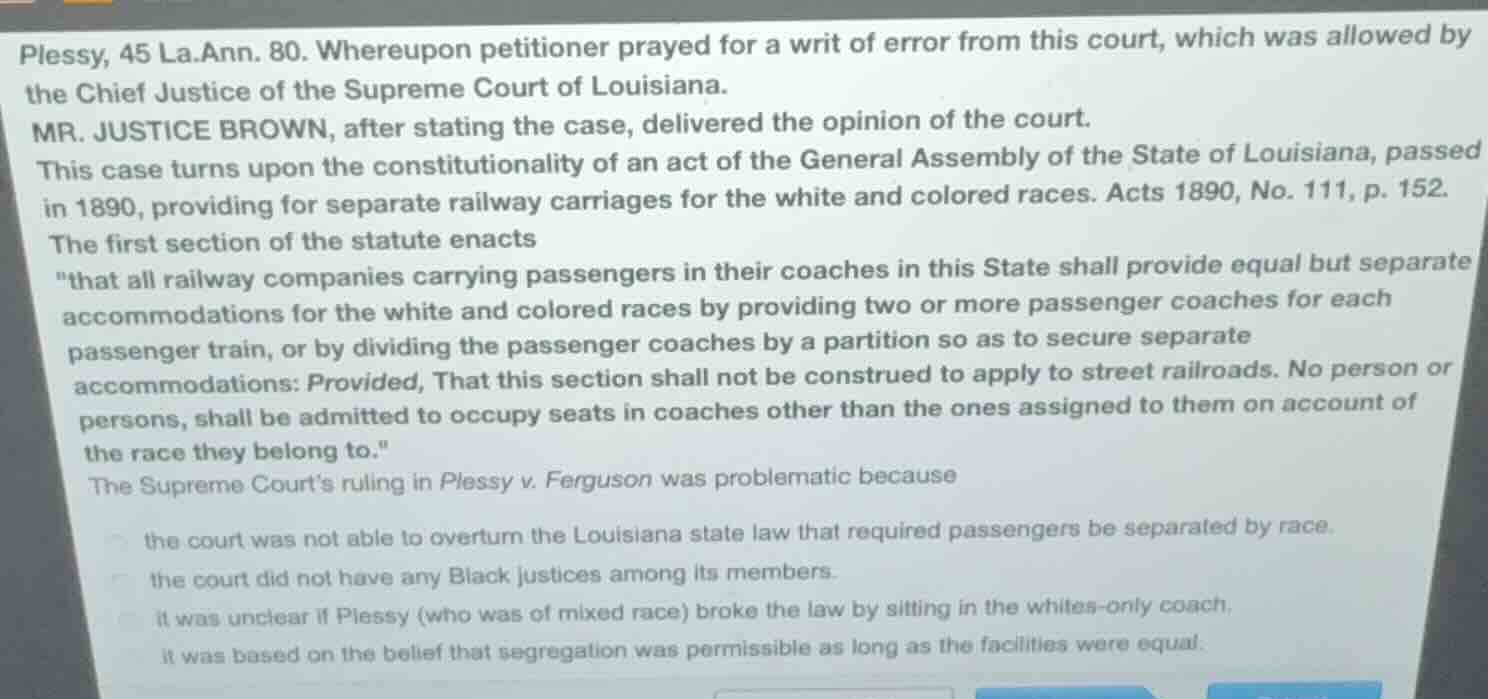
plessy, 45 la.ann. 80. whereupon petitioner prayed for a writ of error from this court, which was allowed by the chief justice of the supreme court of louisiana. mr. justice brown, after stating the case, delivered the opinion of the court. this case turns upon the constitutionality of an act of the general assembly of the state of louisiana, passed in 1890, providing for separate railway carriages for the white and colored races. acts 1890, no. 111, p. 152. the first section of the statute enacts \that all railway companies carrying passengers in their coaches in this state shall provide equal but separate accommodations for the white and colored races by providing two or more passenger coaches for each passenger train, or by dividing the passenger coaches by a partition so as to secure separate accommodations: provided, that this section shall not be construed to apply to street railroads. no person or persons, shall be admitted to occupy seats in coaches other than the ones assigned to them on account of the race they belong to.\ the supreme courts ruling in plessy v. ferguson was problematic because the court was not able to overturn the louisiana state law that required passengers be separated by race. the court did not have any black justices among its members. it was unclear if plessy (who was of mixed race) broke the law by sitting in the whites - only coach, it was based on the belief that segregation was permissible as long as the facilities were equal.
To determine why the Plessy v. Ferguson ruling was problematic, we analyze each option:
- Option 1: The court's inability to overturn the law isn't the core problem with the ruling itself, but rather the reasoning behind upholding it.
- Option 2: The composition of the court (lack of Black justices) isn't the main reason the ruling was problematic; the legal reasoning is key.
- Option 3: The clarity of whether Plessy broke the law isn't the central issue with the ruling's problematic nature.
- Option 4: The ruling established the "separate but equal" doctrine, which was problematic because it upheld racial segregation under the guise of equality. In reality, segregated facilities were rarely equal, and this doctrine perpetuated systemic racism and violated the equal protection clause of the 14th Amendment in spirit (even if the court claimed equality in theory).

Snap & solve any problem in the app
Get step-by-step solutions on Sovi AI
Photo-based solutions with guided steps
Explore more problems and detailed explanations
It was based on the belief that segregation was permissible as long as the facilities were equal.