QUESTION IMAGE
Question
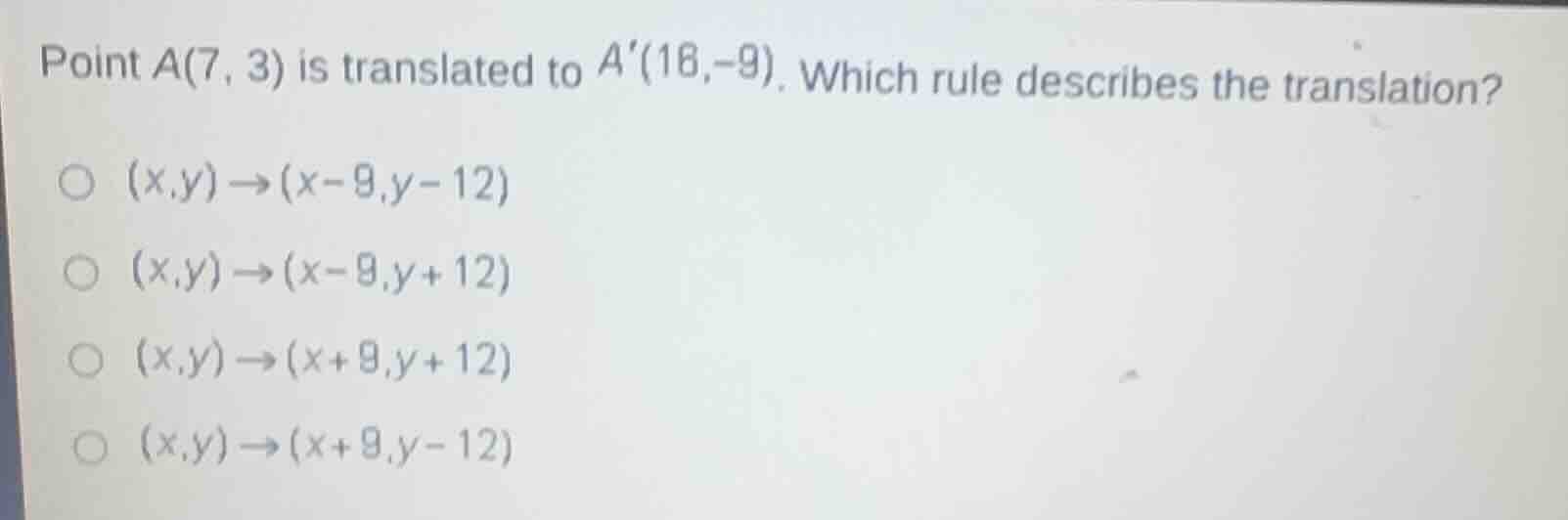
point a(7, 3) is translated to a(18,-9). which rule describes the translation?
○ (x,y)→(x-9,y-12)
○ (x,y)→(x-9,y+12)
○ (x,y)→(x+9,y+12)
○ (x,y)→(x+9,y-12)
Step1: Find the change in x-coordinate
To find the change in the x - coordinate, we subtract the original x - coordinate from the translated x - coordinate. The original x - coordinate of point A is 7, and the translated x - coordinate of point \(A'\) is 18. So, the change in x is \(18 - 7=9\). This means that we add 9 to the x - coordinate of the original point.
Step2: Find the change in y - coordinate
To find the change in the y - coordinate, we subtract the original y - coordinate from the translated y - coordinate. The original y - coordinate of point A is 3, and the translated y - coordinate of point \(A'\) is - 9. So, the change in y is \(-9 - 3=-12\). This means that we subtract 12 from the y - coordinate of the original point.
Step3: Determine the translation rule
From Step 1 and Step 2, the translation rule is \((x,y)\to(x + 9,y-12)\) since we add 9 to the x - value and subtract 12 from the y - value.

Snap & solve any problem in the app
Get step-by-step solutions on Sovi AI
Photo-based solutions with guided steps
Explore more problems and detailed explanations
\((x,y)\to(x + 9,y - 12)\) (the last option: \((x,y)\to(x + 9,y - 12)\))