QUESTION IMAGE
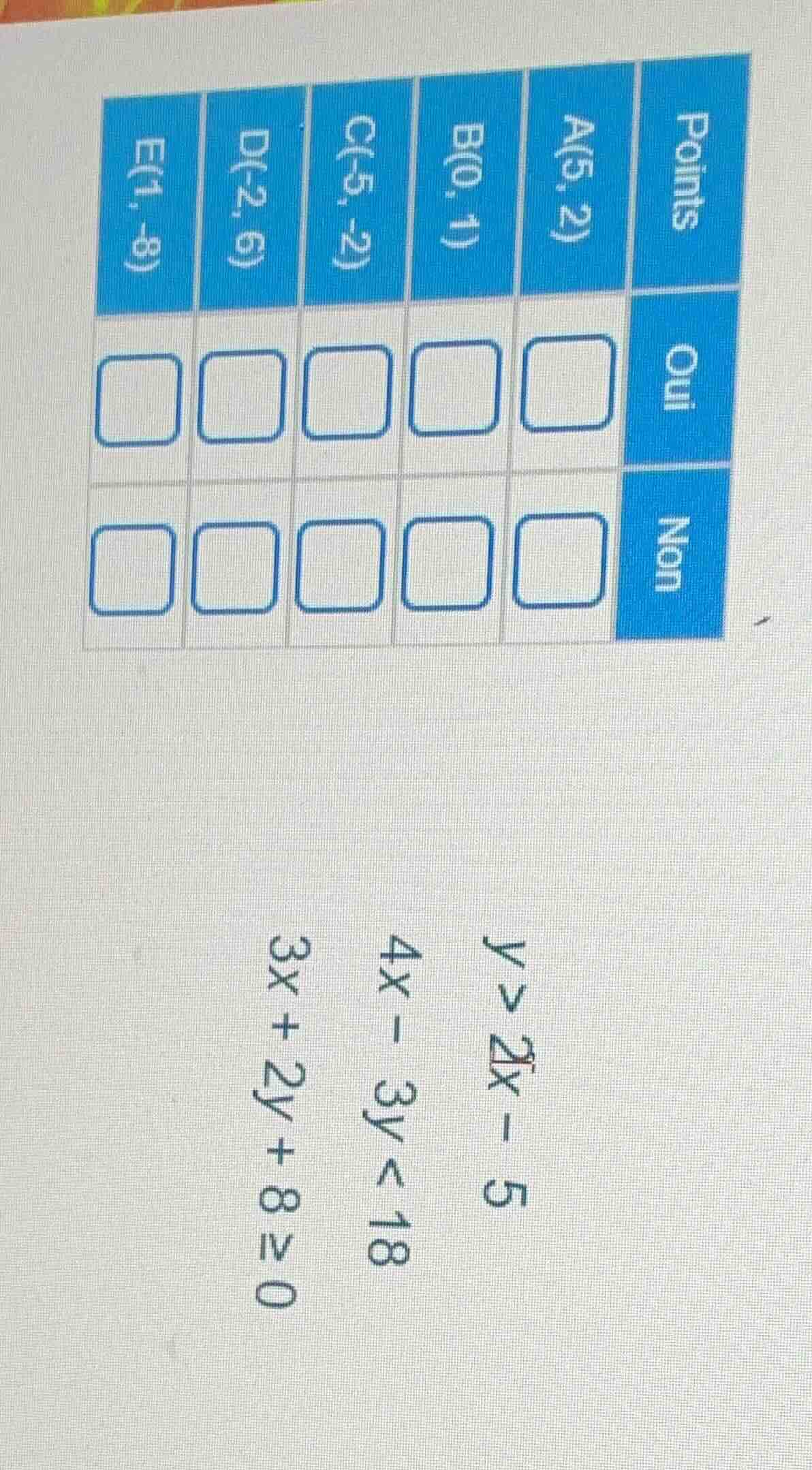
Question
points
a(5, 2)
b(0, 1)
c(-5, -2)
d(-2, 6)
e(1, -8)
oui
non
y > 2x - 5
4x - 3y < 18
3x + 2y + 8 ≥ 0
To solve this, we check each point in each inequality. Let's start with the first inequality \( y > 2x - 5 \), then \( 4x - 3y < 18 \), and \( 3x + 2y + 8 \geq 0 \). But since the problem is about checking points in inequalities, we'll take one inequality first, say \( y > 2x - 5 \), and check each point:
For \( y > 2x - 5 \):
- Point A(5, 2):
Calculate \( 2x - 5 = 2(5) - 5 = 10 - 5 = 5 \).
Check \( 2 > 5 \)? No. So A: Non.
- Point B(0, 1):
\( 2x - 5 = 2(0) - 5 = -5 \).
Check \( 1 > -5 \)? Yes. So B: Oui.
- Point C(-5, -2):
\( 2x - 5 = 2(-5) - 5 = -10 - 5 = -15 \).
Check \( -2 > -15 \)? Yes. So C: Oui.
- Point D(-2, 6):
\( 2x - 5 = 2(-2) - 5 = -4 - 5 = -9 \).
Check \( 6 > -9 \)? Yes. So D: Oui.
- Point E(1, -8):
\( 2x - 5 = 2(1) - 5 = 2 - 5 = -3 \).
Check \( -8 > -3 \)? No. So E: Non.
For \( 4x - 3y < 18 \):
- Point A(5, 2):
\( 4(5) - 3(2) = 20 - 6 = 14 \).
Check \( 14 < 18 \)? Yes. So A: Oui.
- Point B(0, 1):
\( 4(0) - 3(1) = 0 - 3 = -3 \).
Check \( -3 < 18 \)? Yes. So B: Oui.
- Point C(-5, -2):
\( 4(-5) - 3(-2) = -20 + 6 = -14 \).
Check \( -14 < 18 \)? Yes. So C: Oui.
- Point D(-2, 6):
\( 4(-2) - 3(6) = -8 - 18 = -26 \).
Check \( -26 < 18 \)? Yes. So D: Oui.
- Point E(1, -8):
\( 4(1) - 3(-8) = 4 + 24 = 28 \).
Check \( 28 < 18 \)? No. So E: Non.
For \( 3x + 2y + 8 \geq 0 \):
- Point A(5, 2):
\( 3(5) + 2(2) + 8 = 15 + 4 + 8 = 27 \).
Check \( 27 \geq 0 \)? Yes. So A: Oui.
- Point B(0, 1):
\( 3(0) + 2(1) + 8 = 0 + 2 + 8 = 10 \).
Check \( 10 \geq 0 \)? Yes. So B: Oui.
- Point C(-5, -2):
\( 3(-5) + 2(-2) + 8 = -15 - 4 + 8 = -11 \).
Check \( -11 \geq 0 \)? No. So C: Non.
- Point D(-2, 6):
\( 3(-2) + 2(6) + 8 = -6 + 12 + 8 = 14 \).
Check \( 14 \geq 0 \)? Yes. So D: Oui.
- Point E(1, -8):
\( 3(1) + 2(-8) + 8 = 3 - 16 + 8 = -5 \).
Check \( -5 \geq 0 \)? No. So E: Non.
Assuming we need to check all three inequalities (or a specific one, but since the problem shows three inequalities, we can summarize for each point:
| Points | \( y > 2x - 5 \) | \( 4x - 3y < 18 \) | \( 3x + 2y + 8 \geq 0 \) |
|---|---|---|---|
| B(0, 1) | Oui | Oui | Oui |
| C(-5, -2) | Oui | Oui | Non |
| D(-2, 6) | Oui | Oui | Oui |
| E(1, -8) | Non | Non | Non |
If the question is to mark "Oui" or "Non" for each point in the given inequalities (assuming all three, or a specific one), the above analysis applies. For example, for \( y > 2x - 5 \), the "Oui" points are B, C, D; "Non" are A, E.
Since the problem’s table has "Oui" and "Non" columns, we can mark each point:
- A(5, 2): Non (for \( y > 2x - 5 \)), Oui (for \( 4x - 3y < 18 \) and \( 3x + 2y + 8 \geq 0 \))
- B(0, 1): Oui (all three)
- C(-5, -2): Oui (first two), Non (third)
- D(-2, 6): Oui (all three)
- E(1, -8): Non (all three)
If we take the first inequality \( y > 2x - 5 \):
Pour \( y > 2x - 5 \), on substitue \( x \) et \( y \) de chaque point :
- A(5,2) : \( 2 > 2(5)-5 = 5 \) ? Non.
- B(0,1) : \( 1 > 2(0)-5 = -5 \) ? Oui.
- C(-5,-2) : \( -2 > 2(-5)-5 = -15 \) ? Oui.
- D(-2,6) : \( 6 > 2(-2)-5 = -9 \) ? Oui.
- E(1,-8) : \( -8 > 2(1)-5 = -3 \) ? Non.

Snap & solve any problem in the app
Get step-by-step solutions on Sovi AI
Photo-based solutions with guided steps
Explore more problems and detailed explanations
- A(5, 2): Non
- B(0, 1): Oui
- C(-5, -2): Oui
- D(-2, 6): Oui
- E(1, -8): Non
(Adjust based on which inequality is intended; the problem shows three inequalities, so clarify if needed. The above is for \( y > 2x - 5 \) as a sample.)