QUESTION IMAGE
Question
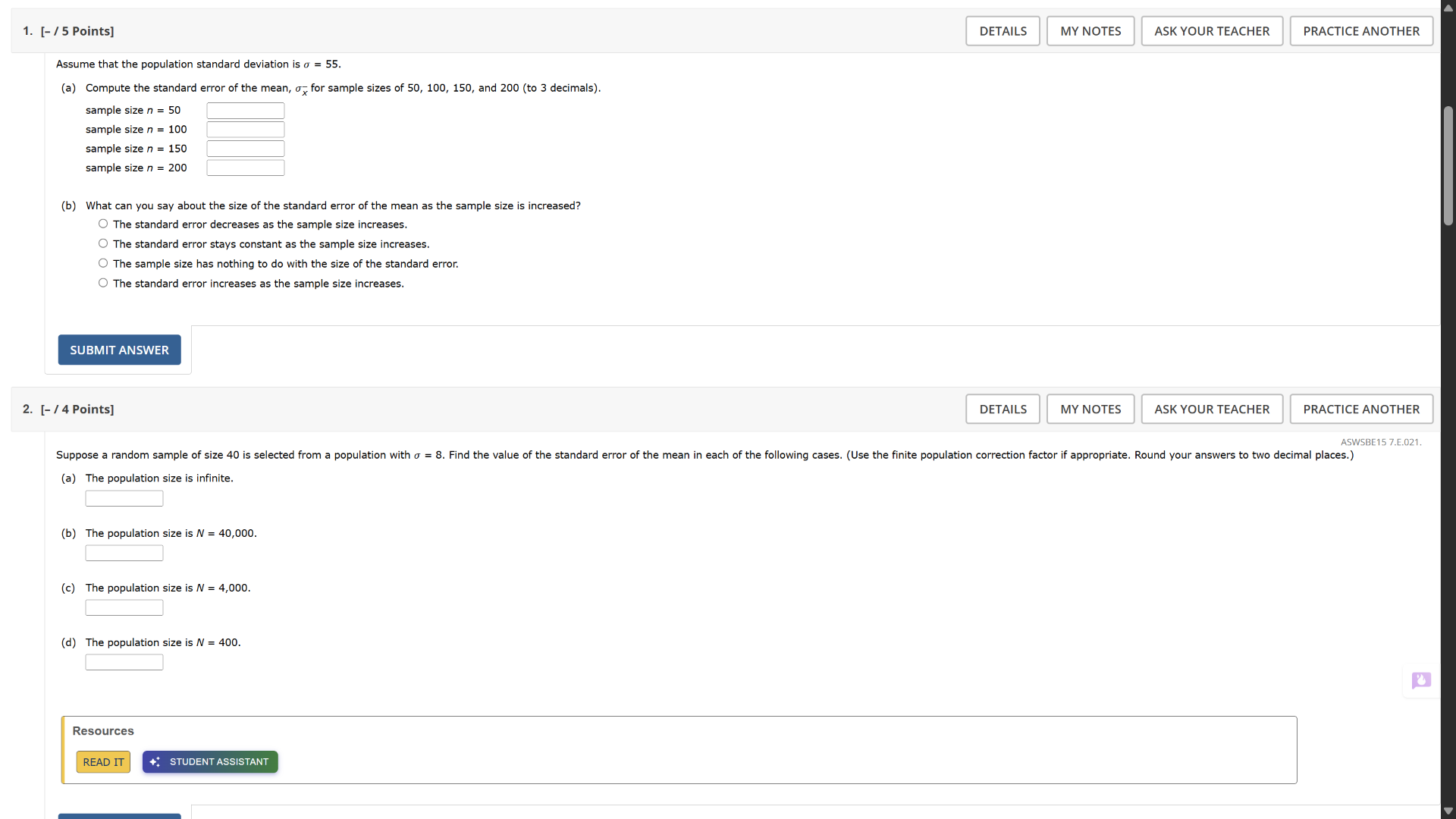
- - / 5 points assume that the population standard deviation is $\sigma = 55$. (a) compute the standard error of the mean, $\sigma_{\bar{x}}$ for sample sizes of 50, 100, 150, and 200 (to 3 decimals). sample size $n = 50$ sample size $n = 100$ sample size $n = 150$ sample size $n = 200$ (b) what can you say about the size of the standard error of the mean as the sample size is increased? \\(\bigcirc\\) the standard error decreases as the sample size increases. \\(\bigcirc\\) the standard error stays constant as the sample size increases. \\(\bigcirc\\) the sample size has nothing to do with the size of the standard error. \\(\bigcirc\\) the standard error increases as the sample size increases. submit answer 2. - / 4 points suppose a random sample of size 40 is selected from a population with $\sigma = 8$. find the value of the standard error of the mean in each of the following cases. (use the finite population correction factor if appropriate. round your answers to two decimal places.) (a) the population size is infinite. (b) the population size is $n = 40,000$. (c) the population size is $n = 4,000$. (d) the population size is $n = 400$. resources read it student assistant
Problem 1 (a)
The formula for the standard error of the mean ($\sigma_{\bar{x}}$) is $\sigma_{\bar{x}} = \frac{\sigma}{\sqrt{n}}$, where $\sigma$ is the population standard deviation and $n$ is the sample size. We are given $\sigma = 55$.
Step 1: For $n = 50$
We substitute $\sigma = 55$ and $n = 50$ into the formula:
$\sigma_{\bar{x}} = \frac{55}{\sqrt{50}}$
First, calculate $\sqrt{50} \approx 7.07107$
Then, $\frac{55}{7.07107} \approx 7.778$ (rounded to 3 decimals)
Step 2: For $n = 100$
Substitute $\sigma = 55$ and $n = 100$:
$\sigma_{\bar{x}} = \frac{55}{\sqrt{100}}$
Since $\sqrt{100} = 10$, we have $\frac{55}{10} = 5.500$
Step 3: For $n = 150$
Substitute $\sigma = 55$ and $n = 150$:
$\sigma_{\bar{x}} = \frac{55}{\sqrt{150}}$
Calculate $\sqrt{150} \approx 12.24745$
Then, $\frac{55}{12.24745} \approx 4.491$ (rounded to 3 decimals)
Step 4: For $n = 200$
Substitute $\sigma = 55$ and $n = 200$:
$\sigma_{\bar{x}} = \frac{55}{\sqrt{200}}$
Calculate $\sqrt{200} \approx 14.14214$
Then, $\frac{55}{14.14214} \approx 3.889$ (rounded to 3 decimals)
As the sample size $n$ increases, the denominator $\sqrt{n}$ in the formula $\sigma_{\bar{x}} = \frac{\sigma}{\sqrt{n}}$ increases. Since the numerator $\sigma$ is constant, the value of $\sigma_{\bar{x}}$ decreases as $n$ increases. So we analyze the options:
- "The standard error decreases as the sample size increases." is correct.
- "The standard error stays constant as the sample size increases." is wrong because $n$ affects the denominator.
- "The sample size has nothing to do with the size of the standard error." is wrong as the formula shows $n$ is in the denominator.
- "The standard error increases as the sample size increases." is wrong because an increasing $n$ makes the denominator larger, so the whole fraction (standard error) decreases.
For an infinite population, we use $\sigma_{\bar{x}} = \frac{\sigma}{\sqrt{n}}$.
Step 1: Substitute values
$\sigma_{\bar{x}} = \frac{8}{\sqrt{40}}$
Calculate $\sqrt{40} \approx 6.32456$
Then, $\frac{8}{6.32456} \approx 1.26$ (rounded to 2 decimals)

Snap & solve any problem in the app
Get step-by-step solutions on Sovi AI
Photo-based solutions with guided steps
Explore more problems and detailed explanations
(for part a):
- Sample size $n = 50$: $\boxed{7.778}$
- Sample size $n = 100$: $\boxed{5.500}$
- Sample size $n = 150$: $\boxed{4.491}$
- Sample size $n = 200$: $\boxed{3.889}$