QUESTION IMAGE
Question
points to ponder
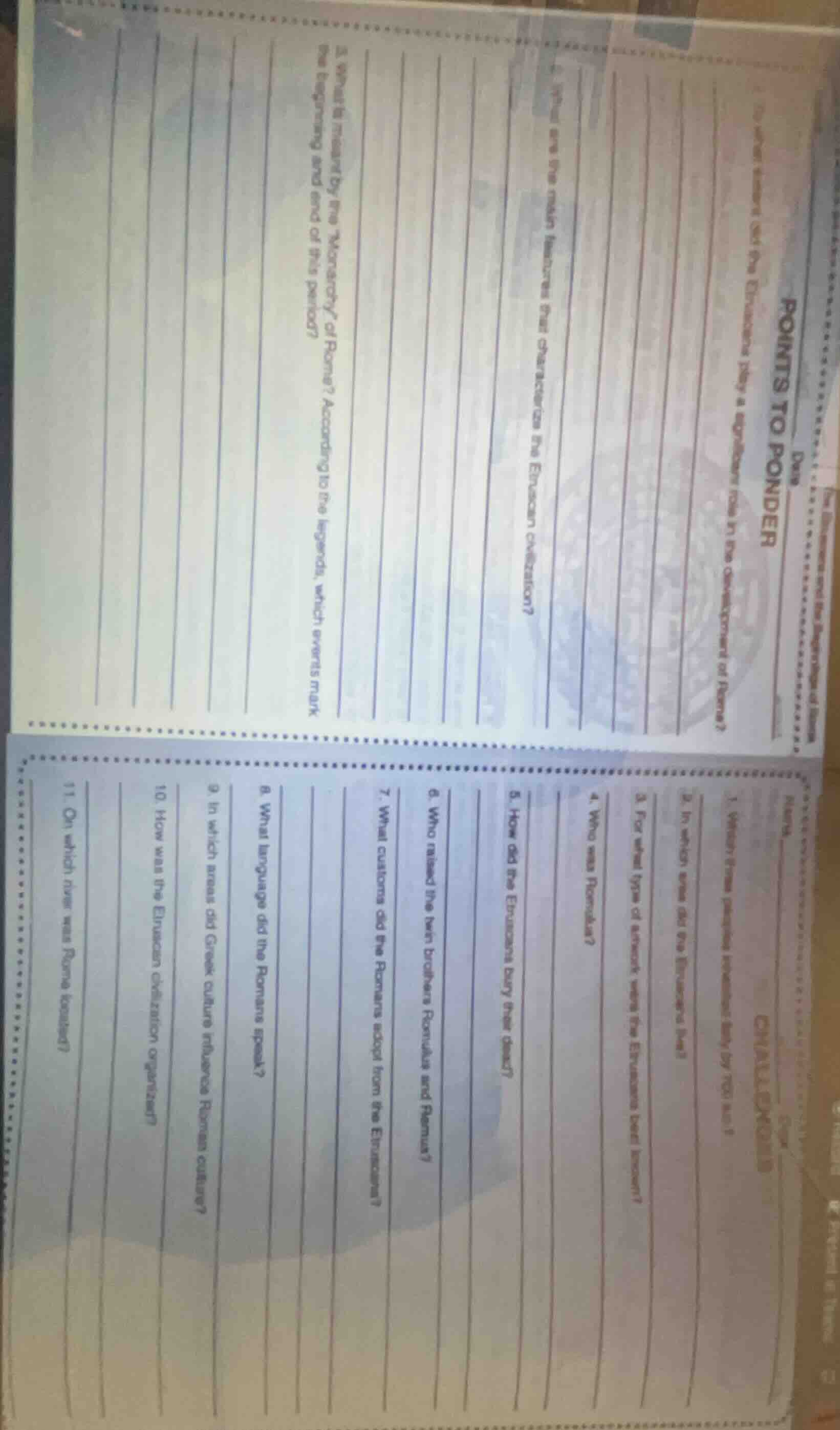
- what number of set a exercises play a significant role in the development of rome?
- what is marked by the monarchy of rome? according to the legends, which events mark the beginning and end of this period?
- what are the main features of the etruscan civilization?
review questions
- which three periods is ancient italy by 753 bc?
- in which area did the etruscans live?
- for what type of artwork were the etruscans best known?
- who was romulus?
- how did the etruscans bury their dead?
- who raised the twin brothers romulus and remus?
- what customs did the romans adopt from the etruscans?
- what language did the romans speak?
- in which areas did greek culture influence roman culture?
- how was the etruscan civilization organized?
- on which river was rome located?
To answer these questions, we'll address each one based on historical knowledge about the Etruscans and Romans:
Question 1: Which three peoples inhabited Italy by 750 B.C.?
By 750 B.C., the three main peoples in Italy were the Etruscans, the Latins (who would later found Rome), and the Greeks (who had established colonies in southern Italy).
Question 2: In which area did the Etruscans live?
The Etruscans lived in the region of Etruria (modern-day Tuscany, northern Lazio, and parts of Umbria) in central Italy.
Question 3: For what type of artwork were the Etruscans best known?
The Etruscans were best known for their funerary art, particularly elaborate tomb paintings (depicting daily life, banquets, and rituals) and sarcophagi (e.g., the Sarcophagus of the Spouses).
Question 4: Who was Romulus?
Romulus was the legendary founder and first king of Rome. According to myth, he and his twin brother Remus were raised by a she-wolf, and Romulus killed Remus during a dispute over the city’s founding.
Question 5: How did the Etruscans bury their dead?
The Etruscans buried their dead in tombs (often underground chambers or “necropolises”) that mimicked the layout of their homes. Tombs were decorated with paintings, and the dead were buried with personal items, jewelry, and even chariots (for elite burials).
Question 6: Who raised the twin brothers Romulus and Remus?
According to legend, Romulus and Remus were raised by a she-wolf (and later a shepherd, Faustulus) after being abandoned as infants near the Tiber River.
Question 7: What customs did the Romans adopt from the Etruscans?
The Romans adopted several Etruscan customs, including:
- Engineering/architecture: The arch, aqueducts, and city planning.
- Religion: Etruscan deities (e.g., adapting Etruscan gods into Roman mythology) and divination practices (interpreting omens).
- Government: The Etruscan model of a monarchy (later replaced by a republic, but early Roman kings were Etruscan-influenced).
- Art/culture: Metalworking, jewelry, and funeral practices.
Question 8: What language did the Romans speak?
The Romans spoke Latin (an Indo-European language). Over time, Latin evolved into the Romance languages (Italian, Spanish, French, etc.).
Question 9: In which areas did Greek culture influence Roman culture?
Greek culture influenced Rome in:
- Religion: Romans adopted Greek gods (e.g., Zeus → Jupiter, Aphrodite → Venus).
- Philosophy: Stoicism, Epicureanism, and other Greek schools.
- Art/literature: Roman art (sculpture, pottery) imitated Greek styles; Roman literature (e.g., Virgil’s Aeneid) drew on Greek epic traditions.
- Architecture: Columns, temples, and the use of marble (inspired by Greek models).
Question 10: How was the Etruscan civilization organized?
The Etruscan civilization was organized into a confederation of independent city-states (e.g., Veii, Tarquinia, Cerveteri). Each city-state had its own government, but they shared cultural and religious ties.
Question 11: On which river was Rome located?
Rome was located on the Tiber River (Latin: Tiberis), which provided water, transportation, and a natural defense.
"Points to Ponder" Questions:
1. In what ways did the Etruscans play a significant role in the development of Rome?
The Etruscans shaped Rome by:
- Establishing early urban infrastructure (sewers, roads, buildings).
- Introducing writing (adapting the Greek alphabet into Latin).
- Influencing polit…

Snap & solve any problem in the app
Get step-by-step solutions on Sovi AI
Photo-based solutions with guided steps
Explore more problems and detailed explanations
To answer these questions, we'll address each one based on historical knowledge about the Etruscans and Romans:
Question 1: Which three peoples inhabited Italy by 750 B.C.?
By 750 B.C., the three main peoples in Italy were the Etruscans, the Latins (who would later found Rome), and the Greeks (who had established colonies in southern Italy).
Question 2: In which area did the Etruscans live?
The Etruscans lived in the region of Etruria (modern-day Tuscany, northern Lazio, and parts of Umbria) in central Italy.
Question 3: For what type of artwork were the Etruscans best known?
The Etruscans were best known for their funerary art, particularly elaborate tomb paintings (depicting daily life, banquets, and rituals) and sarcophagi (e.g., the Sarcophagus of the Spouses).
Question 4: Who was Romulus?
Romulus was the legendary founder and first king of Rome. According to myth, he and his twin brother Remus were raised by a she-wolf, and Romulus killed Remus during a dispute over the city’s founding.
Question 5: How did the Etruscans bury their dead?
The Etruscans buried their dead in tombs (often underground chambers or “necropolises”) that mimicked the layout of their homes. Tombs were decorated with paintings, and the dead were buried with personal items, jewelry, and even chariots (for elite burials).
Question 6: Who raised the twin brothers Romulus and Remus?
According to legend, Romulus and Remus were raised by a she-wolf (and later a shepherd, Faustulus) after being abandoned as infants near the Tiber River.
Question 7: What customs did the Romans adopt from the Etruscans?
The Romans adopted several Etruscan customs, including:
- Engineering/architecture: The arch, aqueducts, and city planning.
- Religion: Etruscan deities (e.g., adapting Etruscan gods into Roman mythology) and divination practices (interpreting omens).
- Government: The Etruscan model of a monarchy (later replaced by a republic, but early Roman kings were Etruscan-influenced).
- Art/culture: Metalworking, jewelry, and funeral practices.
Question 8: What language did the Romans speak?
The Romans spoke Latin (an Indo-European language). Over time, Latin evolved into the Romance languages (Italian, Spanish, French, etc.).
Question 9: In which areas did Greek culture influence Roman culture?
Greek culture influenced Rome in:
- Religion: Romans adopted Greek gods (e.g., Zeus → Jupiter, Aphrodite → Venus).
- Philosophy: Stoicism, Epicureanism, and other Greek schools.
- Art/literature: Roman art (sculpture, pottery) imitated Greek styles; Roman literature (e.g., Virgil’s Aeneid) drew on Greek epic traditions.
- Architecture: Columns, temples, and the use of marble (inspired by Greek models).
Question 10: How was the Etruscan civilization organized?
The Etruscan civilization was organized into a confederation of independent city-states (e.g., Veii, Tarquinia, Cerveteri). Each city-state had its own government, but they shared cultural and religious ties.
Question 11: On which river was Rome located?
Rome was located on the Tiber River (Latin: Tiberis), which provided water, transportation, and a natural defense.
"Points to Ponder" Questions:
1. In what ways did the Etruscans play a significant role in the development of Rome?
The Etruscans shaped Rome by:
- Establishing early urban infrastructure (sewers, roads, buildings).
- Introducing writing (adapting the Greek alphabet into Latin).
- Influencing political structure (early Roman kings were Etruscan or Etruscan-influenced).
- Transmitting Greek cultural ideas (art, religion) to Rome.
2. What was ruled by the “Monarchy of Rome”? According to the legends, which events mark the beginning and end of this period?
The “Monarchy of Rome” (753–509 B.C.) ruled the city-state of Rome.
- Beginning: Legendarily marked by Romulus’ founding of Rome (753 B.C.).
- End: Marked by the overthrow of the last Etruscan king, Tarquinius Superbus (509 B.C.), leading to the establishment of the Roman Republic.
These answers draw on historical records, archaeological evidence, and legendary accounts of Etruscan-Roman interactions.