QUESTION IMAGE
Question
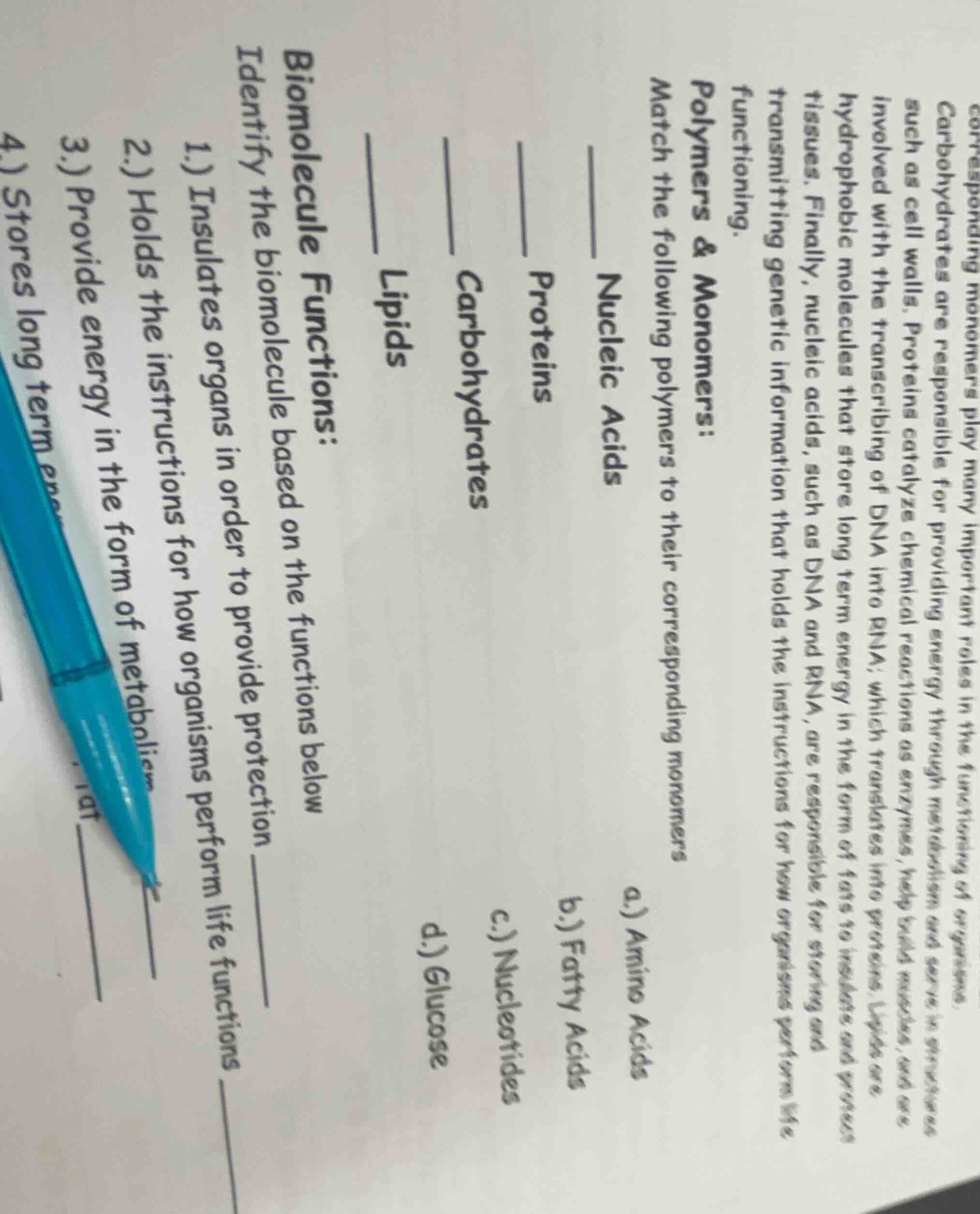
polymers & monomers:
match the following polymers to their corresponding monomers
nucleic acids
proteins
carbohydrates
lipids
biomolecule functions:
identify the biomolecule based on the functions below
1.) insulates organs in order to provide protection
2.) holds the instructions for how organisms perform life functions
3.) provide energy in the form of metabolites
4.) stores long term
a.) amino acids
b.) fatty acids
c.) nucleotides
d.) glucose
Part 1: Polymers & Monomers Matching
Step 1: Analyze Nucleic Acids
Nucleic acids (like DNA and RNA) are polymers made of monomers called nucleotides. So, Nucleic Acids match with c) Nucleotides.
Step 2: Analyze Proteins
Proteins are polymers made of monomers called amino acids. So, Proteins match with a) Amino Acids.
Step 3: Analyze Carbohydrates
Carbohydrates (like starch, glycogen) are polymers made of monomers like glucose. So, Carbohydrates match with d) Glucose.
Step 4: Analyze Lipids
Lipids (fats, oils) are made of fatty acids (and glycerol, but among the options, fatty acids are the monomer - like unit for lipids). So, Lipids match with b) Fatty Acids.
Part 2: Biomolecule Functions
Step 1: Function 1 (Insulates organs for protection)
Lipids (like fat layers) insulate organs. So, the biomolecule is Lipids.
Step 2: Function 2 (Holds instructions for life functions)
Nucleic acids (DNA/RNA) hold genetic instructions. So, the biomolecule is Nucleic Acids.
Step 3: Function 3 (Provide energy in metabolism)
Carbohydrates are the primary energy source in metabolism. So, the biomolecule is Carbohydrates.
Step 4: Function 4 (Stores long - term energy)
Lipids (fats) store long - term energy. So, the biomolecule is Lipids. (Note: If we consider the context, sometimes carbohydrates can also store energy, but long - term energy storage is a key function of lipids)
Final Answers (Matching and Function Identification)
Polymers & Monomers Matching:
- Nucleic Acids: c) Nucleotides
- Proteins: a) Amino Acids
- Carbohydrates: d) Glucose
- Lipids: b) Fatty Acids
Biomolecule Functions:
- Insulates organs: Lipids
- Holds instructions: Nucleic Acids
- Provide energy in metabolism: Carbohydrates
- Stores long - term energy: Lipids

Snap & solve any problem in the app
Get step-by-step solutions on Sovi AI
Photo-based solutions with guided steps
Explore more problems and detailed explanations
Part 1: Polymers & Monomers Matching
Step 1: Analyze Nucleic Acids
Nucleic acids (like DNA and RNA) are polymers made of monomers called nucleotides. So, Nucleic Acids match with c) Nucleotides.
Step 2: Analyze Proteins
Proteins are polymers made of monomers called amino acids. So, Proteins match with a) Amino Acids.
Step 3: Analyze Carbohydrates
Carbohydrates (like starch, glycogen) are polymers made of monomers like glucose. So, Carbohydrates match with d) Glucose.
Step 4: Analyze Lipids
Lipids (fats, oils) are made of fatty acids (and glycerol, but among the options, fatty acids are the monomer - like unit for lipids). So, Lipids match with b) Fatty Acids.
Part 2: Biomolecule Functions
Step 1: Function 1 (Insulates organs for protection)
Lipids (like fat layers) insulate organs. So, the biomolecule is Lipids.
Step 2: Function 2 (Holds instructions for life functions)
Nucleic acids (DNA/RNA) hold genetic instructions. So, the biomolecule is Nucleic Acids.
Step 3: Function 3 (Provide energy in metabolism)
Carbohydrates are the primary energy source in metabolism. So, the biomolecule is Carbohydrates.
Step 4: Function 4 (Stores long - term energy)
Lipids (fats) store long - term energy. So, the biomolecule is Lipids. (Note: If we consider the context, sometimes carbohydrates can also store energy, but long - term energy storage is a key function of lipids)
Final Answers (Matching and Function Identification)
Polymers & Monomers Matching:
- Nucleic Acids: c) Nucleotides
- Proteins: a) Amino Acids
- Carbohydrates: d) Glucose
- Lipids: b) Fatty Acids
Biomolecule Functions:
- Insulates organs: Lipids
- Holds instructions: Nucleic Acids
- Provide energy in metabolism: Carbohydrates
- Stores long - term energy: Lipids