QUESTION IMAGE
Question
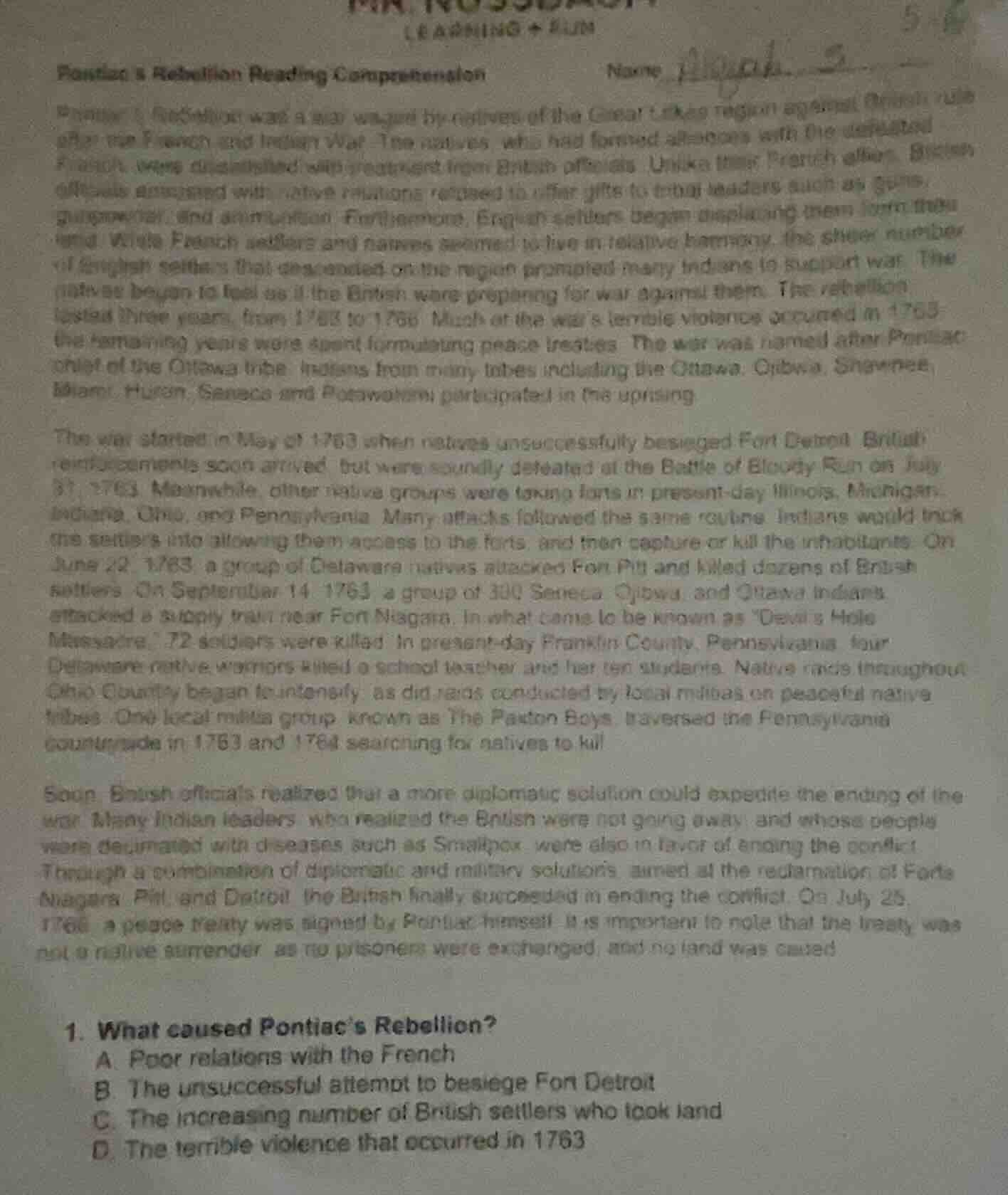
pontiacs rebellion reading comprehension name:pontiacs rebellion was a war waged by natives of the great lakes region against british rule after the french and indian war. the natives, who had formed alliances with the defeated french, were dissatisfied with treatment from british officials. unlike their french allies, british officials associated with native relations refused to offer gifts to tribal leaders such as guns, gunpowder, and ammunition. furthermore, english settlers began displacing them from their land. while french settlers and natives seemed to live in relative harmony, the sheer number of english settlers that descended on the region prompted many indians to support war. the natives began to feel as if the british were preparing for war against them. the rebellion lasted three years, from 1763 to 1766. much of the wars terrible violence occurred in 1763; the remaining years were spent formulating peace treaties. the war was named after pontiac, chief of the ottawa tribe. indians from many tribes including the ottawa, ojibwa, shawnee, miami, huron, seneca and potawatomi participated in the uprising.the war started in may of 1763 when natives unsuccessfully besieged fort detroit. british reinforcements soon arrived, but were soundly defeated at the battle of bloody run on july 31, 1763. meanwhile, other native groups were taking forts in present-day illinois, michigan, indiana, ohio, and pennsylvania. many attacks followed the same routine: indians would trick the settlers into allowing them access to the forts, and then capture or kill the inhabitants. on june 22, 1763, a group of delaware natives attacked fort pitt and killed dozens of british settlers. on september 14, 1763, a group of 300 seneca, ojibwa, and ottawa indians attacked a supply train near fort niagara. in what came to be known as \devils hole massacre,\ 72 soldiers were killed. in present-day franklin county, pennsylvania, four delaware native warriors killed a school teacher and her ten students. native raids throughout ohio country began to intensify, as did raids conducted by local militias on peaceful native tribes. one local militia group, known as the paxton boys, traversed the pennsylvania countryside in 1763 and 1764 searching for natives to kill.soon, british officials realized that a more diplomatic solution could expedite the ending of the war. many indian leaders, who realized the british were not going away, and whose people were decimated with diseases such as smallpox, were also in favor of ending the conflict. through a combination of diplomatic and military solutions, aimed at the reclamation of forts niagara, pitt, and detroit, the british finally succeeded in ending the conflict. on july 25, 1766, a peace treaty was signed by pontiac himself. it is important to note that the treaty was not a native surrender, as no prisoners were exchanged, and no land was ceded.1. what caused pontiacs rebellion?a. poor relations with the frenchb. the unsuccessful attempt to besiege fort detroitc. the increasing number of british settlers who took landd. the terrible violence that occurred in 1763
The rebellion stemmed from Great Lakes natives' dissatisfaction with British rule post-French and Indian War. Key grievances included British officials refusing gifts (unlike the French) and English settlers displacing them from their land, leading natives to fear British war preparations. Option A is wrong as they allied with the defeated French; B is the start of the war, not the cause; D is a war event, not the cause.

Snap & solve any problem in the app
Get step-by-step solutions on Sovi AI
Photo-based solutions with guided steps
Explore more problems and detailed explanations
C. The increasing number of British settlers who took land