QUESTION IMAGE
Question
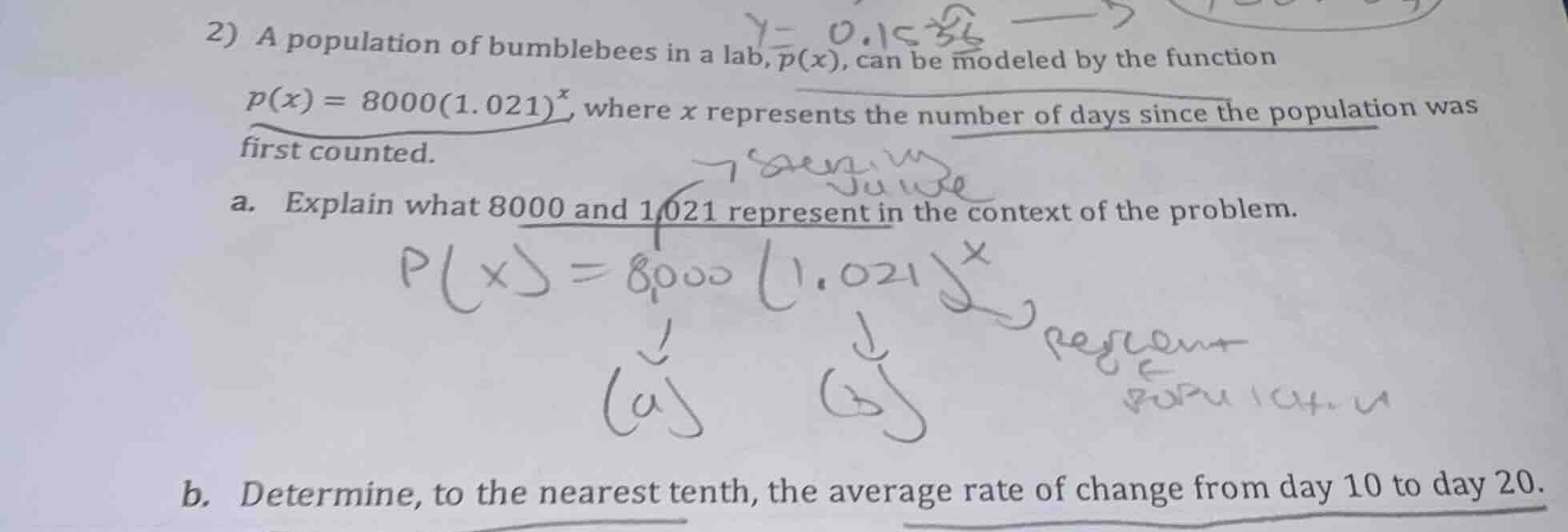
- a population of bumblebees in a lab, p(x), can be modeled by the function p(x) = 8000(1.021)^x, where x represents the number of days since the population was first counted. a. explain what 8000 and 1.021 represent in the context of the problem. b. determine, to the nearest tenth, the average rate of change from day 10 to day 20.
Part a
Step1: Interpret initial value
The value 8000 is the population when \(x=0\) (day 0, the first count).
Step2: Interpret growth factor
The value 1.021 means the population multiplies by this factor daily, so the daily growth rate is \(1.021 - 1 = 0.021 = 2.1\%\).
Part b
Step1: Calculate \(p(10)\)
Substitute \(x=10\) into \(p(x)\):
\(p(10) = 8000(1.021)^{10}\)
Calculate \(1.021^{10} \approx 1.2319\), so \(p(10) \approx 8000 \times 1.2319 = 9855.2\)
Step2: Calculate \(p(20)\)
Substitute \(x=20\) into \(p(x)\):
\(p(20) = 8000(1.021)^{20}\)
Calculate \(1.021^{20} \approx 1.5176\), so \(p(20) \approx 8000 \times 1.5176 = 12140.8\)
Step3: Compute average rate of change
Use the formula \(\frac{p(20)-p(10)}{20-10}\):
\(\frac{12140.8 - 9855.2}{10} = \frac{2285.6}{10} = 228.6\)

Snap & solve any problem in the app
Get step-by-step solutions on Sovi AI
Photo-based solutions with guided steps
Explore more problems and detailed explanations
a. 8000 represents the initial population of bumblebees on the day the population was first counted (day 0). 1.021 represents the daily growth factor, meaning the population increases by 2.1% each day.
b. 228.6