QUESTION IMAGE
Question
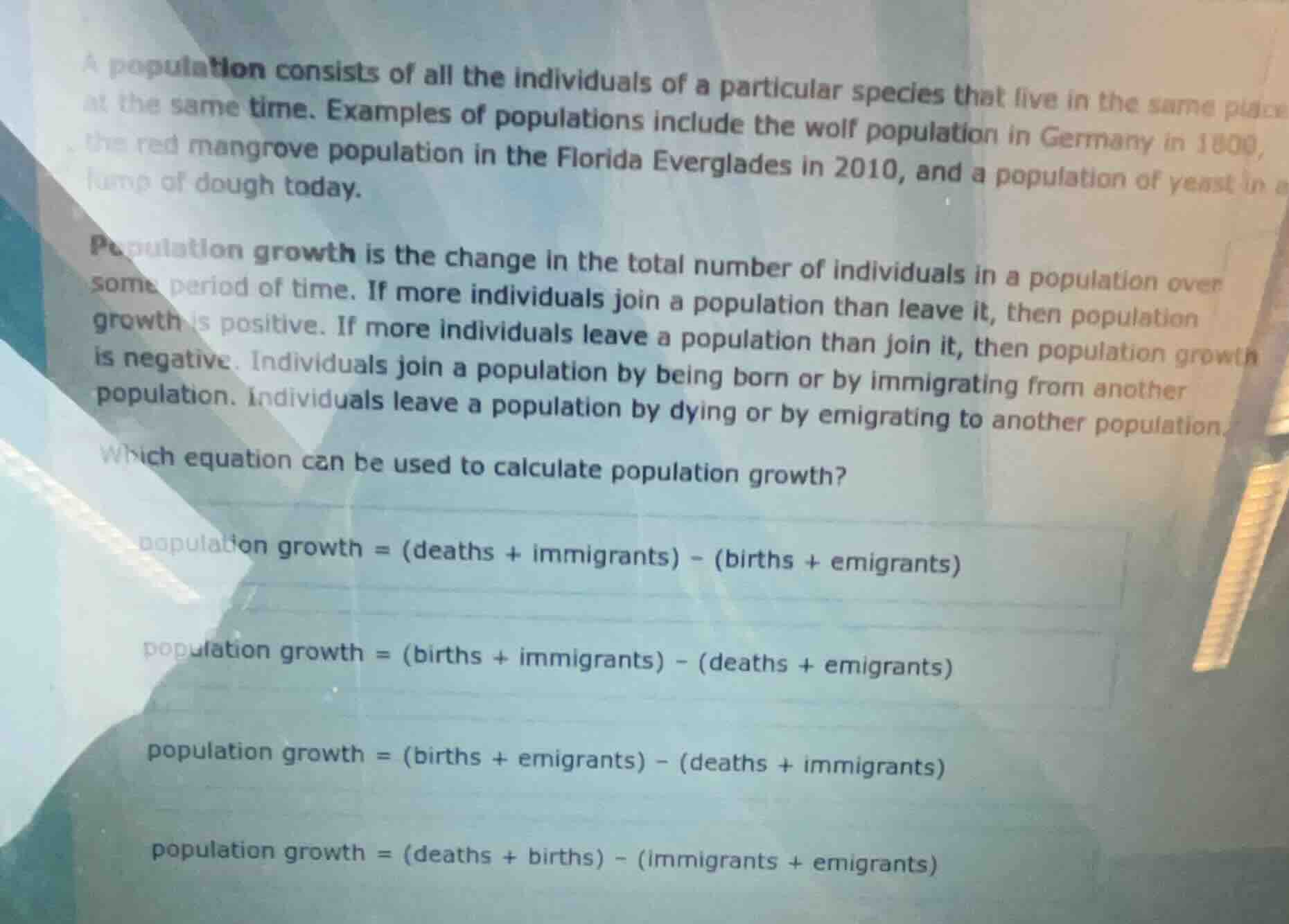
a population consists of all the individuals of a particular species that live in the same place at the same time. examples of populations include the wolf population in germany in 1800, the red mangrove population in the florida everglades in 2010, and a population of yeast in a lump of dough today.
population growth is the change in the total number of individuals in a population over some period of time. if more individuals join a population than leave it, then population growth is positive. if more individuals leave a population than join it, then population growth is negative. individuals join a population by being born or by immigrating from another population. individuals leave a population by dying or by emigrating to another population.
which equation can be used to calculate population growth?
population growth = (deaths + immigrants) - (births + emigrants)
population growth = (births + immigrants) - (deaths + emigrants)
population growth = (births + emigrants) - (deaths + immigrants)
population growth = (deaths + births) - (immigrants + emigrants)
To determine the correct equation for population growth, we analyze how individuals join and leave a population. Individuals join through births (new individuals born into the population) and immigration (individuals moving into the population from elsewhere). Individuals leave through deaths (individuals dying) and emigration (individuals moving out of the population to another area).
Population growth is the net change, so we calculate the number of individuals joining (births + immigrants) and subtract the number of individuals leaving (deaths + emigrants).
Let's evaluate each option:
- Option 1: \( \text{population growth} = (\text{deaths} + \text{immigrants}) - (\text{births} + \text{emigrants}) \) – This incorrectly uses deaths (a leaving factor) as a joining factor and subtracts births (a joining factor), so it's wrong.
- Option 2: \( \text{population growth} = (\text{births} + \text{immigrants}) - (\text{deaths} + \text{emigrants}) \) – This correctly adds the joining factors (births + immigrants) and subtracts the leaving factors (deaths + emigrants), which matches the concept of population growth.
- Option 3: \( \text{population growth} = (\text{births} + \text{emigrants}) - (\text{deaths} + \text{immigrants}) \) – Emigration is a leaving factor, so adding it to births (a joining factor) and subtracting immigrants (a joining factor) is incorrect.
- Option 4: \( \text{population growth} = (\text{deaths} + \text{births}) - (\text{immigrants} + \text{emigrants}) \) – This mixes joining (births) and leaving (deaths) factors in the first term and joining (immigrants) and leaving (emigrants) factors in the second term, which is incorrect.

Snap & solve any problem in the app
Get step-by-step solutions on Sovi AI
Photo-based solutions with guided steps
Explore more problems and detailed explanations
\( \text{population growth} = (\text{births} + \text{immigrants}) - (\text{deaths} + \text{emigrants}) \) (the second option)