QUESTION IMAGE
Question
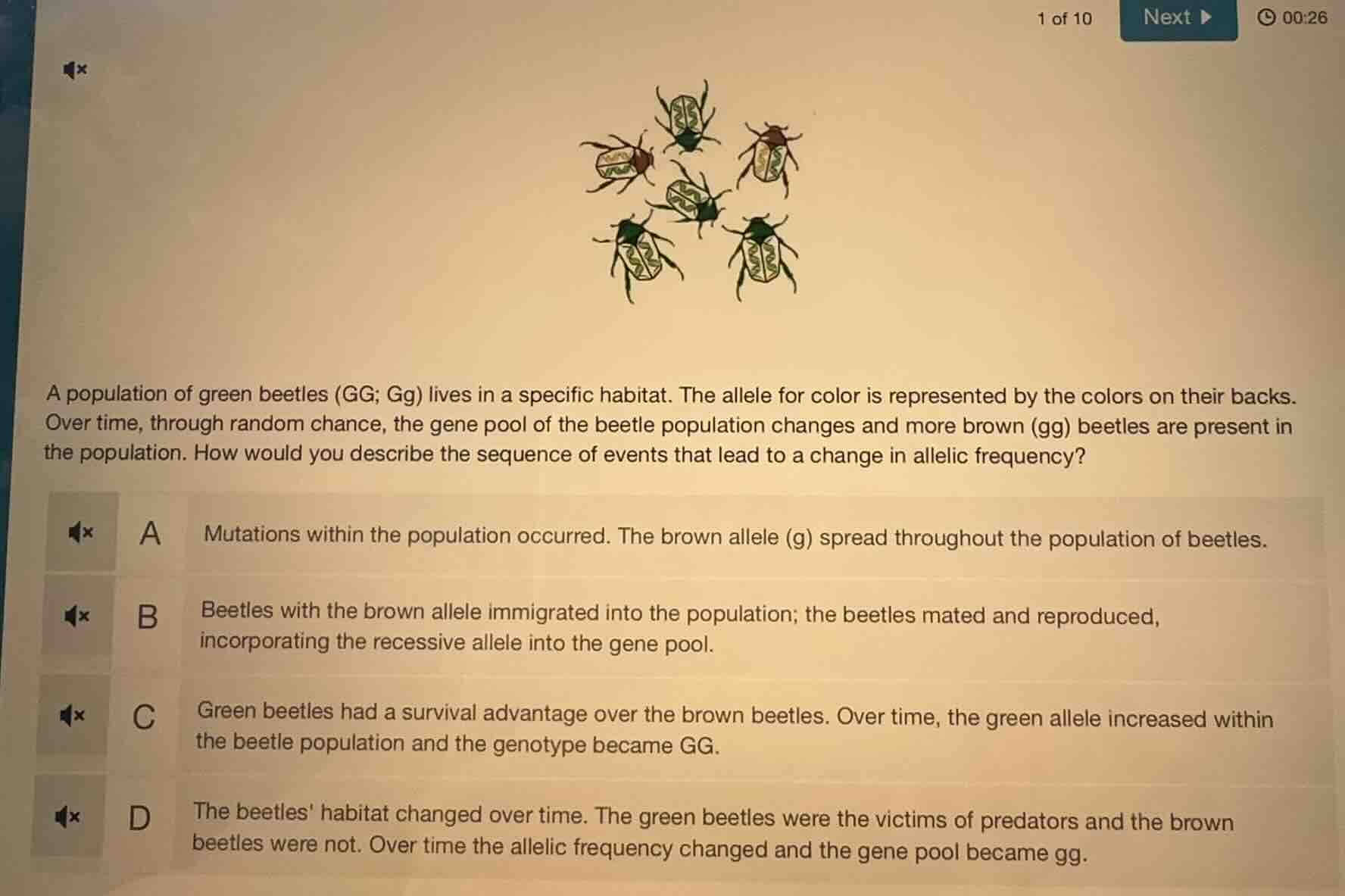
a population of green beetles (gg; gg) lives in a specific habitat. the allele for color is represented by the colors on their backs. over time, through random chance, the gene pool of the beetle population changes and more brown (gg) beetles are present in the population. how would you describe the sequence of events that lead to a change in allelic frequency? a mutations within the population occurred. the brown allele (g) spread throughout the population of beetles. b beetles with the brown allele immigrated into the population; the beetles mated and reproduced, incorporating the recessive allele into the gene pool. c green beetles had a survival advantage over the brown beetles. over time, the green allele increased within the beetle population and the genotype became gg. d the beetles habitat changed over time. the green beetles were the victims of predators and the brown beetles were not. over time the allelic frequency changed and the gene pool became gg.
- Option A: The problem states the change is due to random chance, not mutations. Mutations are not indicated here, so A is incorrect.
- Option B: The question says the change is through random chance, but immigration and subsequent mating/reproduction (gene flow) is a possible mechanism for allele frequency change. However, let's check other options.
- Option C: The problem states more brown beetles are present, but C says green allele increased, which contradicts. So C is incorrect.
- Option D: The problem says the change is due to random chance, but D describes natural selection (predation) as the cause, which is not random. So D is incorrect.
Wait, re - evaluating: The question says "through random chance", but the options don't seem to have a genetic drift option. But among the given options, B is about gene flow (immigration) which can change allele frequencies. Let's re - check the options again.
Wait, maybe I made a mistake. Let's re - analyze each option:
Option A: Mutations are not mentioned in the problem's scenario of "random chance" (genetic drift is random, mutations are not the same as genetic drift). So A is wrong.
Option B: If brown - allele - carrying beetles immigrate, mate and reproduce, that can introduce the recessive allele into the gene pool, changing allele frequencies. This is a valid mechanism (gene flow) and is a possible way allele frequencies change.
Option C: Contradicts the fact that more brown beetles are present. So C is wrong.
Option D: Describes natural selection (predation), but the problem says "through random chance", so D is wrong.
So the correct answer is B.

Snap & solve any problem in the app
Get step-by-step solutions on Sovi AI
Photo-based solutions with guided steps
Explore more problems and detailed explanations
B. Beetles with the brown allele immigrated into the population; the beetles mated and reproduced, incorporating the recessive allele into the gene pool.