QUESTION IMAGE
Question
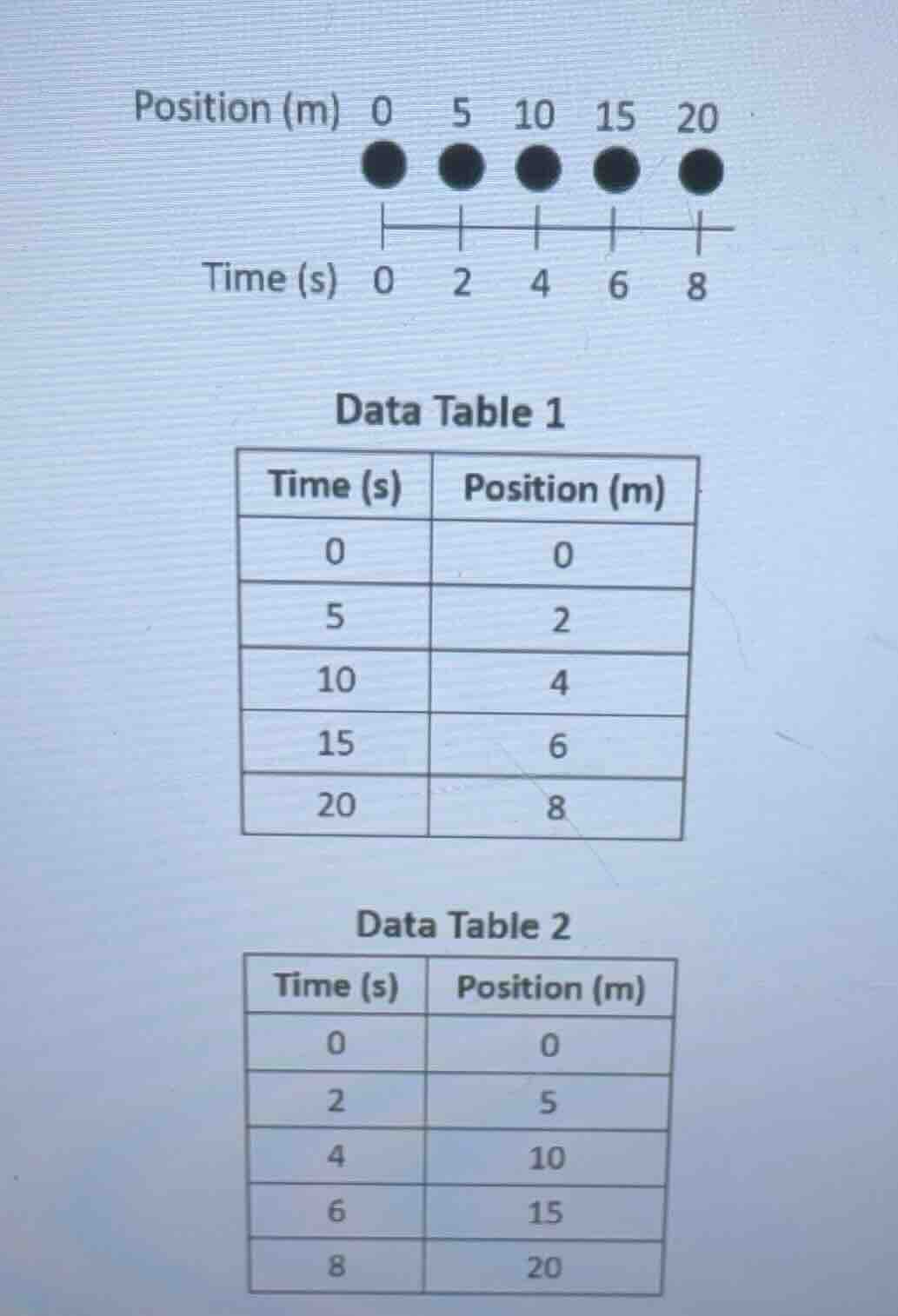
position (m) 0 5 10 15 20
time (s) 0 2 4 6 8
data table 1
time (s) | position (m)
0 | 0
5 | 2
10 | 4
15 | 6
20 | 8
data table 2
time (s) | position (m)
0 | 0
2 | 5
4 | 10
6 | 15
8 | 20
Since the problem is not clearly stated, I assume we might need to find the velocity for each data table. Let's take Data Table 2 first (the process is similar for Data Table 1).
Step1: Recall the formula for velocity
Velocity \( v \) is calculated as the change in position (\( \Delta x \)) divided by the change in time (\( \Delta t \)), i.e., \( v=\frac{\Delta x}{\Delta t} \).
Step2: Calculate \( \Delta x \) and \( \Delta t \) for Data Table 2
For Data Table 2, let's take two consecutive points, say at \( t_1 = 0 \) s, \( x_1 = 0 \) m and \( t_2 = 2 \) s, \( x_2 = 5 \) m.
\( \Delta x=x_2 - x_1=5 - 0 = 5 \) m, \( \Delta t=t_2 - t_1=2 - 0 = 2 \) s.
Step3: Calculate velocity
Using the formula \( v=\frac{\Delta x}{\Delta t} \), we get \( v=\frac{5}{2}=2.5 \) m/s. Let's check with another pair, say \( t_1 = 2 \) s, \( x_1 = 5 \) m and \( t_2 = 4 \) s, \( x_2 = 10 \) m.
\( \Delta x = 10 - 5 = 5 \) m, \( \Delta t = 4 - 2 = 2 \) s. Then \( v=\frac{5}{2}=2.5 \) m/s. So the velocity is constant at 2.5 m/s for Data Table 2.
For Data Table 1, take \( t_1 = 0 \) s, \( x_1 = 0 \) m and \( t_2 = 5 \) s, \( x_2 = 2 \) m.
\( \Delta x=2 - 0 = 2 \) m, \( \Delta t=5 - 0 = 5 \) s. Then \( v=\frac{2}{5}=0.4 \) m/s. Checking another pair, \( t_1 = 5 \) s, \( x_1 = 2 \) m and \( t_2 = 10 \) s, \( x_2 = 4 \) m.
\( \Delta x = 4 - 2 = 2 \) m, \( \Delta t = 10 - 5 = 5 \) s. So \( v=\frac{2}{5}=0.4 \) m/s, constant velocity of 0.4 m/s.

Snap & solve any problem in the app
Get step-by-step solutions on Sovi AI
Photo-based solutions with guided steps
Explore more problems and detailed explanations
For Data Table 1, velocity is \( \boldsymbol{0.4} \) m/s. For Data Table 2, velocity is \( \boldsymbol{2.5} \) m/s.