QUESTION IMAGE
Question
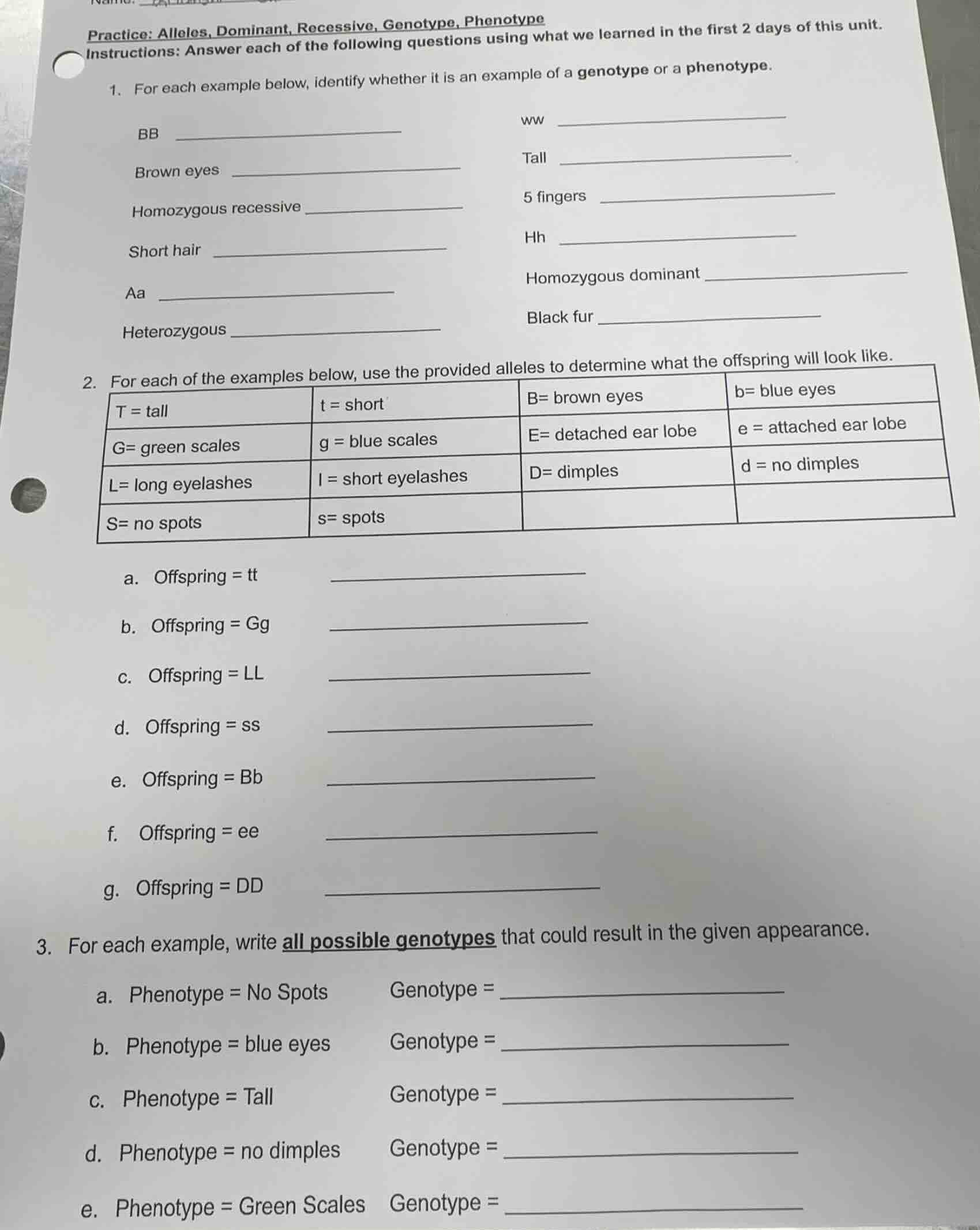
practice: alleles, dominant, recessive, genotype, phenotype
instructions: answer each of the following questions using what we learned in the first 2 days of this unit.
- for each example below, identify whether it is an example of a genotype or a phenotype.
bb
brown eyes
homozygous recessive
short hair
aa
heterozygous
ww
tall
5 fingers
hh
homozygous dominant
black fur
- for each of the examples below, use the provided alleles to determine what the offspring will look like.
| t = tall | t = short | b= brown eyes | b= blue eyes |
| g= green scales | g = blue scales | e= detached ear lobe | e = attached ear lobe |
| l= long eyelashes | l = short eyelashes | d= dimples | d = no dimples |
| s= no spots | s= spots |
a. offspring = tt
b. offspring = gg
c. offspring = ll
d. offspring = ss
e. offspring = bb
f. offspring = ee
g. offspring = dd
- for each example, write all possible genotypes that could result in the given appearance.
a. phenotype = no spots \tgenotype =
b. phenotype = blue eyes \tgenotype =
c. phenotype = tall \t\tgenotype =
d. phenotype = no dimples \tgenotype =
e. phenotype = green scales \tgenotype =
Question 1 Solutions:
To determine if an example is a genotype or phenotype, recall:
- Genotype: Genetic makeup (allele combinations, e.g., \( BB \), \( ww \), \( Aa \)).
- Phenotype: Physical/trait expression (e.g., “Brown eyes,” “Tall,” “Short hair”).
| Example | Classification | Reason |
|---|---|---|
| \( ww \) | Genotype | Allele combination. |
| Brown eyes | Phenotype | Physical trait (eye color). |
| Tall | Phenotype | Physical trait (height). |
| Homozygous recessive | Genotype | Describes allele combination. |
| 5 fingers | Phenotype | Physical trait (digit count). |
| Short hair | Phenotype | Physical trait (hair length). |
| \( Hh \) | Genotype | Allele combination. |
| \( Aa \) | Genotype | Allele combination. |
| Homozygous dominant | Genotype | Describes allele combination. |
| Heterozygous | Genotype | Describes allele combination. |
| Black fur | Phenotype | Physical trait (fur color). |
Question 2 Solutions:
Use the allele key (e.g., \( T = \text{tall} \), \( t = \text{short} \)) to determine the phenotype from the genotype:
| Offspring Genotype | Phenotype (Trait) | Reason (Allele Key) |
|---|---|---|
| \( \text{b. } Gg \) | Green scales | \( G = \text{green scales} \) (dominant allele expressed). |
| \( \text{c. } LL \) | Long eyelashes | \( L = \text{long eyelashes} \), homozygous dominant. |
| \( \text{d. } ss \) | Spots | \( s = \text{spots} \), homozygous recessive. |
| \( \text{e. } Bb \) | Brown eyes | \( B = \text{brown eyes} \) (dominant allele expressed). |
| \( \text{f. } ee \) | Attached ear lobe | \( e = \text{attached ear lobe} \), homozygous recessive. |
| \( \text{g. } DD \) | Dimples | \( D = \text{dimples} \), homozygous dominant. |
Question 3 Solutions:
To find possible genotypes for a phenotype, use dominance rules (dominant allele masks recessive):
| Phenotype | Possible Genotypes | Reason (Allele Key) |
|---|---|---|
| \( \text{b. Blue eyes} \) | \( bb \) | \( b = \text{blue eyes} \) (recessive). Only \( bb \) (homozygous recessive) shows blue eyes (dominant \( B \) masks \( b \)). |
| \( \text{c. Tall} \) | \( TT \), \( Tt \) | \( T = \text{tall} \) (dominant). \( TT \) (homozygous) or \( Tt \) (heterozygous) express “Tall” (recessive \( t \) is masked). |
| \( \text{d. No dimples} \) | \( dd \) | \( d = \text{no dimples} \) (recessive). Only \( dd \) (homozygous recessive) shows no dimples (dominant \( D \) masks \( d \)). |
| \( \text{e. Green Scales} \) | \( GG \), \( Gg \) | \( G = \text{green scales} \) (dominant). \( GG \) (homozygous)… |

Snap & solve any problem in the app
Get step-by-step solutions on Sovi AI
Photo-based solutions with guided steps
Explore more problems and detailed explanations
Question 1 Solutions:
To determine if an example is a genotype or phenotype, recall:
- Genotype: Genetic makeup (allele combinations, e.g., \( BB \), \( ww \), \( Aa \)).
- Phenotype: Physical/trait expression (e.g., “Brown eyes,” “Tall,” “Short hair”).
| Example | Classification | Reason |
|---|---|---|
| \( ww \) | Genotype | Allele combination. |
| Brown eyes | Phenotype | Physical trait (eye color). |
| Tall | Phenotype | Physical trait (height). |
| Homozygous recessive | Genotype | Describes allele combination. |
| 5 fingers | Phenotype | Physical trait (digit count). |
| Short hair | Phenotype | Physical trait (hair length). |
| \( Hh \) | Genotype | Allele combination. |
| \( Aa \) | Genotype | Allele combination. |
| Homozygous dominant | Genotype | Describes allele combination. |
| Heterozygous | Genotype | Describes allele combination. |
| Black fur | Phenotype | Physical trait (fur color). |
Question 2 Solutions:
Use the allele key (e.g., \( T = \text{tall} \), \( t = \text{short} \)) to determine the phenotype from the genotype:
| Offspring Genotype | Phenotype (Trait) | Reason (Allele Key) |
|---|---|---|
| \( \text{b. } Gg \) | Green scales | \( G = \text{green scales} \) (dominant allele expressed). |
| \( \text{c. } LL \) | Long eyelashes | \( L = \text{long eyelashes} \), homozygous dominant. |
| \( \text{d. } ss \) | Spots | \( s = \text{spots} \), homozygous recessive. |
| \( \text{e. } Bb \) | Brown eyes | \( B = \text{brown eyes} \) (dominant allele expressed). |
| \( \text{f. } ee \) | Attached ear lobe | \( e = \text{attached ear lobe} \), homozygous recessive. |
| \( \text{g. } DD \) | Dimples | \( D = \text{dimples} \), homozygous dominant. |
Question 3 Solutions:
To find possible genotypes for a phenotype, use dominance rules (dominant allele masks recessive):
| Phenotype | Possible Genotypes | Reason (Allele Key) |
|---|---|---|
| \( \text{b. Blue eyes} \) | \( bb \) | \( b = \text{blue eyes} \) (recessive). Only \( bb \) (homozygous recessive) shows blue eyes (dominant \( B \) masks \( b \)). |
| \( \text{c. Tall} \) | \( TT \), \( Tt \) | \( T = \text{tall} \) (dominant). \( TT \) (homozygous) or \( Tt \) (heterozygous) express “Tall” (recessive \( t \) is masked). |
| \( \text{d. No dimples} \) | \( dd \) | \( d = \text{no dimples} \) (recessive). Only \( dd \) (homozygous recessive) shows no dimples (dominant \( D \) masks \( d \)). |
| \( \text{e. Green Scales} \) | \( GG \), \( Gg \) | \( G = \text{green scales} \) (dominant). \( GG \) (homozygous) or \( Gg \) (heterozygous) express “Green Scales” (recessive \( g \) is masked). |
Final Answers (Summarized):
Question 1:
- \( BB \): Genotype
- \( ww \): Genotype
- Brown eyes: Phenotype
- Tall: Phenotype
- Homozygous recessive: Genotype
- 5 fingers: Phenotype
- Short hair: Phenotype
- \( Hh \): Genotype
- \( Aa \): Genotype
- Homozygous dominant: Genotype
- Heterozygous: Genotype
- Black fur: Phenotype
Question 2:
- a. \( tt \): Short
- b. \( Gg \): Green scales
- c. \( LL \): Long eyelashes
- d. \( ss \): Spots
- e. \( Bb \): Brown eyes
- f. \( ee \): Attached ear lobe
- g. \( DD \): Dimples
Question 3:
- a. No Spots: \( SS \), \( Ss \)
- b. Blue eyes: \( bb \)
- c. Tall: \( TT \), \( Tt \)
- d. No dimples: \( dd \)
- e. Green Scales: \( GG \), \( Gg \)