QUESTION IMAGE
Question
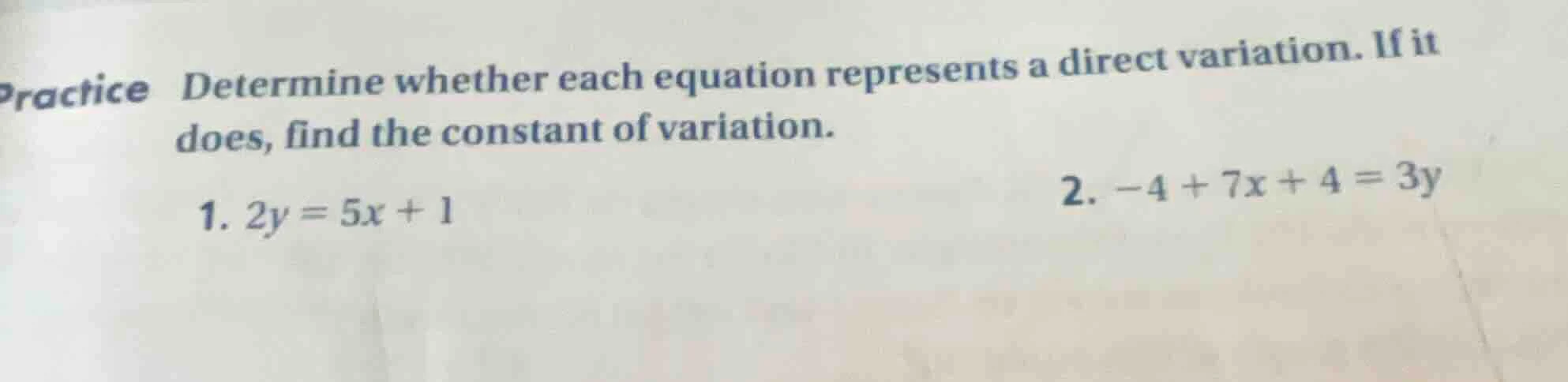
practice determine whether each equation represents a direct variation. if it does, find the constant of variation. 1. $2y = 5x + 1$ 2. $-4 + 7x + 4 = 3y$
Problem 1: \( 2y = 5x + 1 \)
Step 1: Recall direct variation form
The form of a direct variation is \( y = kx \), where \( k \) is the constant of variation (and \( k
eq0 \)), and there is no constant term. First, solve the given equation for \( y \).
Divide both sides of \( 2y = 5x + 1 \) by 2:
\( y=\frac{5}{2}x+\frac{1}{2} \)
Step 2: Check direct variation
Since the equation has a constant term \( \frac{1}{2} \), it does not match the form \( y = kx \) (which has no constant term). So, \( 2y = 5x + 1 \) does not represent a direct variation.
Problem 2: \( -4 + 7x + 4 = 3y \)
Step 1: Simplify the equation
Simplify the left - hand side of \( -4 + 7x + 4 = 3y \). The \( -4 \) and \( +4 \) cancel out:
\( 7x=3y \)
Step 2: Solve for \( y \) in terms of \( x \)
Divide both sides of \( 7x = 3y \) by 3:
\( y=\frac{7}{3}x \)
Step 3: Identify direct variation and constant of variation
The equation \( y=\frac{7}{3}x \) is in the form \( y = kx \), where \( k=\frac{7}{3} \). So, this equation represents a direct variation, and the constant of variation \( k=\frac{7}{3} \).

Snap & solve any problem in the app
Get step-by-step solutions on Sovi AI
Photo-based solutions with guided steps
Explore more problems and detailed explanations
s:
- The equation \( 2y = 5x + 1 \) does not represent a direct variation.
- The equation \( -4 + 7x + 4 = 3y \) represents a direct variation, and the constant of variation is \( \frac{7}{3} \).