QUESTION IMAGE
Question
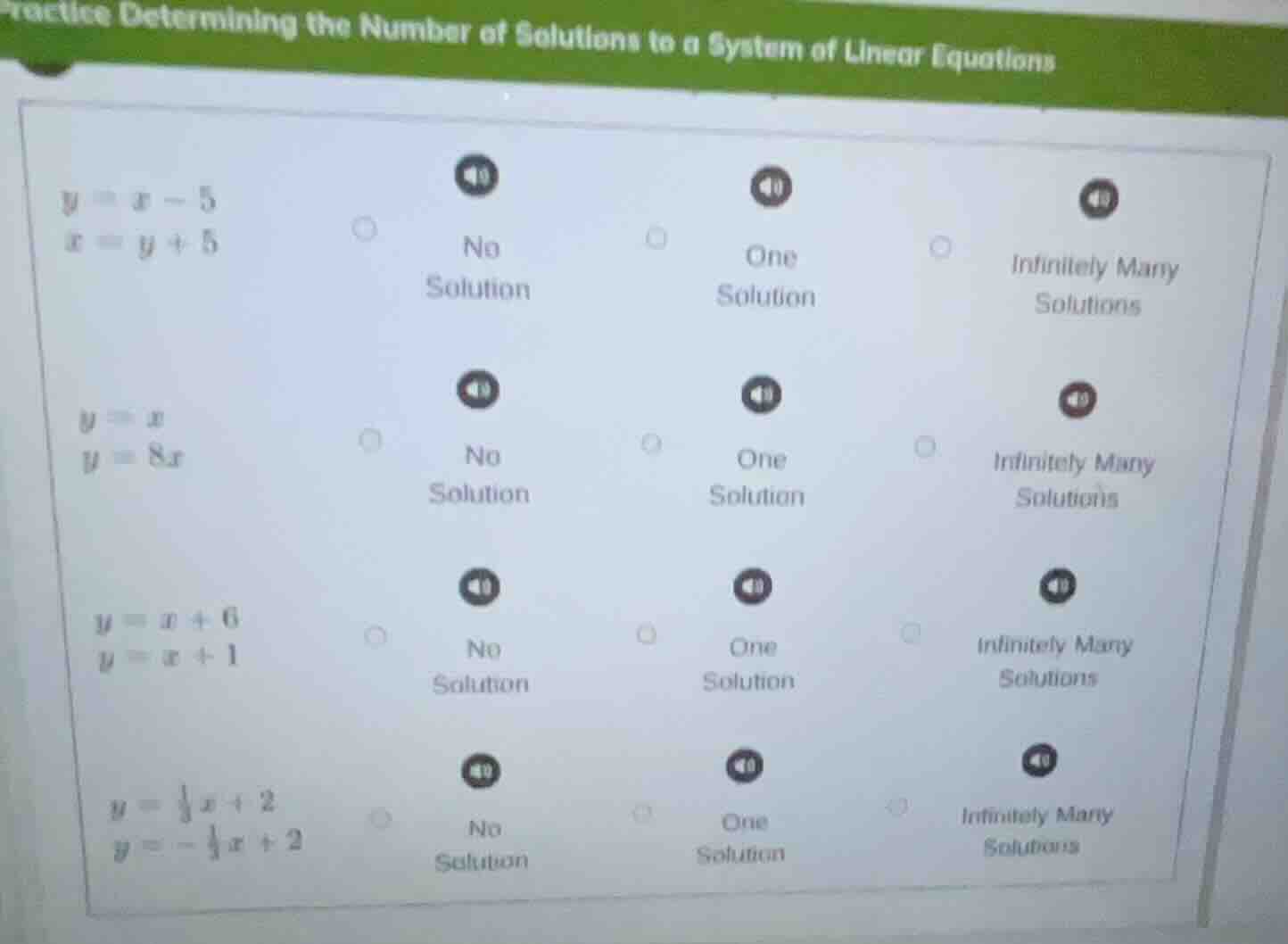
practice determining the number of solutions to a system of linear equations
- ( y = x - 5 )
( x = y + 5 )
(circ) no solution (circ) one solution (circ) infinitely many solutions
- ( y = x )
( y = 8x )
(circ) no solution (circ) one solution (circ) infinitely many solutions
- ( y = x + 6 )
( y = x + 1 )
(circ) no solution (circ) one solution (circ) infinitely many solutions
- ( y = \frac{1}{3}x + 2 )
( y = -\frac{1}{3}x + 2 )
(circ) no solution (circ) one solution (circ) infinitely many solutions
First System: \( y = x - 5 \) and \( x = y + 5 \)
Step1: Rewrite the second equation
Rewrite \( x = y + 5 \) as \( y = x - 5 \) (subtract 5 from both sides).
Step2: Compare with the first equation
The first equation is \( y = x - 5 \), so both equations are identical.
Step1: Substitute \( y \) from first into second
Substitute \( y = x \) into \( y = 8x \), we get \( x = 8x \).
Step2: Solve for \( x \)
Subtract \( x \) from both sides: \( 0 = 7x \), so \( x = 0 \). Then \( y = 0 \).
Step1: Subtract the two equations
Subtract \( y = x + 1 \) from \( y = x + 6 \): \( 0 = 5 \), which is false.
Step2: Determine the number of solutions
Since the equation is false, there are no solutions.

Snap & solve any problem in the app
Get step-by-step solutions on Sovi AI
Photo-based solutions with guided steps
Explore more problems and detailed explanations
Infinitely Many Solutions