QUESTION IMAGE
Question
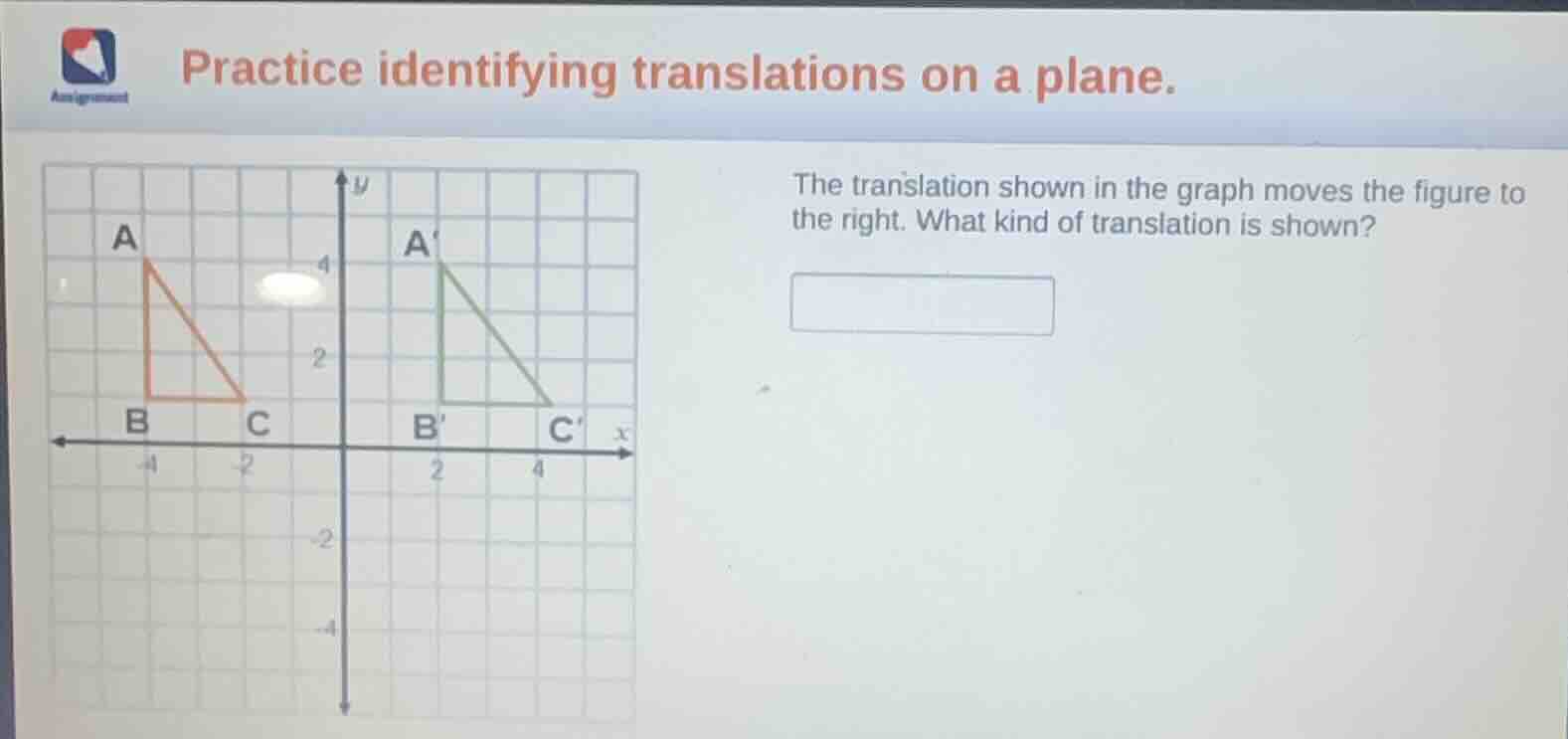
practice identifying translations on a plane. the translation shown in the graph moves the figure to the right. what kind of translation is shown?
To determine the translation, we analyze the coordinates of corresponding points. Let's take point \( B(-4, 0) \) and its image \( B'(2, 0) \). The horizontal change (x - coordinate) is \( 2 - (-4) = 6 \)? Wait, no, wait. Wait, looking at the grid, from \( x = -4 \) to \( x = 2 \), the change is \( 2 - (-4) = 6 \)? Wait, no, maybe I miscounted. Wait, the original triangle has \( B \) at \( x = -4 \), \( B' \) at \( x = 2 \). The difference is \( 2 - (-4) = 6 \)? Wait, no, maybe the grid squares. Wait, each grid square is 1 unit. From \( x = -4 \) to \( x = 2 \), that's 6 units? Wait, no, wait, the distance between \( -4 \) and \( 2 \) is \( 2 - (-4) = 6 \)? Wait, but maybe the translation is 6 units right? Wait, no, let's check another point. Point \( C \) is at \( x = -2 \), \( C' \) is at \( x = 4 \). \( 4 - (-2) = 6 \). So the translation is 6 units to the right? Wait, but the question is "what kind of translation is shown?" Wait, maybe it's a horizontal translation (since it moves right, along the x - axis, no vertical change, because the y - coordinates of \( A, B, C \) and \( A', B', C' \) are the same? Wait, \( A \) is at \( y = 4 \), \( A' \) is at \( y = 4 \). \( B \) is at \( y = 0 \), \( B' \) at \( y = 0 \). \( C \) at \( y = 0 \), \( C' \) at \( y = 0 \). So the vertical change is 0, horizontal change is 6 units? Wait, but maybe the problem is simpler. Wait, the translation moves the figure to the right, and since there's no vertical movement (same y - coordinates), it's a horizontal translation. Wait, or maybe the number of units. Wait, looking at the graph, from \( x = -4 \) (B) to \( x = 2 \) (B'): the difference is \( 2 - (-4) = 6 \)? Wait, no, maybe I made a mistake. Wait, the original triangle is at \( x = -4, -2 \) (for B and C), and the new is at \( x = 2, 4 \). So the horizontal shift is \( 2 - (-4) = 6 \)? Wait, but maybe the answer is a horizontal translation of 6 units to the right? Wait, but the question is "what kind of translation is shown?" Maybe it's a horizontal translation (since it's moving along the x - axis, no vertical movement). Wait, or the number of units. Wait, let's count the grid squares. From B (-4, 0) to B' (2, 0): that's 6 units to the right (since -4 + 6 = 2). Similarly, C (-2, 0) to C' (4, 0): -2 + 6 = 4. So the translation is 6 units to the right. But maybe the problem is asking for the type (horizontal) or the number of units. Wait, the question says "what kind of translation is shown?" Maybe it's a horizontal translation (since it's moving right, no vertical change) or the number of units. Wait, maybe the answer is a translation of 6 units to the right? Wait, but let's check again. The coordinates:
- \( B(-4, 0) \) to \( B'(2, 0) \): change in x: \( 2 - (-4) = 6 \), change in y: \( 0 - 0 = 0 \)
- \( C(-2, 0) \) to \( C'(4, 0) \): change in x: \( 4 - (-2) = 6 \), change in y: \( 0 - 0 = 0 \)
- \( A(-4, 4) \) to \( A'(2, 4) \): change in x: \( 2 - (-4) = 6 \), change in y: \( 4 - 4 = 0 \)
So the translation vector is \( (6, 0) \), meaning 6 units to the right (horizontal translation, 6 units right, 0 units up/down). So the translation is a horizontal translation of 6 units to the right, or simply a horizontal translation (since it moves along the x - axis with no vertical movement). But the question is "what kind of translation is shown?" So probably, since it moves right (horizontal direction) and no vertical movement, it's a horizontal translation (or a translation 6 units to the right). Wait, maybe the answer is a translation of 6 units to the right, or a horizontal translation. Bu…

Snap & solve any problem in the app
Get step-by-step solutions on Sovi AI
Photo-based solutions with guided steps
Explore more problems and detailed explanations
The translation shown is a horizontal translation (or a translation of 6 units to the right, but since the question says "what kind of", likely horizontal translation as it moves along the x - axis with no vertical change). Wait, but maybe the answer is 6 units to the right. Wait, let's confirm the coordinates:
- \( B \): (-4, 0)
- \( B' \): (2, 0)
- The change in x - coordinate: \( 2 - (-4) = 6 \)
- Change in y - coordinate: \( 0 - 0 = 0 \)
So the translation vector is \( (6, 0) \), meaning 6 units to the right (horizontal translation, 6 units right). So the answer is a translation of 6 units to the right (or horizontal translation 6 units right).