QUESTION IMAGE
Question
practice: lewis structures
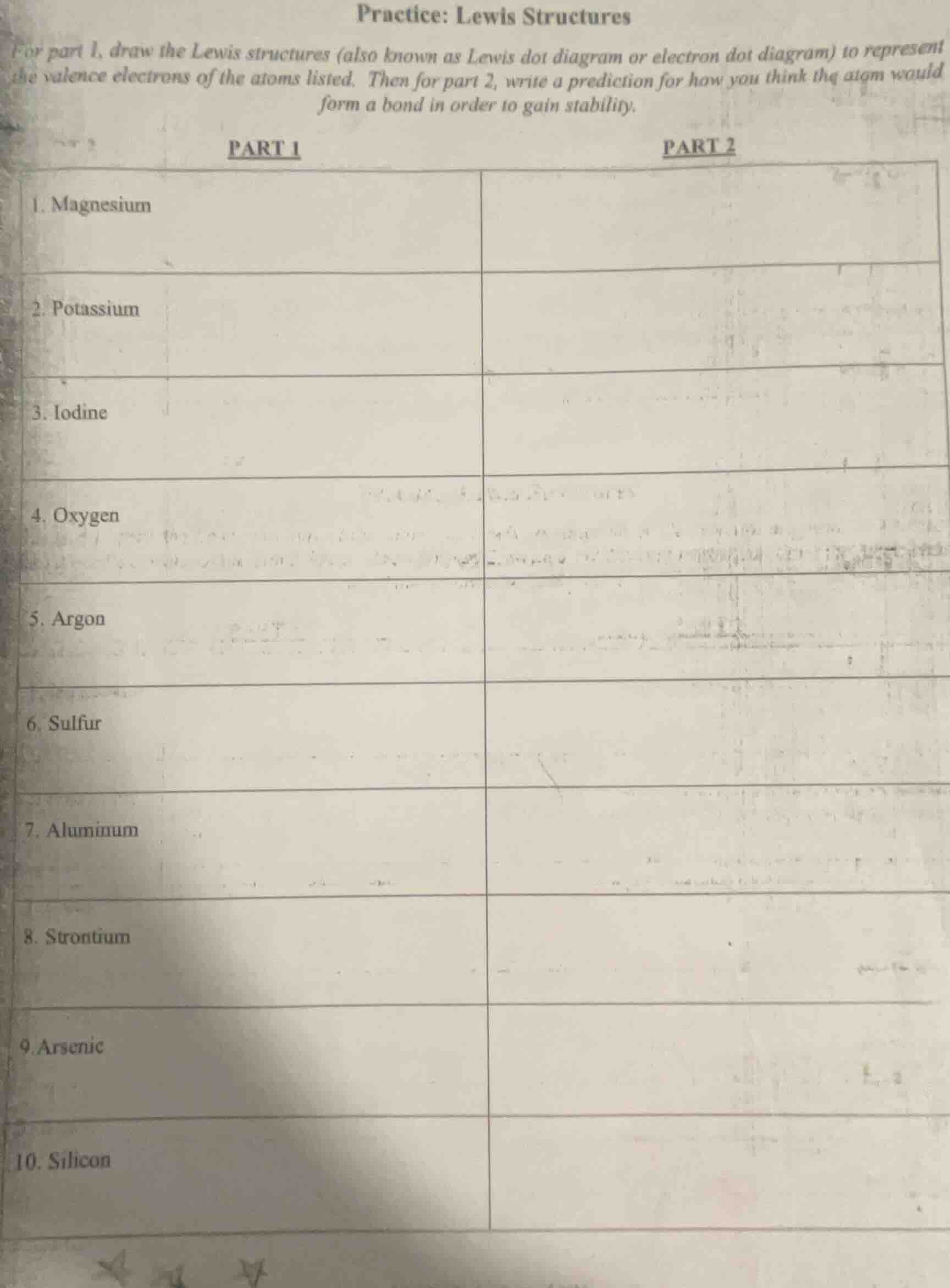
for part 1, draw the lewis structures (also known as lewis dot diagram or electron dot diagram) to represent
the valence electrons of the atoms listed. then for part 2, write a prediction for how you think the atom would
form a bond in order to gain stability.
| part 1 | part 2 |
|---|---|
| 2. potassium | |
| 3. iodine | |
| 4. oxygen | |
| 5. argon | |
| 6. sulfur | |
| 7. aluminum | |
| 8. strontium | |
| 9. arsenic | |
| 10. silicon |
Brief Explanations
For each atom, the Lewis structure shows the chemical symbol with valence electrons as dots. Bonding predictions follow the octet rule (atoms gain/lose/share electrons to get 8 valence electrons, or 2 for Group 1/2).

Snap & solve any problem in the app
Get step-by-step solutions on Sovi AI
Photo-based solutions with guided steps
Explore more problems and detailed explanations
| Part 1 (Lewis Structure) | Part 2 (Bonding Prediction) |
|---|---|
| 2. $\text{K} \cdot$ | Lose 1 electron to form ionic bonds |
| 3. $\cdot \ddot{\text{I}} :$ | Gain 1 electron to form ionic bonds, or share electrons in covalent bonds |
| 4. $\cdot \ddot{\text{O}} \cdot$ | Gain 2 electrons to form ionic bonds, or share 2 electrons in covalent bonds |
| 5. $: \ddot{\text{Ar}} :$ | No bonding; already stable (full octet) |
| 6. $\cdot \ddot{\text{S}} \cdot$ | Gain 2 electrons to form ionic bonds, or share 2 electrons in covalent bonds |
| 7. $\cdot \text{Al} \cdot \cdot$ | Lose 3 electrons to form ionic bonds |
| 8. $\text{Sr} \cdot \cdot$ | Lose 2 electrons to form ionic bonds |
| 9. $\cdot \ddot{\text{As}} \cdot$ | Gain 3 electrons to form ionic bonds, or share 3 electrons in covalent bonds |
| 10. $\cdot \dot{\text{Si}} \cdot$ | Share 4 electrons to form covalent bonds |