QUESTION IMAGE
Question
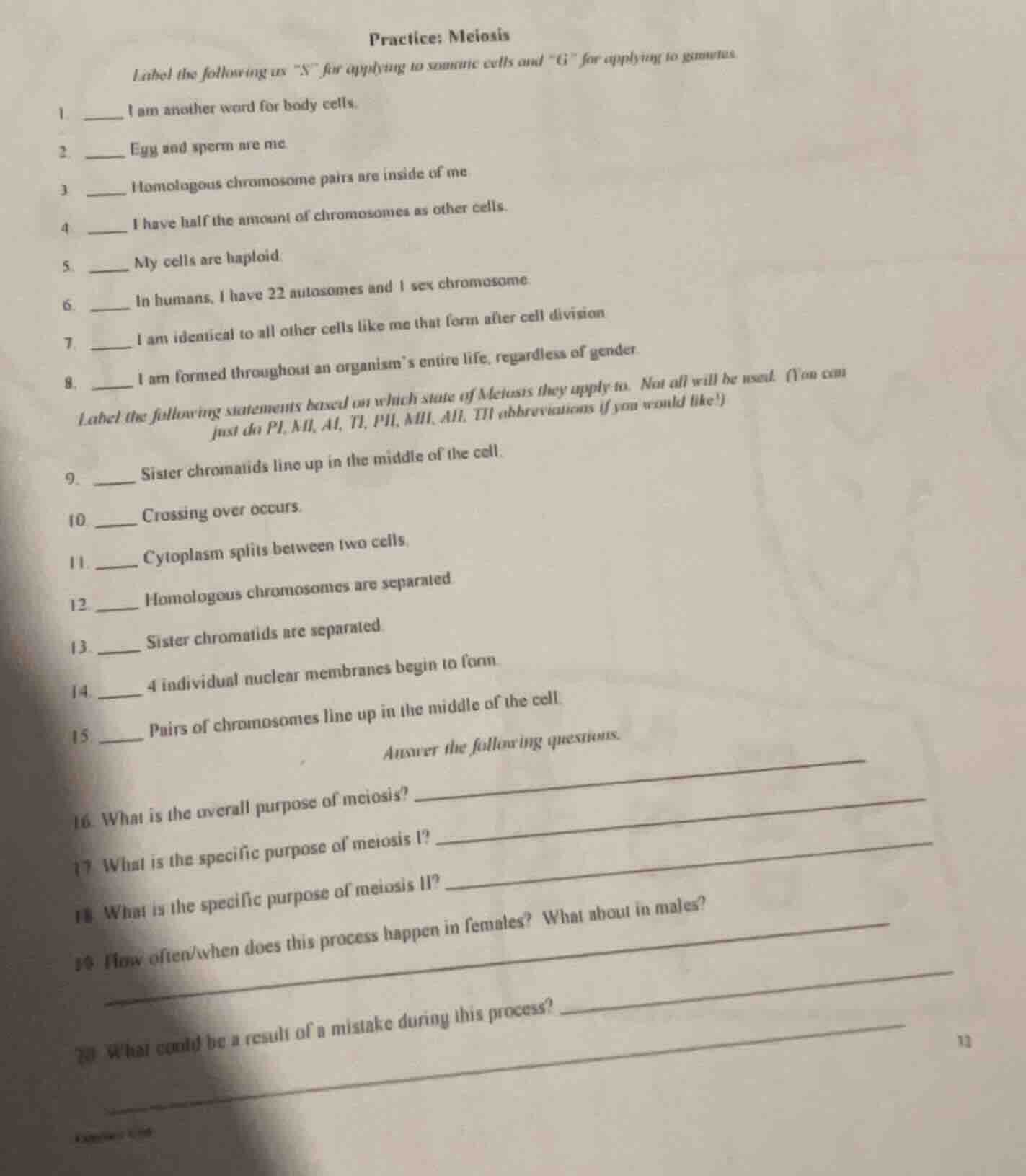
practice: meiosis
label the following as \s\ for applying to somatic cells and \g\ for applying to gametes.
- ____ i am another word for body cells.
- ____ egg and sperm are me.
- ____ homologous chromosome pairs are inside of me.
- ____ i have half the amount of chromosomes as other cells.
- ____ my cells are haploid.
- ____ in humans, i have 22 autosomes and 1 sex chromosome.
- ____ i am identical to all other cells like me that form after cell division
- ____ i am formed throughout an organisms entire life, regardless of gender.
label the following statements based on which stage of meiosis they apply to. not all will be used. (you can just do pi, mii, ai, ti, pii, miii, aii, tii abbreviations if you would like!)
- ____ sister chromatids line up in the middle of the cell.
- ____ crossing over occurs.
- ____ cytoplasm splits between two cells.
- ____ homologous chromosomes are separated.
- ____ sister chromatids are separated.
- ____ 4 individual nuclear membranes begin to form.
- ____ pairs of chromosomes line up in the middle of the cell.
answer the following questions.
- what is the overall purpose of meiosis? _________________________________________
- what is the specific purpose of meiosis i? _______________________________________
- what is the specific purpose of meiosis ii? _______________________________________
- how often/when does this process happen in females? what about in males?
________________________________________________________________________________
- what could be a result of a mistake during this process? ___________________________
Brief Explanations
Part 1 (Somatic "S" / Gamete "G")
- Body cells = somatic cells.
- Egg/sperm are reproductive gametes.
- Somatic cells have homologous pairs (diploid).
- Gametes have half the chromosome count.
- Haploid cells = gametes (1 set of chromosomes).
- Human gametes have 22 autosomes + 1 sex chromosome.
- Somatic cells divide via mitosis to make identical cells.
- Somatic cells form throughout an organism's life.
Part 2 (Meiosis Stages)
- Sister chromatids line up at metaphase of Meiosis II.
- Crossing over occurs in prophase I of Meiosis I.
- Cytoplasm splits during cytokinesis, which follows telophase I.
- Homologous chromosomes separate in anaphase I.
- Sister chromatids separate in anaphase II.
- 4 nuclear membranes form in telophase II (end of meiosis).
- Homologous pairs line up in metaphase I.
Part 3 (Short Answer Questions)
- Meiosis creates haploid gametes for sexual reproduction, introducing genetic variation.
- Meiosis I separates homologous chromosome pairs, reducing the chromosome number by half (diploid to haploid) and creating genetic variation via crossing over.
- Meiosis II separates sister chromatids, producing 4 genetically unique haploid cells from the 2 cells formed in Meiosis I.
- In females: Meiosis starts before birth, pauses, and completes only if an egg is fertilized (1 functional gamete per cycle). In males: Meiosis occurs continuously after puberty, producing millions of sperm daily.
- Errors in meiosis (nondisjunction) can lead to aneuploidy, where gametes have an abnormal number of chromosomes, resulting in conditions like Down syndrome.

Snap & solve any problem in the app
Get step-by-step solutions on Sovi AI
Photo-based solutions with guided steps
Explore more problems and detailed explanations
Part 1
- S
- G
- S
- G
- G
- G
- S
- S
Part 2
- MII
- PI
- TI
- AI
- AII
- TII
- MI
Part 3
- To produce genetically unique haploid gametes (egg/sperm) for sexual reproduction, which also introduces genetic variation in offspring.
- To separate homologous chromosome pairs, reduce the diploid cell to haploid, and generate genetic variation via crossing over.
- To separate sister chromatids, resulting in four genetically distinct haploid gamete cells.
- Females: Meiosis begins before birth, pauses in prophase I, and only completes if an egg is fertilized (1 viable gamete per cycle). Males: Meiosis occurs continuously after puberty, producing millions of sperm daily.
- Chromosomal abnormalities (like nondisjunction) leading to gametes with an incorrect number of chromosomes, which can cause conditions such as Down syndrome, Turner syndrome, or Klinefelter syndrome in offspring.