QUESTION IMAGE
Question
practice it
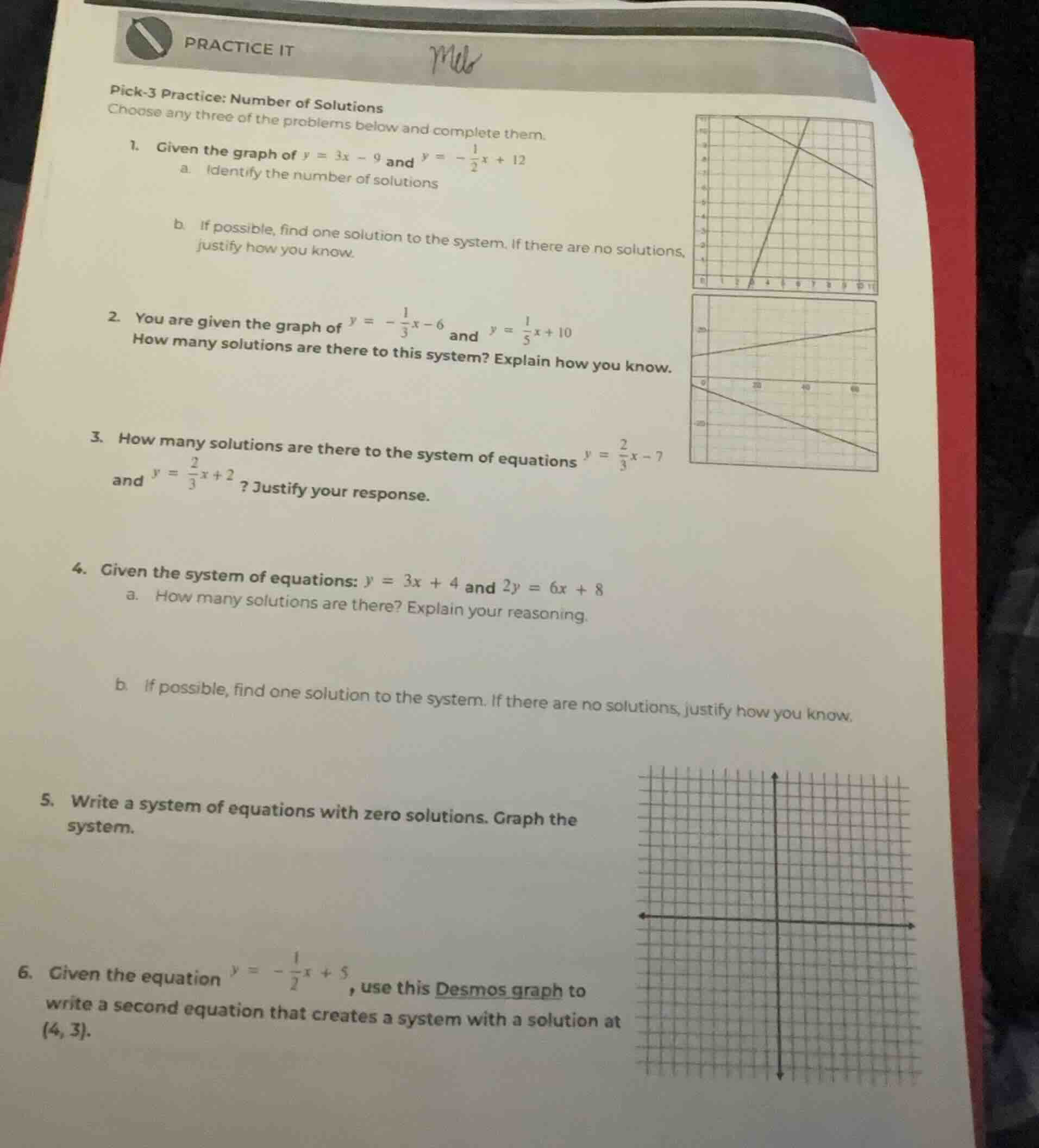
pick-3 practice: number of solutions
choose any three of the problems below and complete them.
- given the graph of ( y = 3x - 9 ) and ( y = -\frac{1}{2}x + 12 )
a. identify the number of solutions
b. if possible, find one solution to the system. if there are no solutions, justify how you know.
- you are given the graph of ( y = -\frac{1}{3}x - 6 ) and ( y = \frac{1}{5}x + 10 )
how many solutions are there to this system? explain how you know.
- how many solutions are there to the system of equations ( y = \frac{2}{3}x - 7 ) and ( y = \frac{2}{3}x + 2 )? justify your response.
- given the system of equations: ( y = 3x + 4 ) and ( 2y = 6x + 8 )
a. how many solutions are there? explain your reasoning.
b. if possible, find one solution to the system. if there are no solutions, justify how you know.
- write a system of equations with zero solutions. graph the system.
- given the equation ( y = -\frac{1}{2}x + 5 ), use this desmos graph to write a second equation that creates a system with a solution at ( (4, 3) ).
Step1: Solve problem 1a: Count intersections
The two lines intersect once, so there is 1 solution.
Step1: Solve problem 1b: Find intersection
Set equations equal: $3x - 9 = -\frac{1}{2}x + 12$
Multiply by 2: $6x - 18 = -x + 24$
Combine like terms: $7x = 42$
Solve for $x$: $x = 6$
Substitute $x=6$: $y=3(6)-9=9$
Step1: Solve problem 3: Check slopes
Both lines have slope $\frac{2}{3}$, different y-intercepts. Parallel lines never intersect, so 0 solutions.
Step1: Solve problem 4a: Simplify second equation
Divide $2y=6x+8$ by 2: $y=3x+4$, same as first equation. Coinciding lines have infinitely many solutions.
Step1: Solve problem 4b: Find a solution
Substitute $x=0$: $y=3(0)+4=4$, so $(0,4)$ is a solution.

Snap & solve any problem in the app
Get step-by-step solutions on Sovi AI
Photo-based solutions with guided steps
Explore more problems and detailed explanations
1.
a. 1 solution
b. $(6, 9)$
- 0 solutions; the lines are parallel (same slope, different y-intercepts) so they never intersect.
4.
a. Infinitely many solutions; the two equations simplify to the same line, so every point on the line is a solution.
b. One solution is $(0, 4)$ (any point satisfying $y=3x+4$ is valid)