QUESTION IMAGE
Question
practice & problem solving
practice
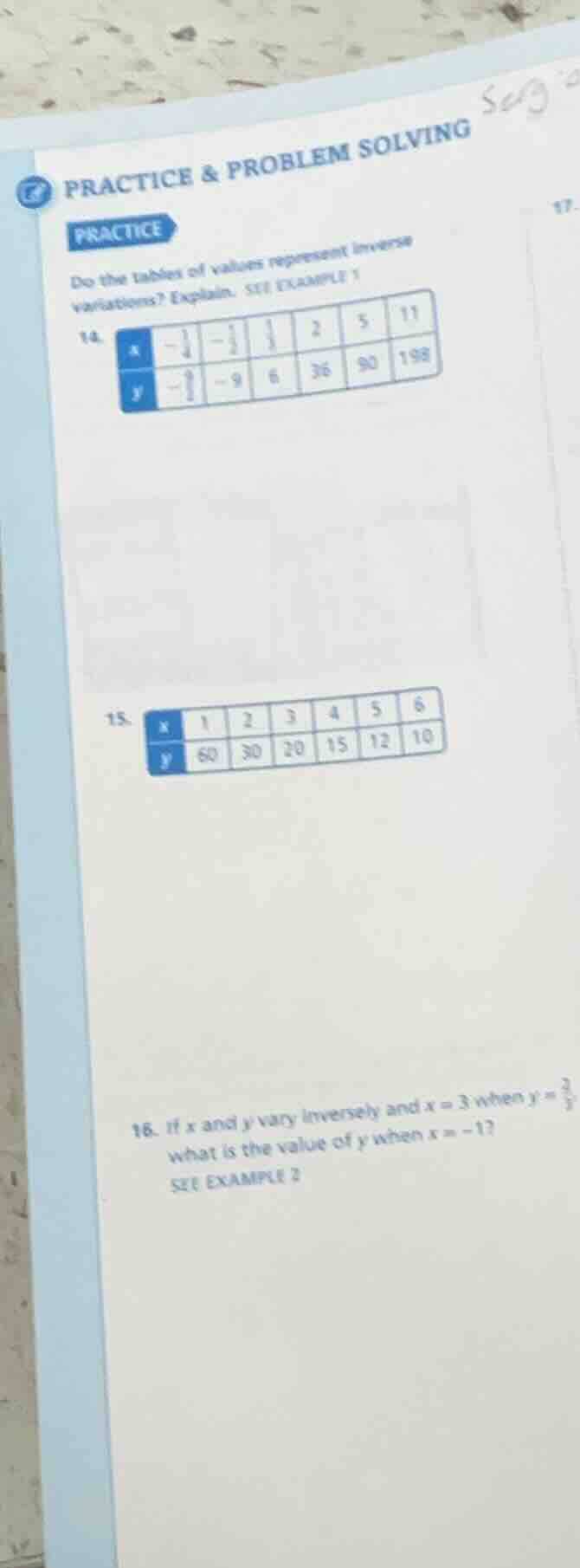
do the tables of values represent inverse variations? explain. see example 1
14.
| x | -\\(\frac{1}{4}\\) | -\\(\frac{1}{2}\\) | \\(\frac{1}{3}\\) | 2 | 5 | 11 |
| y | -\\(\frac{9}{2}\\) | -9 | 6 | 36 | 90 | 198 |
15.
| x | 1 | 2 | 3 | 4 | 5 | 6 |
| y | 60 | 30 | 20 | 15 | 12 | 10 |
- if x and y vary inversely and x = 3 when y = \\(\frac{3}{2}\\), what is the value of y when x = -1?
see example 2
Problem 14:
Step1: Recall inverse variation formula
For inverse variation, \( xy = k \) (constant) for all pairs \((x, y)\).
Step2: Calculate \( xy \) for each pair
- For \( x = -\frac{1}{4}, y = -\frac{9}{4} \): \( (-\frac{1}{4})(-\frac{9}{4}) = \frac{9}{16} \)
- For \( x = -\frac{1}{2}, y = -9 \): \( (-\frac{1}{2})(-9) = \frac{9}{2} \)
- For \( x = \frac{1}{3}, y = 6 \): \( (\frac{1}{3})(6) = 2 \)
- For \( x = 2, y = 36 \): \( (2)(36) = 72 \)
- For \( x = 5, y = 90 \): \( (5)(90) = 450 \)
- For \( x = 11, y = 198 \): \( (11)(198) = 2178 \)
Since \( xy \) is not constant, the table does not represent inverse variation.
Step1: Recall inverse variation formula
For inverse variation, \( xy = k \) (constant) for all pairs \((x, y)\).
Step2: Calculate \( xy \) for each pair
- For \( x = 1, y = 60 \): \( (1)(60) = 60 \)
- For \( x = 2, y = 30 \): \( (2)(30) = 60 \)
- For \( x = 3, y = 20 \): \( (3)(20) = 60 \)
- For \( x = 4, y = 15 \): \( (4)(15) = 60 \)
- For \( x = 5, y = 12 \): \( (5)(12) = 60 \)
- For \( x = 6, y = 10 \): \( (6)(10) = 60 \)
Since \( xy = 60 \) (constant) for all pairs, the table represents inverse variation.
Step1: Recall inverse variation formula
Inverse variation: \( xy = k \). Given \( x = 3, y = \frac{3}{2} \), find \( k \).
\( k = (3)(\frac{3}{2}) = \frac{9}{2} \)
Step2: Find \( y \) when \( x = -1 \)
Using \( xy = k \), substitute \( x = -1 \) and \( k = \frac{9}{2} \):
\( (-1)y = \frac{9}{2} \)
\( y = -\frac{9}{2} \)

Snap & solve any problem in the app
Get step-by-step solutions on Sovi AI
Photo-based solutions with guided steps
Explore more problems and detailed explanations
No, because \( xy \) is not constant for all pairs.