QUESTION IMAGE
Question
practice
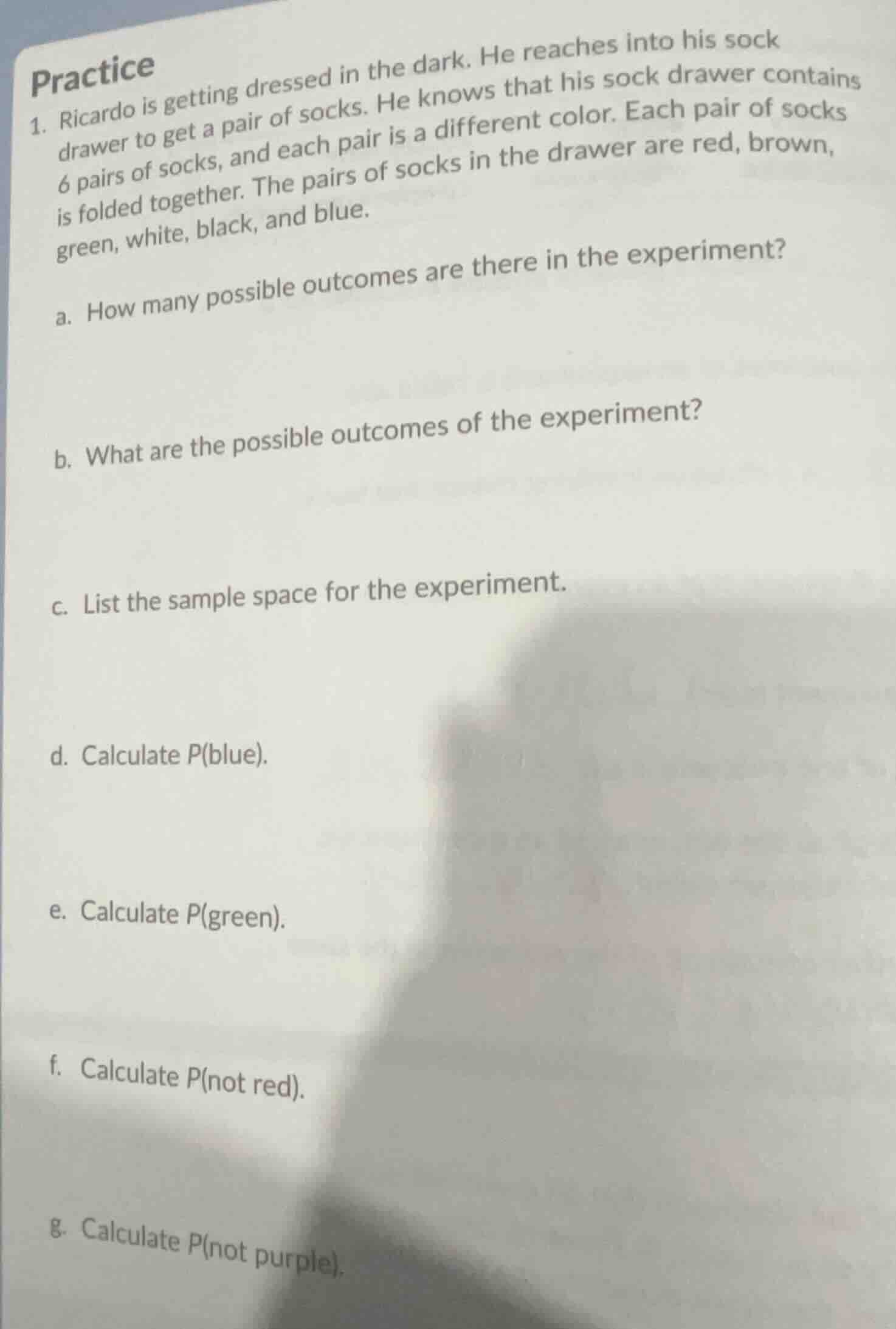
- ricardo is getting dressed in the dark. he reaches into his sock
drawer to get a pair of socks. he knows that his sock drawer contains
6 pairs of socks, and each pair is a different color. each pair of socks
is folded together. the pairs of socks in the drawer are red, brown,
green, white, black, and blue.
a. how many possible outcomes are there in the experiment?
b. what are the possible outcomes of the experiment?
c. list the sample space for the experiment.
d. calculate ( p(\text{blue}) ).
e. calculate ( p(\text{green}) ).
f. calculate ( p(\text{not red}) ).
g. calculate ( p(\text{not purple}) ).
Step1: Count total sock pairs
Total pairs = 6
Step2: Identify distinct color outcomes
Colors: red, brown, green, white, black, blue
Step3: Define sample space
List all color outcomes
Step4: Calculate P(blue)
Probability = $\frac{\text{Number of blue pairs}}{\text{Total pairs}}$ = $\frac{1}{6}$
Step5: Calculate P(green)
Probability = $\frac{\text{Number of green pairs}}{\text{Total pairs}}$ = $\frac{1}{6}$
Step6: Calculate P(not red)
Probability = $1 - \frac{\text{Number of red pairs}}{\text{Total pairs}}$ = $1 - \frac{1}{6} = \frac{5}{6}$
Step7: Calculate P(not purple)
Probability = $1 - \frac{\text{Number of purple pairs}}{\text{Total pairs}}$ = $1 - 0 = 1$

Snap & solve any problem in the app
Get step-by-step solutions on Sovi AI
Photo-based solutions with guided steps
Explore more problems and detailed explanations
a. 6
b. The possible outcomes are selecting a red pair, a brown pair, a green pair, a white pair, a black pair, or a blue pair of socks.
c. Sample space: {red, brown, green, white, black, blue}
d. $\frac{1}{6}$
e. $\frac{1}{6}$
f. $\frac{5}{6}$
g. $1$