QUESTION IMAGE
Question
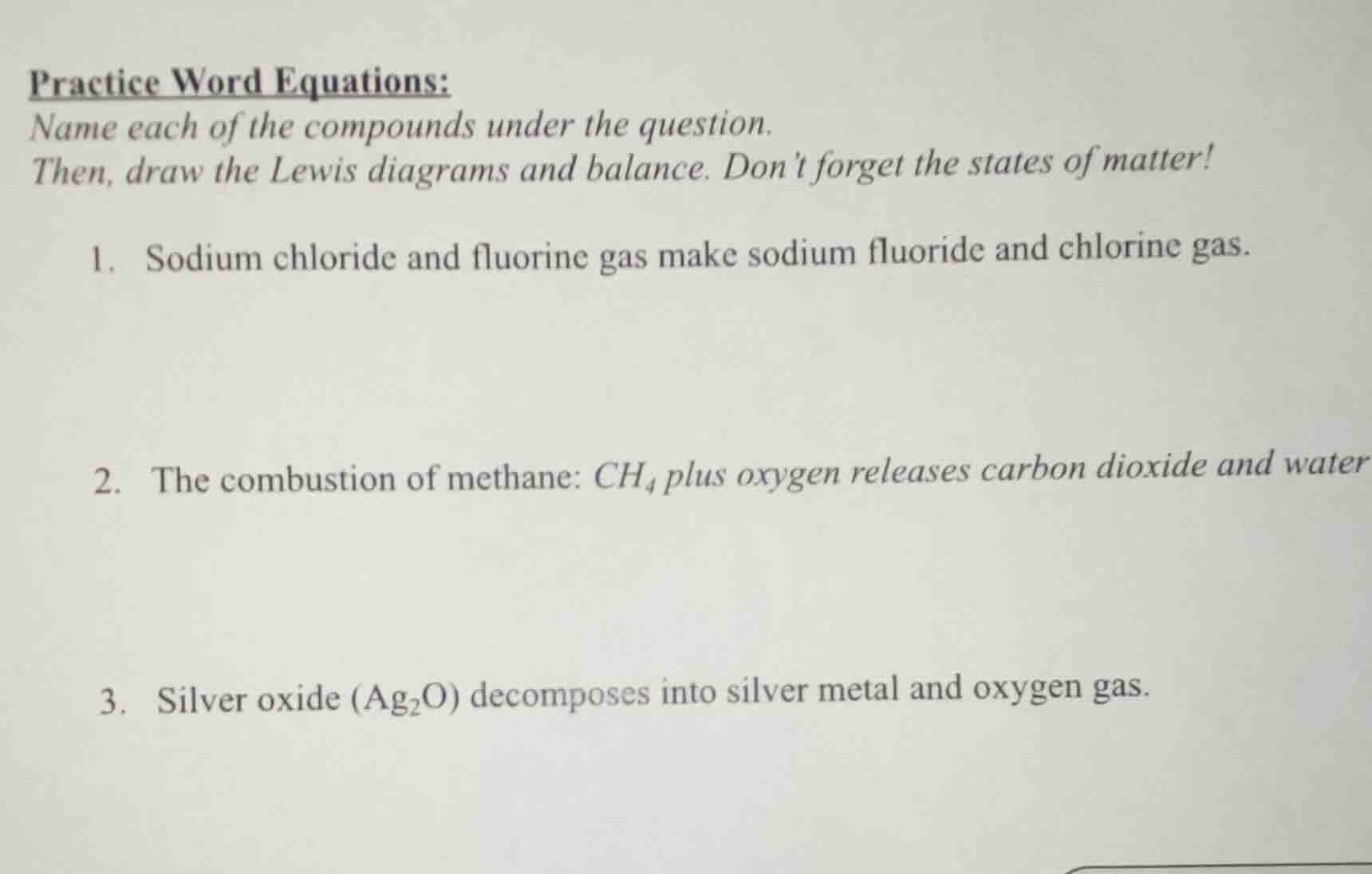
practice word equations:
name each of the compounds under the question.
then, draw the lewis diagrams and balance. dont forget the states of matter!
- sodium chloride and fluorine gas make sodium fluoride and chlorine gas.
- the combustion of methane: ch₄ plus oxygen releases carbon dioxide and water
- silver oxide (ag₂o) decomposes into silver metal and oxygen gas.
Problem 1:
Step 1: Identify Compounds and States
- Sodium chloride: \( \text{NaCl} \) (solid, \( \text{s} \))
- Fluorine gas: \( \text{F}_2 \) (gas, \( \text{g} \))
- Sodium fluoride: \( \text{NaF} \) (solid, \( \text{s} \))
- Chlorine gas: \( \text{Cl}_2 \) (gas, \( \text{g} \))
Step 2: Write Unbalanced Equation
\( \text{NaCl}(\text{s}) + \text{F}_2(\text{g})
ightarrow \text{NaF}(\text{s}) + \text{Cl}_2(\text{g}) \)
Step 3: Balance the Equation
- Balance Cl: There are 2 Cl on the right, so put 2 in front of \( \text{NaCl} \).
\( 2\text{NaCl}(\text{s}) + \text{F}_2(\text{g})
ightarrow 2\text{NaF}(\text{s}) + \text{Cl}_2(\text{g}) \)
- Check Na and F: Na: 2 on left and right; F: 2 on left and right. Balanced.
Step 4: Lewis Diagrams (Brief)
- \( \text{NaCl} \): Ionic, \( \text{Na}^+ \) and \( \text{Cl}^- \). Lewis: \( \text{Na}^+[:\ddot{\text{Cl}}:]^- \)
- \( \text{F}_2 \): Covalent, \( \text{F}::\text{F} \) (each F has 3 lone pairs)
- \( \text{NaF} \): Ionic, \( \text{Na}^+[:\ddot{\text{F}}:]^- \)
- \( \text{Cl}_2 \): Covalent, \( \text{Cl}::\text{Cl} \) (each Cl has 3 lone pairs)
Problem 2:
Step 1: Identify Compounds and States
- Methane: \( \text{CH}_4 \) (gas, \( \text{g} \))
- Oxygen gas: \( \text{O}_2 \) (gas, \( \text{g} \))
- Carbon dioxide: \( \text{CO}_2 \) (gas, \( \text{g} \))
- Water: \( \text{H}_2\text{O} \) (liquid, \( \text{l} \)) (assuming combustion, water is liquid)
Step 2: Write Unbalanced Equation
\( \text{CH}_4(\text{g}) + \text{O}_2(\text{g})
ightarrow \text{CO}_2(\text{g}) + \text{H}_2\text{O}(\text{l}) \)
Step 3: Balance the Equation
- Balance C: 1 on left and right (already balanced).
- Balance H: 4 on left, so put 2 in front of \( \text{H}_2\text{O} \).
\( \text{CH}_4(\text{g}) + \text{O}_2(\text{g})
ightarrow \text{CO}_2(\text{g}) + 2\text{H}_2\text{O}(\text{l}) \)
- Balance O: 2 on left, 2 + 2 = 4 on right. Put 2 in front of \( \text{O}_2 \).
\( \text{CH}_4(\text{g}) + 2\text{O}_2(\text{g})
ightarrow \text{CO}_2(\text{g}) + 2\text{H}_2\text{O}(\text{l}) \)
Step 4: Lewis Diagrams (Brief)
- \( \text{CH}_4 \): Tetrahedral, \( \text{H}-\text{C}-\text{H} \) (each H single bonded to C, C has no lone pairs)
- \( \text{O}_2 \): Double bond, \( \text{O}=\text{O} \) (each O has 2 lone pairs)
- \( \text{CO}_2 \): Double bonds, \( \text{O}=\text{C}=\text{O} \) (each O has 2 lone pairs)
- \( \text{H}_2\text{O} \): Bent, \( \text{H}-\text{O}-\text{H} \) (O has 2 lone pairs)
Problem 3:
Step 1: Identify Compounds and States
- Silver oxide: \( \text{Ag}_2\text{O} \) (solid, \( \text{s} \))
- Silver metal: \( \text{Ag} \) (solid, \( \text{s} \))
- Oxygen gas: \( \text{O}_2 \) (gas, \( \text{g} \))
Step 2: Write Unbalanced Equation
\( \text{Ag}_2\text{O}(\text{s})
ightarrow \text{Ag}(\text{s}) + \text{O}_2(\text{g}) \)
Step 3: Balance the Equation
- Balance O: 1 on left, 2 on right. Put 2 in front of \( \text{Ag}_2\text{O} \).
\( 2\text{Ag}_2\text{O}(\text{s})
ightarrow \text{Ag}(\text{s}) + \text{O}_2(\text{g}) \)
- Balance Ag: 4 on left, so put 4 in front of \( \text{Ag} \).
\( 2\text{Ag}_2\text{O}(\text{s})
ightarrow 4\text{Ag}(\text{s}) + \text{O}_2(\text{g}) \)
Step 4: Lewis Diagrams (Brief)
- \( \text{Ag}_2\text{O} \): Ionic, \( \text{Ag}^+ \) and \( \text{O}^{2-} \) (two \( \text{Ag}^+ \) per \( \text{O}^{2-} \))
- \( \text{Ag} \): Metallic, no Lewis diagram in the same sense (metallic bonding)
- \( \text{O}_2 \): Covalent, \( \text{O}=\text{O} \) (each O has 2 lone pairs)

Snap & solve any problem in the app
Get step-by-step solutions on Sovi AI
Photo-based solutions with guided steps
Explore more problems and detailed explanations
s:
1. Balanced Equation:
\( \boldsymbol{2\text{NaCl}(\text{s}) + \text{F}_2(\text{g}) = 2\text{NaF}(\text{s}) + \text{Cl}_2(\text{g})} \)
2. Balanced Equation:
\( \boldsymbol{\text{CH}_4(\text{g}) + 2\text{O}_2(\text{g}) = \text{CO}_2(\text{g}) + 2\text{H}_2\text{O}(\text{l})} \)
3. Balanced Equation:
\( \boldsymbol{2\text{Ag}_2\text{O}(\text{s}) = 4\text{Ag}(\text{s}) + \text{O}_2(\text{g})} \)
(Note: Lewis diagrams are drawn based on bonding types: ionic compounds show ions with valence electrons, covalent compounds show shared/unshared electrons. States of matter are included as \( \text{s} \) (solid), \( \text{g} \) (gas), \( \text{l} \) (liquid).)