QUESTION IMAGE
Question
pre - lab assignment
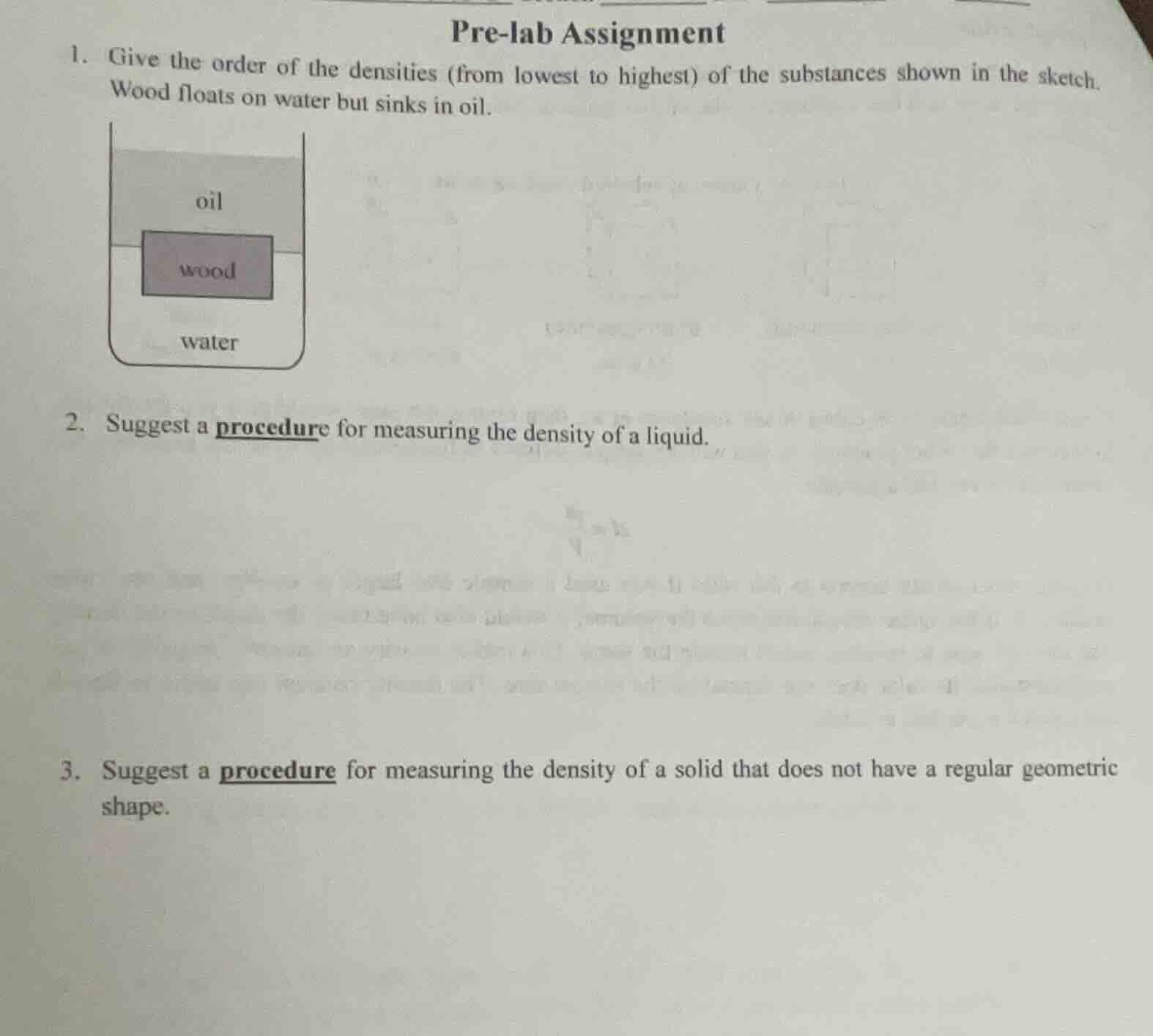
- give the order of the densities (from lowest to highest) of the substances shown in the sketch. wood floats on water but sinks in oil.
- suggest a procedure for measuring the density of a liquid.
- suggest a procedure for measuring the density of a solid that does not have a regular geometric shape.
Response
Question 1
Step1: Analyze buoyancy and density
An object floats in a fluid if its density is less than the fluid's density, and sinks if its density is greater. Given wood floats on water (\(
ho_{wood} <
ho_{water}\)) and sinks in oil (\(
ho_{wood} >
ho_{oil}\)). Also, oil is above water, so \(
ho_{oil} <
ho_{water}\) (since less dense fluids float on more dense ones).
Step2: Order the densities
From the relationships: \(
ho_{oil} <
ho_{wood} <
ho_{water}\) (lowest to highest).
Brief Explanations
- Measure mass of liquid: Use a balance to find the mass (\(m\)) of an empty graduated cylinder, then fill it with the liquid and measure the combined mass. Subtract to get the liquid's mass (\(m = m_{total} - m_{cylinder}\)).
- Measure volume of liquid: Read the volume (\(V\)) of the liquid from the graduated cylinder's scale.
- Calculate density: Use the formula \(
ho = \frac{m}{V}\) to find the liquid's density.
Brief Explanations
- Measure mass of solid: Use a balance to find the solid’s mass (\(m\)).
- Measure volume (water displacement): Fill a graduated cylinder with water (record initial volume \(V_1\)). Submerge the solid (ensure it’s fully immersed, no air bubbles), then record the final volume \(V_2\). The solid’s volume is \(V = V_2 - V_1\).
- Calculate density: Use \(
ho = \frac{m}{V}\) to find the solid’s density.

Snap & solve any problem in the app
Get step-by-step solutions on Sovi AI
Photo-based solutions with guided steps
Explore more problems and detailed explanations
oil, wood, water