QUESTION IMAGE
Question
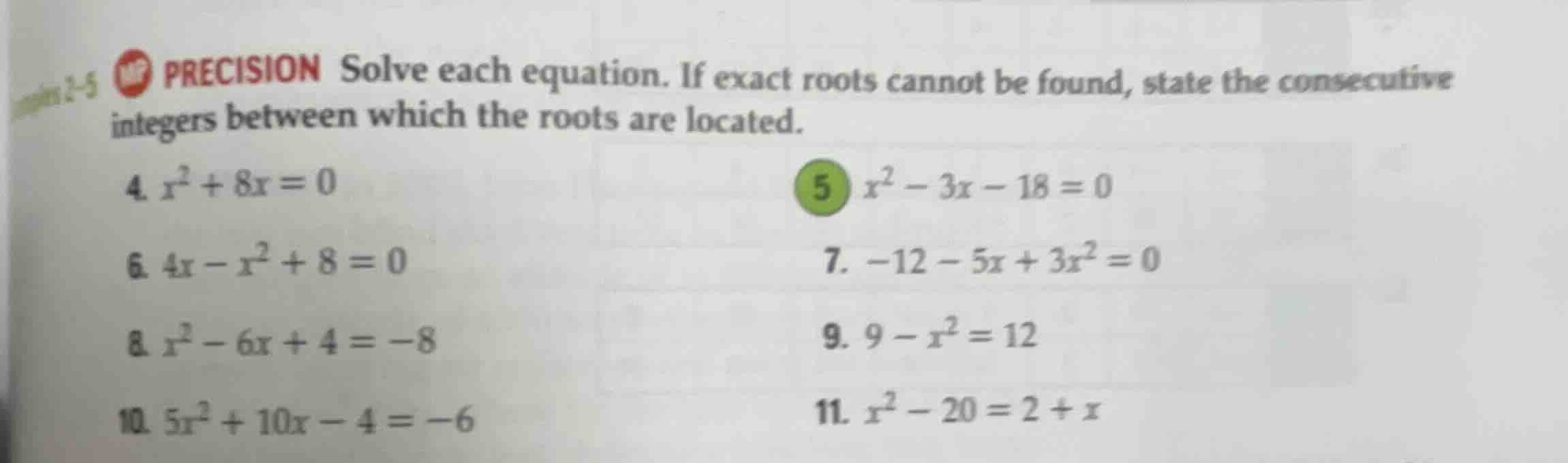
precision solve each equation. if exact roots cannot be found, state the consecutive integers between which the roots are located. 4. $x^2 + 8x = 0$ 5 $x^2 - 3x - 18 = 0$ 6. $4x - x^2 + 8 = 0$ 7. $-12 - 5x + 3x^2 = 0$ 8. $x^2 - 6x + 4 = -8$ 9. $9 - x^2 = 12$ 10. $5x^2 + 10x - 4 = -6$ 11. $x^2 - 20 = 2 + x$
Problem 4: \( x^2 + 8x = 0 \)
Step1: Factor out \( x \)
\( x(x + 8) = 0 \)
Step2: Apply zero - product property
If \( ab = 0 \), then either \( a = 0 \) or \( b = 0 \). So \( x = 0 \) or \( x+8 = 0 \)
Step3: Solve for \( x \)
For \( x + 8=0 \), we get \( x=-8 \)
Step1: Factor the quadratic
We need two numbers that multiply to \( - 18\) and add up to \( - 3\). The numbers are \( - 6\) and \( 3\). So \( x^2-3x - 18=(x - 6)(x+3)=0 \)
Step2: Apply zero - product property
\( x - 6=0 \) or \( x + 3=0 \)
Step3: Solve for \( x \)
For \( x - 6=0 \), \( x = 6 \); for \( x+3 = 0 \), \( x=-3 \)
Step1: Rewrite in standard form
\( -x^2+4x + 8=0 \), multiply both sides by \( - 1\) to get \( x^2-4x - 8=0 \)
Step2: Use quadratic formula \( x=\frac{-b\pm\sqrt{b^2 - 4ac}}{2a}\), where \( a = 1\), \( b=-4 \), \( c=-8 \)
First, calculate the discriminant \( \Delta=b^2-4ac=(-4)^2-4\times1\times(-8)=16 + 32=48 \)
Step3: Find the roots
\( x=\frac{4\pm\sqrt{48}}{2}=\frac{4\pm4\sqrt{3}}{2}=2\pm2\sqrt{3}\)
\( \sqrt{3}\approx1.732 \), so \( 2 + 2\sqrt{3}\approx2 + 3.464 = 5.464\) and \( 2-2\sqrt{3}\approx2-3.464=-1.464 \)
The root \( 2 - 2\sqrt{3}\) is between \( - 2\) and \( - 1\), and the root \( 2 + 2\sqrt{3}\) is between \( 5\) and \( 6\)

Snap & solve any problem in the app
Get step-by-step solutions on Sovi AI
Photo-based solutions with guided steps
Explore more problems and detailed explanations
The solutions are \( x = 0 \) and \( x=-8 \)