QUESTION IMAGE
Question
predicting outcomes
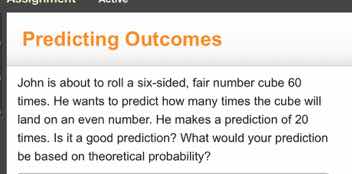
john is about to roll a six - sided, fair number cube 60 times. he wants to predict how many times the cube will land on an even number. he makes a prediction of 20 times. is it a good prediction? what would your prediction be based on theoretical probability?
Step1: Determine theoretical probability of even number
A six - sided cube has numbers 1, 2, 3, 4, 5, 6. The even numbers are 2, 4, 6. So there are 3 even numbers out of 6 total numbers. The theoretical probability \(P(\text{even})\) is \(\frac{3}{6}=\frac{1}{2}\).
Step2: Calculate expected number of even rolls
If John rolls the cube \(n = 60\) times, the expected number of times it lands on an even number is \(n\times P(\text{even})\). Substitute \(n = 60\) and \(P(\text{even})=\frac{1}{2}\) into the formula: \(60\times\frac{1}{2}=30\).
Step3: Evaluate John's prediction
John predicted 20 times. The expected number is 30, so his prediction is not a good prediction.

Snap & solve any problem in the app
Get step-by-step solutions on Sovi AI
Photo-based solutions with guided steps
Explore more problems and detailed explanations
The theoretical probability of rolling an even number on a fair six - sided cube is \(\frac{1}{2}\). For 60 rolls, the expected number of times an even number is rolled is \(60\times\frac{1}{2} = 30\). John's prediction of 20 times is not a good prediction because the expected number of even rolls is 30.