QUESTION IMAGE
Question
pregunta 1-8
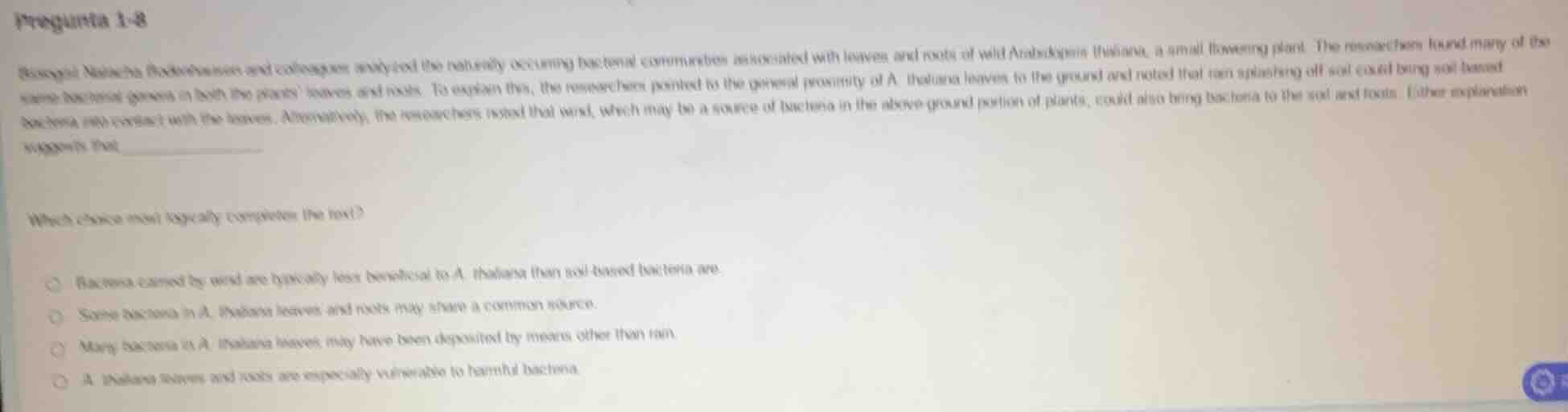
rassoul niaecho, rhodobacteraceae and colleagues analyzed the naturally occurring bacterial communities associated with leaves and roots of wild arabidopsis thaliana, a small flowering plant. the researchers found many of the same bacterial genera in both the plants leaves and roots. to explain this, the researchers pointed to the general proximity of a. thaliana leaves to the ground and noted that rain splashing off soil could bring soil - bound bacteria into contact with the leaves. alternatively, the researchers noted that wind, which may be a source of bacteria in the above - ground portion of plants, could also bring bacteria to the soil and roots. either explanation supports that
which choice most logically completes the text?
- bacteria carried by wind are typically less beneficial to a. thaliana than soil - bound bacteria are.
- some bacteria in a. thaliana leaves and roots may share a common source.
- many bacteria in a. thaliana leaves may have been deposited by means other than rain.
- a. thaliana leaves and roots are especially vulnerable to harmful bacteria.
The text presents two explanations for why the same bacterial species are found in both the leaves and roots of A. thaliana: rain splashing soil bacteria onto leaves, or wind carrying bacteria to both soil/roots and leaves. Both explanations imply that the shared bacteria come from a common origin. The other options are not supported: there is no mention of bacterial benefit, the second explanation includes rain as a possible method, and there is no discussion of vulnerability to harmful bacteria.

Snap & solve any problem in the app
Get step-by-step solutions on Sovi AI
Photo-based solutions with guided steps
Explore more problems and detailed explanations
Some bacteria in A. thaliana leaves and roots may share a common source.