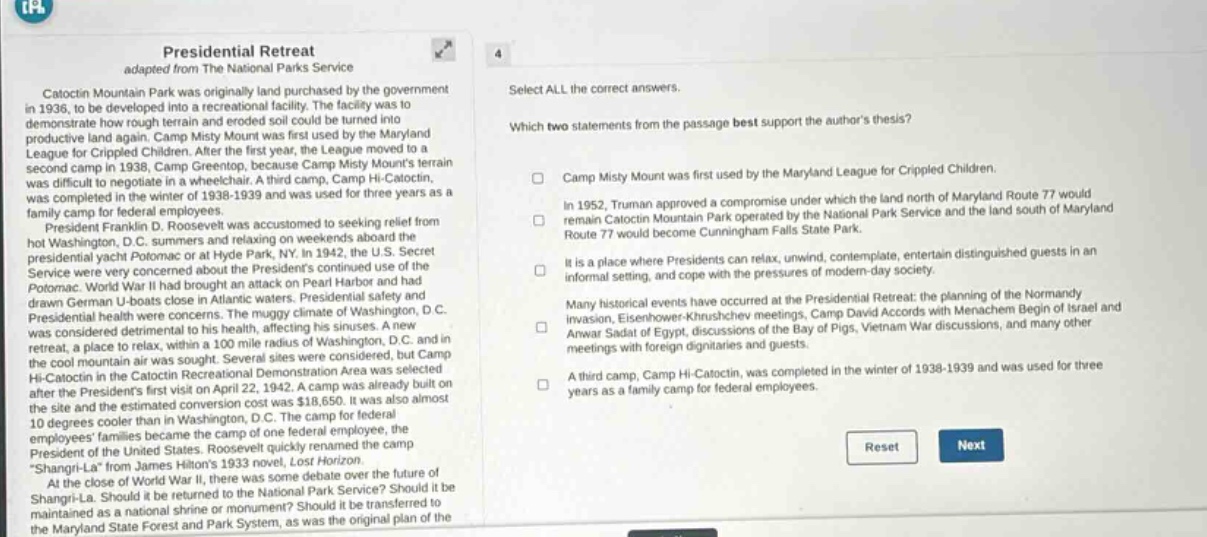
QUESTION IMAGE
Question
presidential retreat
adapted from the national parks service
catoctin mountain park was originally land purchased by the government
in 1936, to be developed into a recreational facility. the facility was to
demonstrate how rough terrain and eroded soil could be turned into
productive land again. camp misty mount was first used by the maryland
league for crippled children. after the first year, the league moved to a
second camp in 1938, camp greentop, because camp misty mounts terrain
was difficult to negotiate in a wheelchair. a third camp, camp hi-catoctin,
was completed in the winter of 1938-1939 and was used for three years as a
family camp for federal employees.
president franklin d. roosevelt was accustomed to seeking relief from
hot washington, d.c. summers and relaxing in weekends aboard the
presidential yacht potomac or at hyde park, ny. in 1942, the u.s. secret
service were very concerned about the presidents continued use of the
potomac. world war ii had brought an attack on pearl harbor and had
drawn german u-boats close in atlantic waters. presidential safety and
presidential health were concerns. the muggy climate of washington, d.c.
was considered detrimental to his health, affecting his sinuses. a new
retreat, a place to relax, within a 100 mile radius of washington, d.c. and
in the cool mountain air was sought. several sites were considered, but camp
hi-catoctin in the catoctin recreational demonstration area was selected
after the presidents first visit on april 22, 1942. a camp was already built on
the site and the estimated conversion cost was $18,650. it was also almost
10 degrees cooler than in washington, d.c. the camp for federal
employees families became the camp of one federal employee, the
president of the united states. roosevelt quickly renamed the camp
\shangri-la\ from james hiltons 1933 novel, lost horizon.
at the close of world war ii, there was some debate over the future of
shangri-la. should it be returned to the national park service? should it be
maintained as a national shrine or monument? should it be transferred to
the maryland state forest and park system, as was the original plan of the
4
select all the correct answers.
which two statements from the passage best support the authors thesis?
camp misty mount was first used by the maryland league for crippled children.
in 1952, truman approved a compromise under which the land north of maryland route 77 would
remain catoctin mountain park operated by the national park service and the land south of maryland
route 77 would become cunningham falls state park.
it is a place where presidents can relax, unwind, contemplate, entertain distinguished guests in an
informal setting, and cope with the pressures of modern - day society.
many historical events have occurred at the presidential retreat: the planning of the normandy
invasion, eisenhower - khrushchev meetings, camp david accords with menachem begin of israel and
anwar sadat of egypt, discussions of the bay of pigs, vietnam war discussions, and many other
meetings with foreign dignitaries and guests.
a third camp, camp hi - catoctin, was completed in the winter of 1938 - 1939 and was used for three
years as a family camp for federal employees.
reset next
The author's thesis centers on the Presidential Retreat's dual role as a personal respite for presidents and a venue for significant historical events. The first selected statement directly addresses its function as a relaxation space, aligning with the thesis's focus on presidential relief. The second statement lists key historical events tied to the retreat, supporting the thesis's emphasis on its historical significance. Other options focus on specific historical details (e.g., Camp Misty Mount's use, land compromises, early camp construction) that do not capture the core thesis about the retreat's purpose and impact.

Snap & solve any problem in the app
Get step-by-step solutions on Sovi AI
Photo-based solutions with guided steps
Explore more problems and detailed explanations
It is a place where Presidents can relax, unwind, contemplate, entertain distinguished guests in an informal setting, and cope with the pressures of modern-day society.
Many historical events have occurred at the Presidential Retreat: the planning of the Normandy Invasion, Eisenhower-Khrushchev meetings, Camp David Accords with Menachem Begin of Israel and Anwar Sadat of Egypt, discussions of the Bay of Pigs, Vietnam War discussions, and many other meetings with foreign dignitaries and guests.