QUESTION IMAGE
Question
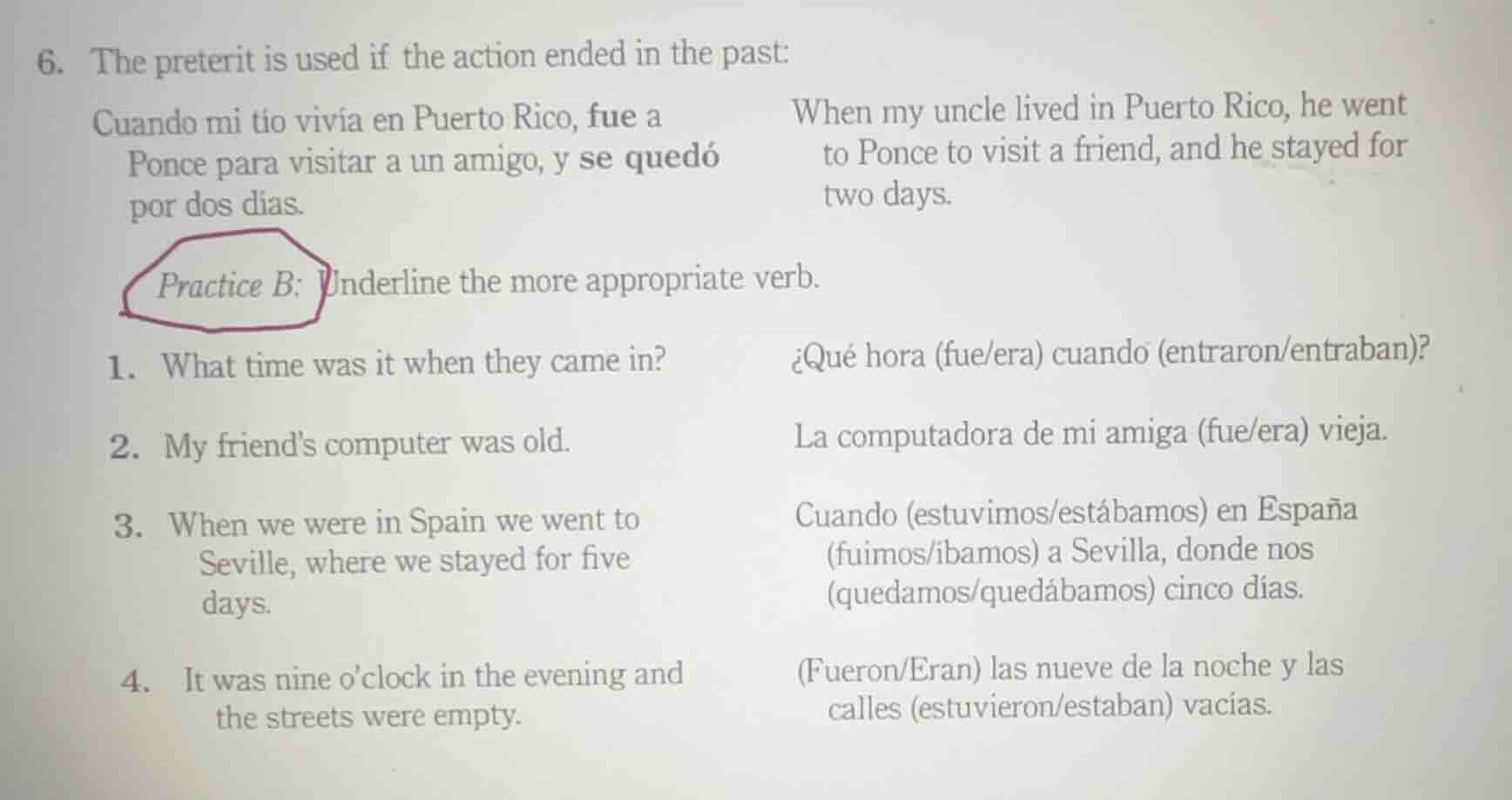
- the preterit is used if the action ended in the past:
cuando mi tío vivía en puerto rico, fue a ponce para visitar a un amigo, y se quedó por dos días. when my uncle lived in puerto rico, he went to ponce to visit a friend, and he stayed for two days.
practice b: underline the more appropriate verb.
- what time was it when they came in? ¿qué hora (fue/era) cuando (entraron/entraban)?
- my friends computer was old. la computadora de mi amiga (fue/era) vieja.
- when we were in spain we went to seville, where we stayed for five days. cuando (estuvimos/estábamos) en españa (fuimos/íbamos) a sevilla, donde nos (quedamos/quedábamos) cinco días.
- it was nine oclock in the evening and the streets were empty. (fueron/eran) las nueve de la noche y las calles (estuvieron/estaban) vacías.
1.
To determine the appropriate verbs, we analyze the tense usage. "fue" is preterit (for a completed action or a specific time point), and "era" is imperfect (for ongoing states or background info). "entraron" is preterit (completed action of coming in), "entraban" is imperfect (ongoing action). The question asks for the time when they came in (a completed action), so we use preterit for the time - related verb? Wait, no: "¿Qué hora (fue/era) cuando (entraron/entraban)?" The action of "coming in" (entrar) is a completed action, so "entraron" (preterit). For "qué hora", when asking about a specific time when an action happened, we use "fue" (preterit) as it's a specific moment. So the appropriate verbs are "fue" and "entraron".
"fue" is preterit (used for completed actions or events), "era" is imperfect (used for ongoing states or descriptions in the past). The sentence is describing the state of the friend's computer (that it was old), which is a continuous state in the past, so we use the imperfect tense "era".
- "estuvimos" is preterit (completed action of being in Spain), "estábamos" is imperfect (ongoing action of being in Spain). The action of being in Spain and then going to Seville is a sequence of completed actions? Wait, no: "When we were in Spain" - the state of being in Spain is a background action (imperfect), but then "we went to Seville" (completed, preterit), and "we stayed for five days" (completed, preterit). Wait, let's re - analyze: "Cuando (estuvimos/estábamos) en España (fuimos/íbamos) a Sevilla, donde nos (quedamos/quedábamos) cinco días."
- "estábamos" is imperfect (describing the time when we were in Spain, a continuous period), "estuvimos" is preterit (a completed action of being in Spain, but here it's a background for the other actions). Wait, actually, when we have a main action (going to Seville, staying) which are completed, the "being in Spain" can be seen as the background (imperfect) or a completed action? No, "being in Spain" is a state. But in the context of the sentence, "when we were in Spain" (a period during which we did other things), so "estábamos" (imperfect) is better for the background.
- "fuimos" is preterit (completed action of going to Seville), "íbamos" is imperfect (ongoing action of going, which doesn't fit here as going to Seville is a completed trip).
- "quedamos" is preterit (completed action of staying for five days), "quedábamos" is imperfect (ongoing action of staying, which doesn't fit as the stay was for a specific five days, a completed action). So the appropriate verbs are "estábamos", "fuimos", "quedamos". Wait, no: maybe I made a mistake. Let's think again. The actions of "being in Spain", "going to Seville", and "staying for five days" - if we consider the entire event as a sequence of completed actions, then "estuvimos" (preterit, being in Spain as a completed period), "fuimos" (preterit, going to Seville), "quedamos" (preterit, staying for five days). But the original sentence in English is "When we were in Spain we went to Seville, where we stayed for five days." The "were" in English can be seen as a continuous state (imperfect), but in Spanish, sometimes we use preterit for a completed period. This is a bit tricky. But generally, for a sequence of actions in the past, we use preterit. So "estuvimos" (preterit, being in Spain as a completed action), "fuimos" (preterit, going to Seville), "quedamos" (preterit, staying for five days).

Snap & solve any problem in the app
Get step-by-step solutions on Sovi AI
Photo-based solutions with guided steps
Explore more problems and detailed explanations
\underline{fue} and \underline{entraron}