QUESTION IMAGE
Question
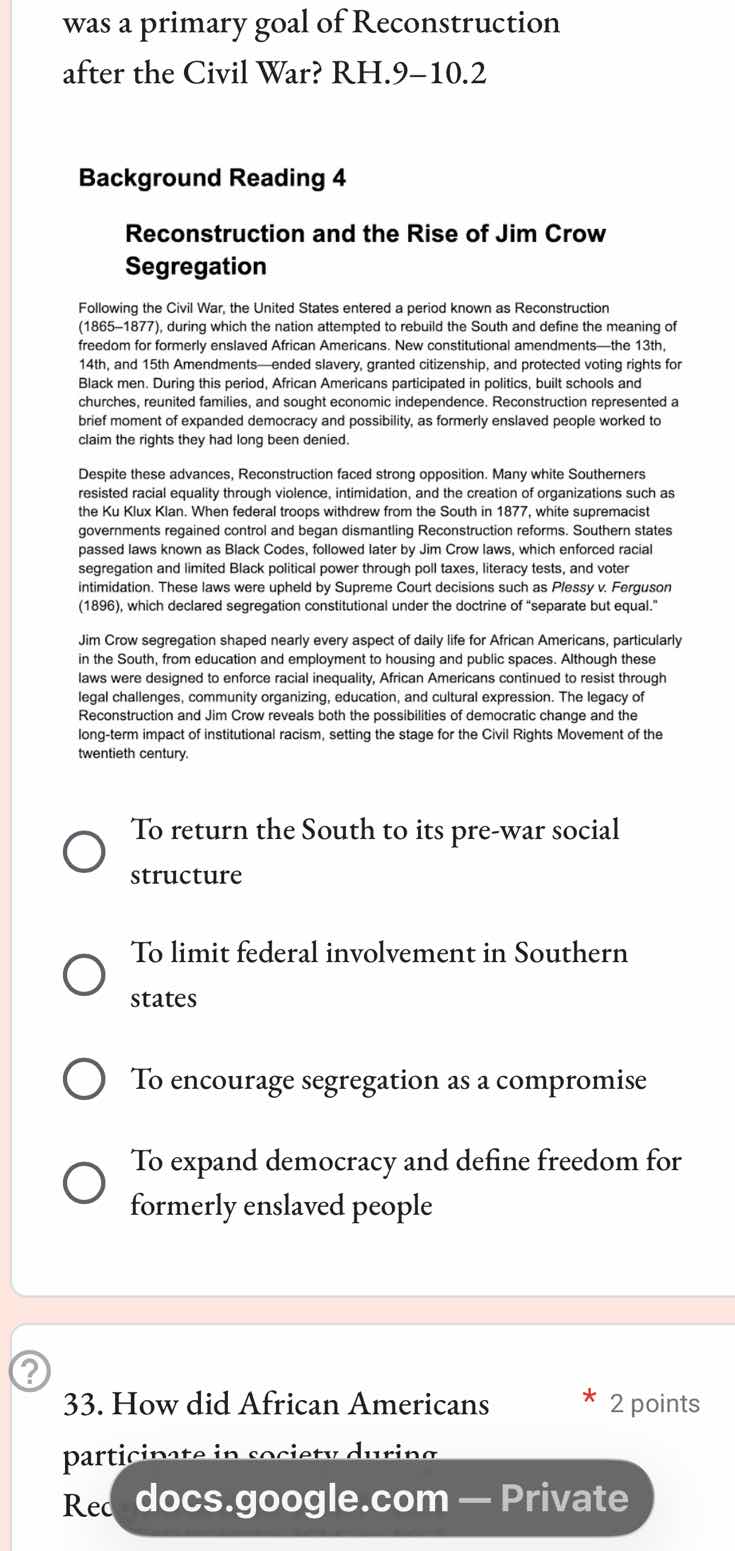
was a primary goal of reconstruction after the civil war? rh.9–10.2
background reading 4
reconstruction and the rise of jim crow segregation
following the civil war, the united states entered a period known as reconstruction (1865–1877), during which the nation attempted to rebuild the south and define the meaning of freedom for formerly enslaved african americans. new constitutional amendments—the 13th, 14th, and 15th amendments—ended slavery, granted citizenship, and protected voting rights for black men. during this period, african americans participated in politics, built schools and churches, reunited families, and sought economic independence. reconstruction represented a brief moment of expanded democracy and possibility, as formerly enslaved people worked to claim the rights they had long been denied.
despite these advances, reconstruction faced strong opposition. many white southerners resisted racial equality through violence, intimidation, and the creation of organizations such as the ku klux klan. when federal troops withdrew from the south in 1877, white supremacist governments regained control and began dismantling reconstruction reforms. southern states passed laws known as black codes, followed later by jim crow laws, which enforced racial segregation and limited black political power through poll taxes, literacy tests, and voter intimidation. these laws were upheld by supreme court decisions such as plessy v. ferguson (1896), which declared segregation constitutional under the doctrine of “separate but equal.”
jim crow segregation shaped nearly every aspect of daily life for african americans, particularly in the south, from education and employment to housing and public spaces. although these laws were designed to enforce racial inequality, african americans continued to resist through legal challenges, community organizing, education, and cultural expression. the legacy of reconstruction and jim crow reveals both the possibilities of democratic change and the long - term impact of institutional racism, setting the stage for the civil rights movement of the twentieth century.
○ to return the south to its pre - war social structure
○ to limit federal involvement in southern states
○ to encourage segregation as a compromise
○ to expand democracy and define freedom for formerly enslaved people
- how did african americans participate in society during rec
The background reading states that during Reconstruction, the nation attempted to rebuild the South and define the meaning of freedom for formerly enslaved African Americans, with new amendments ending slavery, granting citizenship, and protecting voting rights. African Americans participated in politics, built schools, etc., showing an expansion of democracy and an effort to define freedom. The other options are incorrect: returning to pre - war social structure (which had slavery) was opposed by Reconstruction efforts; limiting federal involvement was not a goal (federal troops were involved initially); and encouraging segregation was part of the opposition to Reconstruction, not a goal of Reconstruction.

Snap & solve any problem in the app
Get step-by-step solutions on Sovi AI
Photo-based solutions with guided steps
Explore more problems and detailed explanations
To expand democracy and define freedom for formerly enslaved people