QUESTION IMAGE
Question
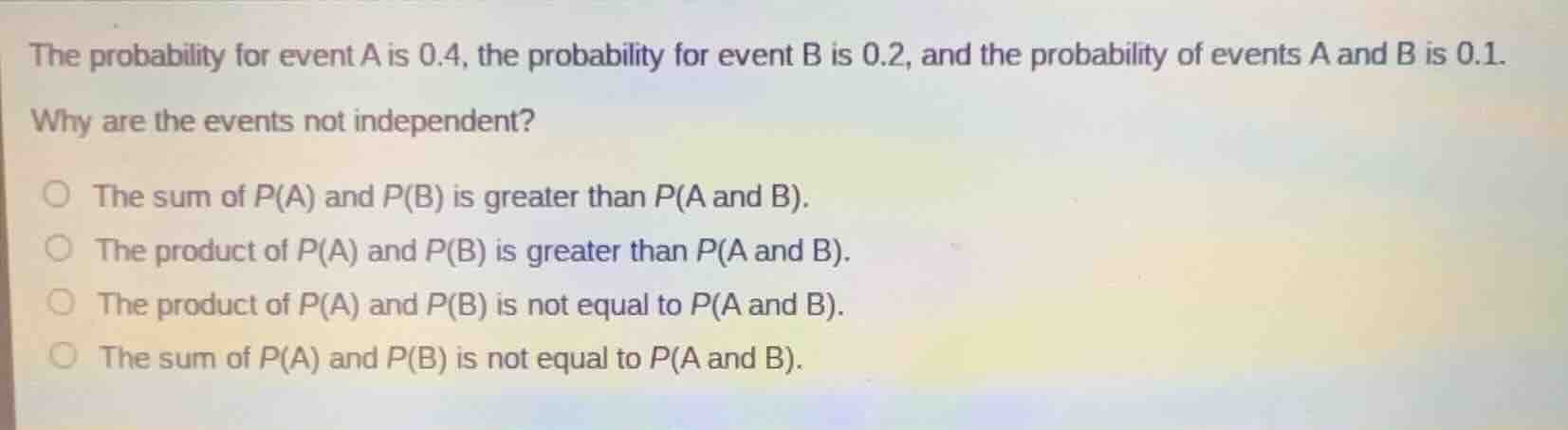
the probability for event a is 0.4, the probability for event b is 0.2, and the probability of events a and b is 0.1. why are the events not independent?
the sum of p(a) and p(b) is greater than p(a and b).
the product of p(a) and p(b) is greater than p(a and b).
the product of p(a) and p(b) is not equal to p(a and b).
the sum of p(a) and p(b) is not equal to p(a and b).
To determine if events \( A \) and \( B \) are independent, we use the rule for independent events: \( P(A \text{ and } B) = P(A) \times P(B) \).
- Calculate \( P(A) \times P(B) \):
Given \( P(A) = 0.4 \) and \( P(B) = 0.2 \),
\( P(A) \times P(B) = 0.4 \times 0.2 = 0.08 \).
- Compare to \( P(A \text{ and } B) \):
We know \( P(A \text{ and } B) = 0.1 \).
Since \( 0.08
eq 0.1 \), the product of \( P(A) \) and \( P(B) \) is not equal to \( P(A \text{ and } B) \), so the events are not independent.
The other options are incorrect:
- The sum of probabilities (\( 0.4 + 0.2 = 0.6 \)) being greater than \( P(A \text{ and } B) \) is always true for non - mutually exclusive events and is not related to independence.
- The product (\( 0.08 \)) is less than \( P(A \text{ and } B) \) (\( 0.1 \)), not greater.
- The sum of probabilities is never expected to equal \( P(A \text{ and } B) \) for independent (or most) events, so this is irrelevant.

Snap & solve any problem in the app
Get step-by-step solutions on Sovi AI
Photo-based solutions with guided steps
Explore more problems and detailed explanations
C. The product of \( P(A) \) and \( P(B) \) is not equal to \( P(A \text{ and } B) \).