QUESTION IMAGE
Question
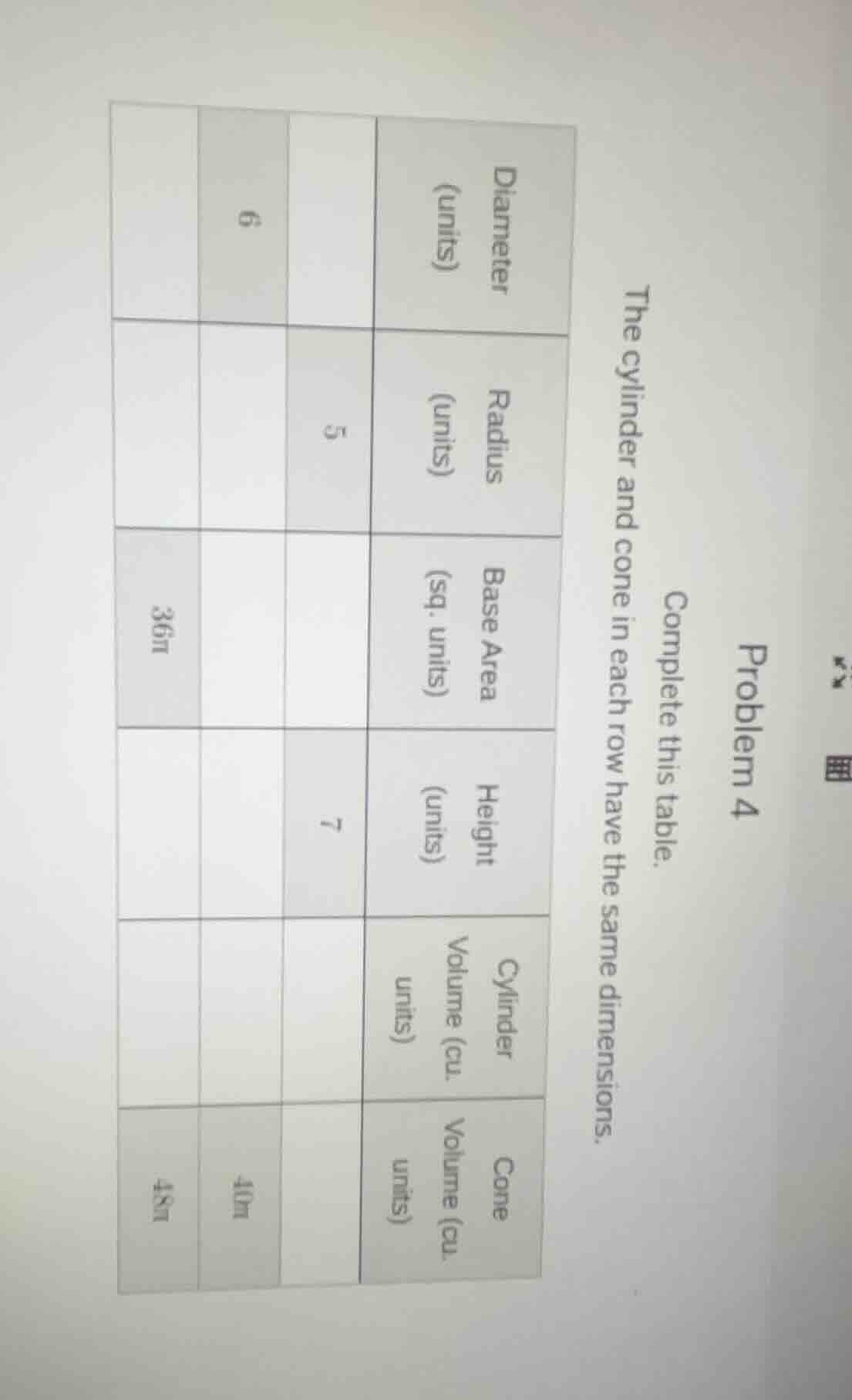
problem 4
complete this table.
the cylinder and cone in each row have the same dimensions.
| diameter (units) | radius (units) | base area (sq. units) | height (units) | cylinder volume (cu. units) | cone volume (cu. units) | |
|---|---|---|---|---|---|---|
| row 2 | 6 | 40π | ||||
| row 3 | 36π | 48π |
To solve the problem, we analyze each row of the table using the formulas for the volume of a cylinder (\( V_{\text{cylinder}} = \text{Base Area} \times \text{Height} \)) and the volume of a cone (\( V_{\text{cone}} = \frac{1}{3} \times \text{Base Area} \times \text{Height} \)). We also use the relationship between radius and diameter (\( \text{Radius} = \frac{\text{Diameter}}{2} \)) and the formula for the area of a circle (\( \text{Base Area} = \pi r^2 \)).
First Row (Radius = 5, Height = 7)
- Diameter: \( \text{Diameter} = 2 \times \text{Radius} = 2 \times 5 = 10 \)
- Base Area: \( \text{Base Area} = \pi r^2 = \pi (5)^2 = 25\pi \)
- Cylinder Volume: \( V_{\text{cylinder}} = \text{Base Area} \times \text{Height} = 25\pi \times 7 = 175\pi \)
- Cone Volume: \( V_{\text{cone}} = \frac{1}{3} \times \text{Base Area} \times \text{Height} = \frac{1}{3} \times 25\pi \times 7 = \frac{175\pi}{3} \)
Second Row (Diameter = 6, Cone Volume = \( 40\pi \))
- Radius: \( \text{Radius} = \frac{\text{Diameter}}{2} = \frac{6}{2} = 3 \)
- Base Area: \( \text{Base Area} = \pi r^2 = \pi (3)^2 = 9\pi \)
- Cylinder Volume: Since \( V_{\text{cylinder}} = 3 \times V_{\text{cone}} \) (for the same base and height), \( V_{\text{cylinder}} = 3 \times 40\pi = 120\pi \)
- Height: Using \( V_{\text{cone}} = \frac{1}{3} \times \text{Base Area} \times \text{Height} \), solve for height:
\( 40\pi = \frac{1}{3} \times 9\pi \times \text{Height} \)
\( 40\pi = 3\pi \times \text{Height} \)
\( \text{Height} = \frac{40\pi}{3\pi} = \frac{40}{3} \) (Wait, but the table shows "40π" for cone volume. Wait, maybe a miscalculation. Wait, the table has "40π" as cone volume. Let's recheck:
\( V_{\text{cone}} = \frac{1}{3} \times \text{Base Area} \times \text{Height} \)
\( 40\pi = \frac{1}{3} \times 9\pi \times h \)
\( 40\pi = 3\pi h \)
\( h = \frac{40\pi}{3\pi} = \frac{40}{3} \approx 13.33 \). But maybe the table has a typo or I misread. Wait, the table shows "40π" for cone volume. Alternatively, maybe the base area is 36π? Wait, third row: Base Area = 36π, Cone Volume = 48π. Let's check third row.
Third Row (Base Area = \( 36\pi \), Cone Volume = \( 48\pi \))
- Radius: \( \text{Base Area} = \pi r^2 = 36\pi \implies r^2 = 36 \implies r = 6 \)
Diameter: \( \text{Diameter} = 2 \times 6 = 12 \)
- Height: Using \( V_{\text{cone}} = \frac{1}{3} \times \text{Base Area} \times \text{Height} \):
\( 48\pi = \frac{1}{3} \times 36\pi \times \text{Height} \)
\( 48\pi = 12\pi \times \text{Height} \)
\( \text{Height} = \frac{48\pi}{12\pi} = 4 \)
- Cylinder Volume: \( V_{\text{cylinder}} = \text{Base Area} \times \text{Height} = 36\pi \times 4 = 144\pi \) (Wait, the table shows "48π" for cone volume. Wait, maybe I made a mistake. Wait, \( V_{\text{cylinder}} = 3 \times V_{\text{cone}} \) when base and height are the same. So if \( V_{\text{cone}} = 48\pi \), then \( V_{\text{cylinder}} = 3 \times 48\pi = 144\pi \). Then height: \( 144\pi = 36\pi \times \text{Height} \implies \text{Height} = 4 \). That matches. So radius is 6, diameter 12, height 4, cylinder volume 144π.
Completed Table:
| Diameter (units) | Radius (units) | Base Area (sq. units) | Height (units) | Cylinder Volume (cu. units) | Cone Volume (cu. units) |
|---|
|…

Snap & solve any problem in the app
Get step-by-step solutions on Sovi AI
Photo-based solutions with guided steps
Explore more problems and detailed explanations
To solve the problem, we analyze each row of the table using the formulas for the volume of a cylinder (\( V_{\text{cylinder}} = \text{Base Area} \times \text{Height} \)) and the volume of a cone (\( V_{\text{cone}} = \frac{1}{3} \times \text{Base Area} \times \text{Height} \)). We also use the relationship between radius and diameter (\( \text{Radius} = \frac{\text{Diameter}}{2} \)) and the formula for the area of a circle (\( \text{Base Area} = \pi r^2 \)).
First Row (Radius = 5, Height = 7)
- Diameter: \( \text{Diameter} = 2 \times \text{Radius} = 2 \times 5 = 10 \)
- Base Area: \( \text{Base Area} = \pi r^2 = \pi (5)^2 = 25\pi \)
- Cylinder Volume: \( V_{\text{cylinder}} = \text{Base Area} \times \text{Height} = 25\pi \times 7 = 175\pi \)
- Cone Volume: \( V_{\text{cone}} = \frac{1}{3} \times \text{Base Area} \times \text{Height} = \frac{1}{3} \times 25\pi \times 7 = \frac{175\pi}{3} \)
Second Row (Diameter = 6, Cone Volume = \( 40\pi \))
- Radius: \( \text{Radius} = \frac{\text{Diameter}}{2} = \frac{6}{2} = 3 \)
- Base Area: \( \text{Base Area} = \pi r^2 = \pi (3)^2 = 9\pi \)
- Cylinder Volume: Since \( V_{\text{cylinder}} = 3 \times V_{\text{cone}} \) (for the same base and height), \( V_{\text{cylinder}} = 3 \times 40\pi = 120\pi \)
- Height: Using \( V_{\text{cone}} = \frac{1}{3} \times \text{Base Area} \times \text{Height} \), solve for height:
\( 40\pi = \frac{1}{3} \times 9\pi \times \text{Height} \)
\( 40\pi = 3\pi \times \text{Height} \)
\( \text{Height} = \frac{40\pi}{3\pi} = \frac{40}{3} \) (Wait, but the table shows "40π" for cone volume. Wait, maybe a miscalculation. Wait, the table has "40π" as cone volume. Let's recheck:
\( V_{\text{cone}} = \frac{1}{3} \times \text{Base Area} \times \text{Height} \)
\( 40\pi = \frac{1}{3} \times 9\pi \times h \)
\( 40\pi = 3\pi h \)
\( h = \frac{40\pi}{3\pi} = \frac{40}{3} \approx 13.33 \). But maybe the table has a typo or I misread. Wait, the table shows "40π" for cone volume. Alternatively, maybe the base area is 36π? Wait, third row: Base Area = 36π, Cone Volume = 48π. Let's check third row.
Third Row (Base Area = \( 36\pi \), Cone Volume = \( 48\pi \))
- Radius: \( \text{Base Area} = \pi r^2 = 36\pi \implies r^2 = 36 \implies r = 6 \)
Diameter: \( \text{Diameter} = 2 \times 6 = 12 \)
- Height: Using \( V_{\text{cone}} = \frac{1}{3} \times \text{Base Area} \times \text{Height} \):
\( 48\pi = \frac{1}{3} \times 36\pi \times \text{Height} \)
\( 48\pi = 12\pi \times \text{Height} \)
\( \text{Height} = \frac{48\pi}{12\pi} = 4 \)
- Cylinder Volume: \( V_{\text{cylinder}} = \text{Base Area} \times \text{Height} = 36\pi \times 4 = 144\pi \) (Wait, the table shows "48π" for cone volume. Wait, maybe I made a mistake. Wait, \( V_{\text{cylinder}} = 3 \times V_{\text{cone}} \) when base and height are the same. So if \( V_{\text{cone}} = 48\pi \), then \( V_{\text{cylinder}} = 3 \times 48\pi = 144\pi \). Then height: \( 144\pi = 36\pi \times \text{Height} \implies \text{Height} = 4 \). That matches. So radius is 6, diameter 12, height 4, cylinder volume 144π.
Completed Table:
| Diameter (units) | Radius (units) | Base Area (sq. units) | Height (units) | Cylinder Volume (cu. units) | Cone Volume (cu. units) |
|---|---|---|---|---|---|
| 6 | 3 | \( 9\pi \) | \( \frac{40}{3} \) | \( 120\pi \) | \( 40\pi \) |
| 12 | 6 | \( 36\pi \) | 4 | \( 144\pi \) | \( 48\pi \) |
Key Formulas:
- Radius: \( r = \frac{d}{2} \)
- Base Area (circle): \( A = \pi r^2 \)
- Cylinder Volume: \( V_{\text{cylinder}} = A \times h \)
- Cone Volume: \( V_{\text{cone}} = \frac{1}{3} A \times h \) (or \( V_{\text{cone}} = \frac{1}{3} V_{\text{cylinder}} \))
Final Answers (for each row):
- First Row:
- Diameter: \( \boldsymbol{10} \)
- Base Area: \( \boldsymbol{25\pi} \)
- Cylinder Volume: \( \boldsymbol{175\pi} \)
- Cone Volume: \( \boldsymbol{\frac{175\pi}{3}} \)
- Second Row:
- Radius: \( \boldsymbol{3} \)
- Base Area: \( \boldsymbol{9\pi} \)
- Height: \( \boldsymbol{\frac{40}{3}} \)
- Cylinder Volume: \( \boldsymbol{120\pi} \)
- Third Row:
- Diameter: \( \boldsymbol{12} \)
- Radius: \( \boldsymbol{6} \)
- Height: \( \boldsymbol{4} \)
- Cylinder Volume: \( \boldsymbol{144\pi} \)
If you need specific values (e.g., numerical approximations), substitute \( \pi \approx 3.14 \) into the expressions.