QUESTION IMAGE
Question
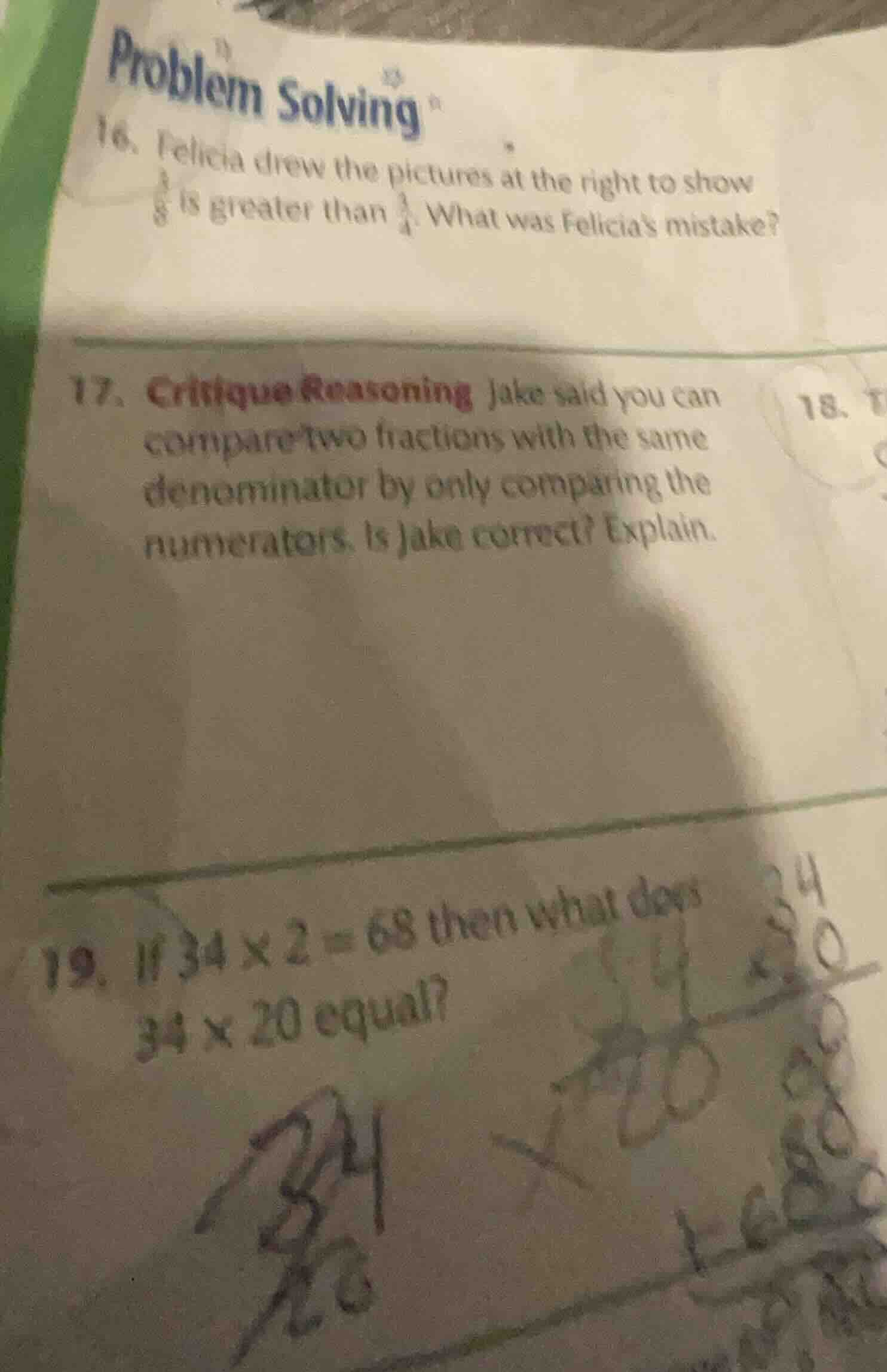
problem solving 16. felicia drew the pictures at the right to show \\(\frac{5}{8}\\) is greater than \\(\frac{3}{4}\\). what was felicias mistake? 17. critique reasoning jake said you can compare two fractions with the same denominator by only comparing the numerators. is jake correct? explain. 18. 19. if \\(34 \times 2 = 68\\) then what does \\(34 \times 20\\) equal?
Step1: Rewrite 20 as 2×10
$34 \times 20 = 34 \times (2 \times 10)$
Step2: Use associative property of multiplication
$34 \times (2 \times 10) = (34 \times 2) \times 10$
Step3: Substitute given value 34×2=68
$(34 \times 2) \times 10 = 68 \times 10$
Step4: Calculate final product
$68 \times 10 = 680$
Jake is correct. When fractions have the same denominator, they represent parts of the same whole that are split into equal-sized pieces. The numerator counts how many of those equal pieces we have, so a larger numerator means more of the equal pieces, hence a larger fraction.
Felicia's mistake is that she likely used wholes of different sizes or did not partition the wholes equally when drawing. To compare $\frac{3}{8}$ and $\frac{3}{4}$, the wholes must be the same size, and $\frac{3}{4}$ is equivalent to $\frac{6}{8}$, which is larger than $\frac{3}{8}$. She probably drew the whole for $\frac{3}{8}$ as larger than the whole for $\frac{3}{4}$, or did not split them into equal parts properly.

Snap & solve any problem in the app
Get step-by-step solutions on Sovi AI
Photo-based solutions with guided steps
Explore more problems and detailed explanations
680
---