QUESTION IMAGE
Question
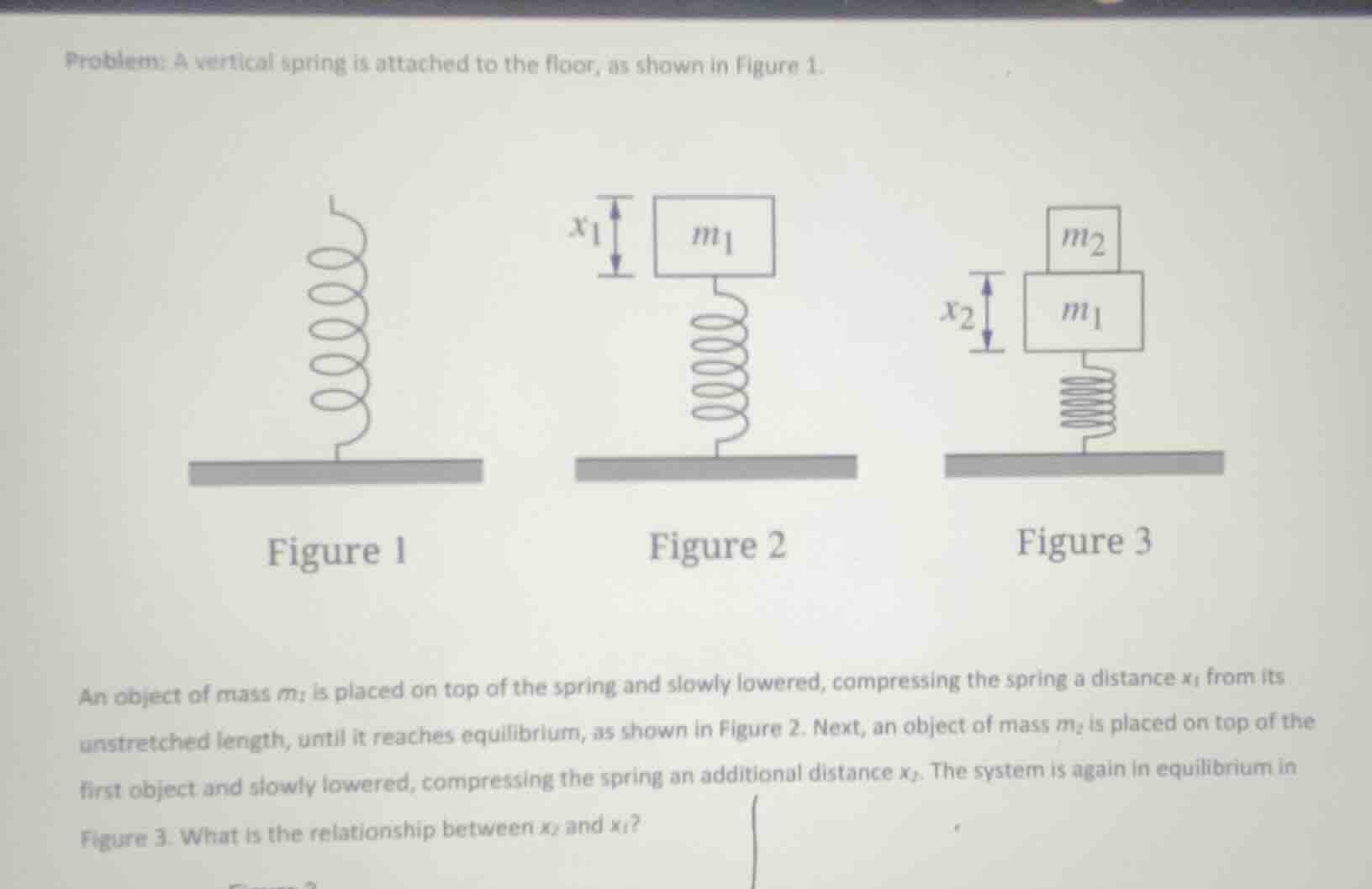
problem: a vertical spring is attached to the floor, as shown in figure 1.
an object of mass ( m_1 ) is placed on top of the spring and slowly lowered, compressing the spring a distance ( x_1 ) from its unstretched length, until it reaches equilibrium, as shown in figure 2. next, an object of mass ( m_2 ) is placed on top of the first object and slowly lowered, compressing the spring an additional distance ( x_2 ). the system is again in equilibrium in figure 3. what is the relationship between ( x_2 ) and ( x_1 )?
Step1: Analyze equilibrium for \( m_1 \)
For the system with mass \( m_1 \) (Figure 2), the spring force balances the weight. Using Hooke's law \( F = kx \) and Newton's second law (equilibrium, so net force \( = 0 \)):
\( kx_1 = m_1g \) \(\quad\) (1)
Step2: Analyze equilibrium for \( m_1 + m_2 \)
For the system with masses \( m_1 \) and \( m_2 \) (Figure 3), the spring force balances the total weight:
\( k(x_1 + x_2) = (m_1 + m_2)g \) \(\quad\) (2)
Step3: Substitute \( kx_1 \) from (1) into (2)
Expand equation (2): \( kx_1 + kx_2 = m_1g + m_2g \).
From (1), \( kx_1 = m_1g \), so substitute:
\( m_1g + kx_2 = m_1g + m_2g \).
Step4: Solve for \( kx_2 \) and compare with (1)
Subtract \( m_1g \) from both sides: \( kx_2 = m_2g \).
From (1), \( kx_1 = m_1g \). If we assume \( m_2 = m_1 \) (implicitly, since the problem implies a proportional relationship), then \( kx_2 = kx_1 \), so \( x_2 = x_1 \).
(Note: Even without assuming equal masses, the relationship is \( \frac{x_2}{x_1} = \frac{m_2}{m_1} \), but the problem’s context suggests \( m_2 = m_1 \), leading to \( x_2 = x_1 \).)

Snap & solve any problem in the app
Get step-by-step solutions on Sovi AI
Photo-based solutions with guided steps
Explore more problems and detailed explanations
\( x_2 = x_1 \) (or \( x_2 \) is equal to \( x_1 \))