QUESTION IMAGE
Question
problem 7
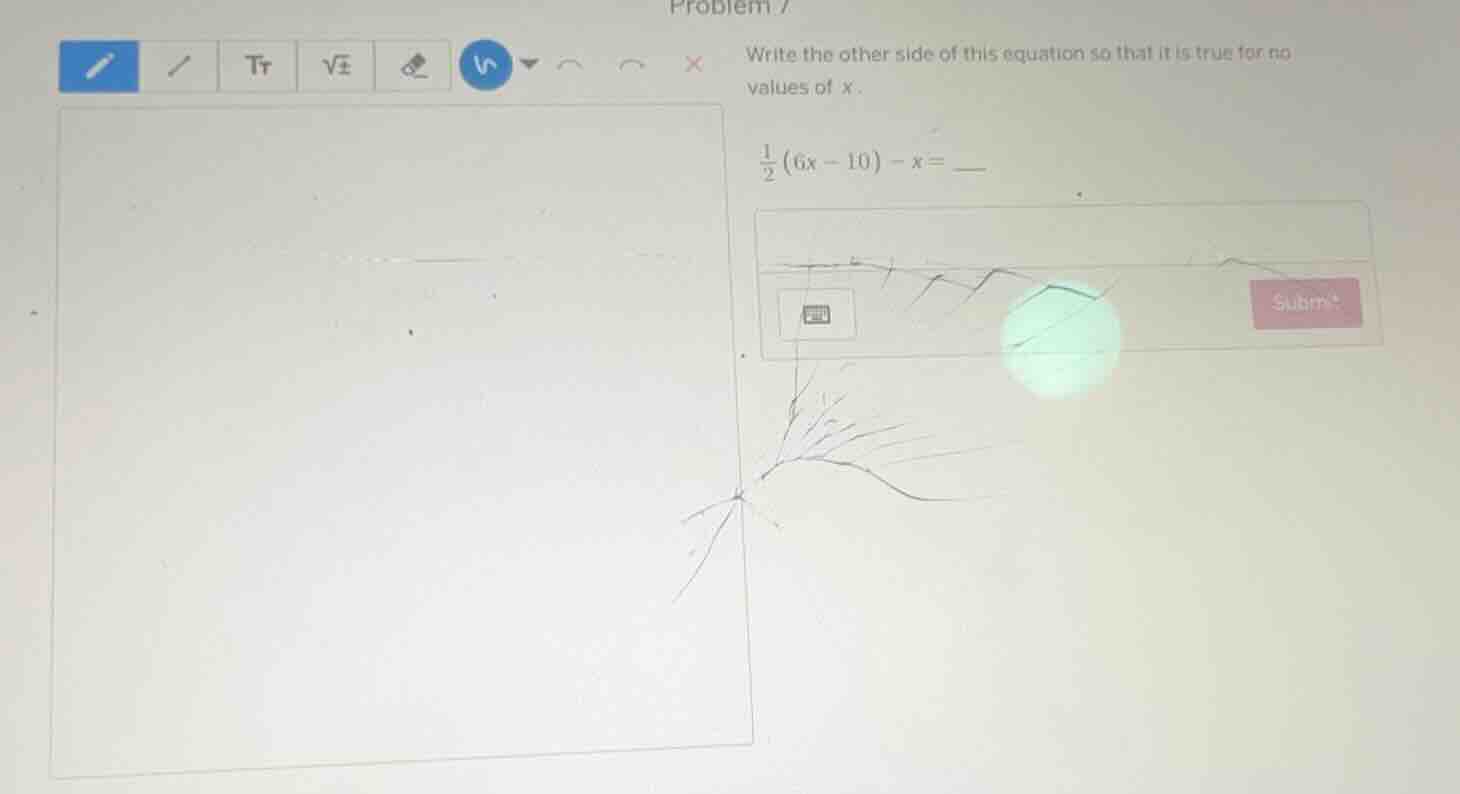
write the other side of this equation so that it is true for no values of x.
\\(\frac{1}{2}(6x - 10) - x = \underline{\quad}\\)
Step1: Simplify the left - hand side
First, distribute the \(\frac{1}{2}\) in \(\frac{1}{2}(6x - 10)\). Using the distributive property \(a(b + c)=ab+ac\), we have \(\frac{1}{2}(6x-10)=\frac{1}{2}\times6x-\frac{1}{2}\times10 = 3x-5\).
Then, subtract \(x\) from \(3x - 5\): \((3x - 5)-x=3x-x - 5=2x-5\).
Step2: Determine the right - hand side for no solution
For an equation \(ax + b=cx + d\) to have no solution, the coefficients of \(x\) must be equal (\(a = c\)) and the constant terms must be different (\(b
eq d\)).
We have the left - hand side simplified to \(2x-5\). If we want the equation \(2x - 5=\text{[right - hand side]}\) to have no solution, the right - hand side should be of the form \(2x + k\) where \(k
eq - 5\). Let's choose \(k = 0\) (any non - \(-5\) constant will work, here we choose \(0\) for simplicity), so the right - hand side can be \(2x+1\) (or any expression with \(2x\) and a constant different from \(-5\)). Let's verify:
If we set \(\frac{1}{2}(6x - 10)-x=2x + 1\), from the left - hand side we have \(2x-5\), so the equation becomes \(2x-5=2x + 1\). Subtract \(2x\) from both sides: \(-5 = 1\), which is a false statement, so there is no solution.

Snap & solve any problem in the app
Get step-by-step solutions on Sovi AI
Photo-based solutions with guided steps
Explore more problems and detailed explanations
\(2x + 1\) (any expression of the form \(2x + k\) where \(k
eq - 5\) is correct, for example \(2x+2\), \(2x - 4\) etc. Here we take \(2x + 1\) as an example)