QUESTION IMAGE
Question
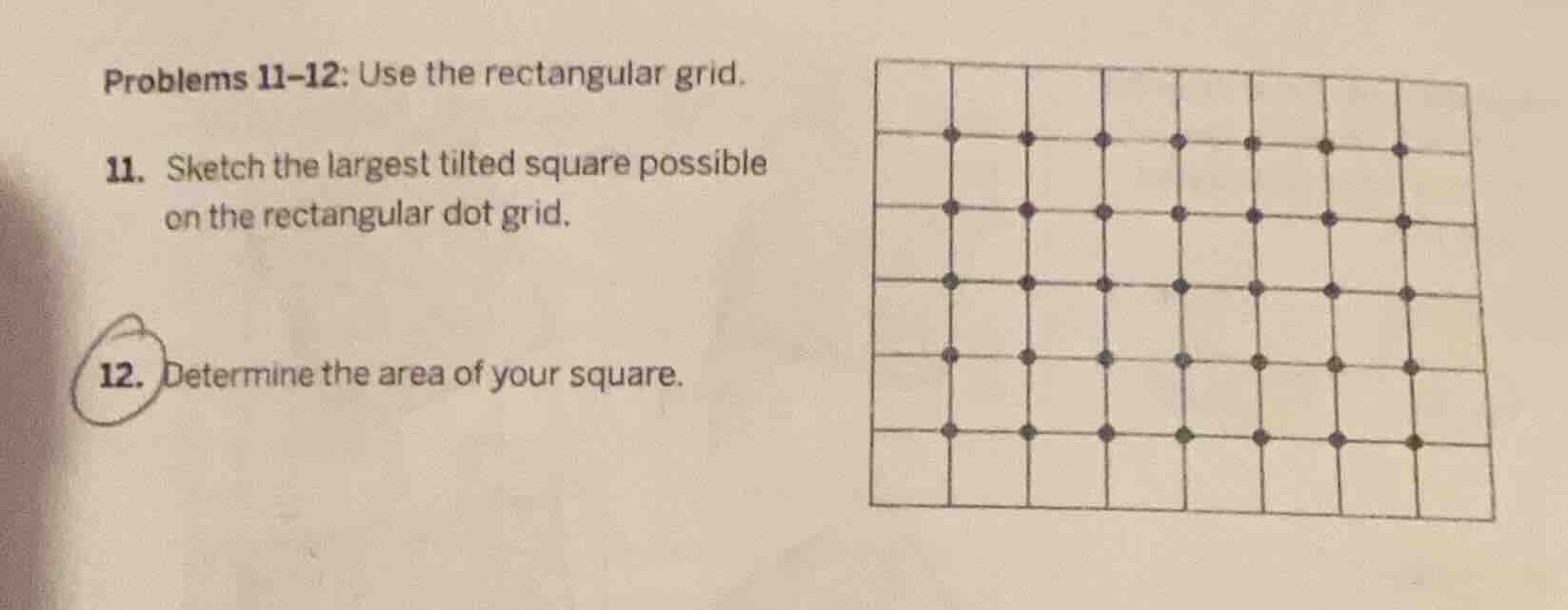
problems 11–12: use the rectangular grid.
- sketch the largest tilted square possible on the rectangular dot grid.
- determine the area of your square.
For Problem 11 (Sketching the square):
To sketch the largest tilted square on the rectangular dot grid, we can consider the grid dimensions. The grid has a width (number of columns of dots) of 7 and height (number of rows of dots) of 5 (from the visible dots). A tilted square (a square whose sides are not aligned with the grid axes) can be formed using the Pythagorean theorem for its side length. The largest possible tilted square will have its vertices on the dots such that the horizontal and vertical distances between adjacent vertices (the legs of the right triangle forming the side) are maximized. For a grid with columns \( n \) and rows \( m \), the largest tilted square will have side length based on the smaller of \( (n - 1) \) and \( (m - 1) \) in some cases, but here, to maximize, we can take horizontal distance \( a = 4 \) and vertical distance \( b = 3 \) (since a 3-4-5 right triangle gives a side length of 5, which is a common Pythagorean triple). So, we can place the vertices such that between two adjacent vertices, moving 4 units horizontally and 3 units vertically (or vice - versa) on the dot grid. For example, start at a dot, then move 4 dots to the right and 3 dots up for the next vertex, then 4 right and 3 up (or 3 down and 4 left) for the subsequent vertices, and connect them to form the square.
For Problem 12 (Calculating the area):
Step 1: Determine the side length of the square
A tilted square's side length can be found using the distance formula between two adjacent vertices. If we consider two adjacent vertices of the square, the horizontal distance (\( x \)) between them is 4 (number of spaces between 5 dots) and the vertical distance (\( y \)) is 3 (number of spaces between 4 dots). Using the Pythagorean theorem, the length of the side (\( s \)) of the square is \( s=\sqrt{x^{2}+y^{2}} \). Here, \( x = 4 \) and \( y = 3 \), so \( s=\sqrt{4^{2}+3^{2}}=\sqrt{16 + 9}=\sqrt{25}=5 \).
Step 2: Calculate the area of the square
The formula for the area of a square is \( A=s^{2} \). Since \( s = 5 \), we have \( A = 5^{2}=25 \). We can also use the method of subtracting the area of the right triangles from the area of the enclosing rectangle. The enclosing rectangle for a square with side formed by a 3 - 4 - 5 triangle has dimensions \( (4 + 3)\times(4 + 3)=7\times7 = 49 \)? No, wait, actually, when we have a square with side length \( \sqrt{a^{2}+b^{2}} \), the area can also be calculated as \( a^{2}+b^{2} \) (from the Pythagorean theorem and the fact that the square can be thought of as the sum of the squares of the two legs of the right triangle, or by subtracting the area of the four right triangles from the area of the rectangle. The four right triangles each have an area of \( \frac{1}{2}\times3\times4 = 6 \). The area of the rectangle that encloses the square (with length \( 4 + 4=8 \)? No, earlier mistake. Let's correct it. If the side of the square is formed by a right triangle with legs 3 and 4, then the square can be inscribed in a rectangle with length \( 4+3 = 7 \) and width \( 4 + 3=7 \)? No, the correct way is: when we have a square with vertices at points such that the horizontal distance between two adjacent vertices is \( a \) and vertical distance is \( b \), the area of the square is \( a^{2}+b^{2} \) (because the square can be divided into a square of side \( a \), a square of side \( b \), and two rectangles of length \( a \) and width \( b \), but actually, a more straightforward way is using the Pythagorean theorem for the side and then squaring it. Since the side length \( s=\sqrt{3^{2}+4^{2}} = 5 \), the area \( A=s^{2}=25 \). Another way: the four right triangles outside the square (but inside the rectangle that has length \( 3 + 4=7 \) and width \( 3+4 = 7 \))? No, the rectangle that has the square inside and the four right triangles (each with legs 3 and 4) has an area of \( (3 + 4)\times(3 + 4)=49 \). The area of each right triangle is \( \frac{1}{2}\times3\times4 = 6 \), and there are 4 of them, so the total area of the triangles is \( 4\times6 = 24 \). Then the area of the square is \( 49-24 = 25 \), which matches the previous result.

Snap & solve any problem in the app
Get step-by-step solutions on Sovi AI
Photo-based solutions with guided steps
Explore more problems and detailed explanations
The area of the square is 25.