QUESTION IMAGE
Question
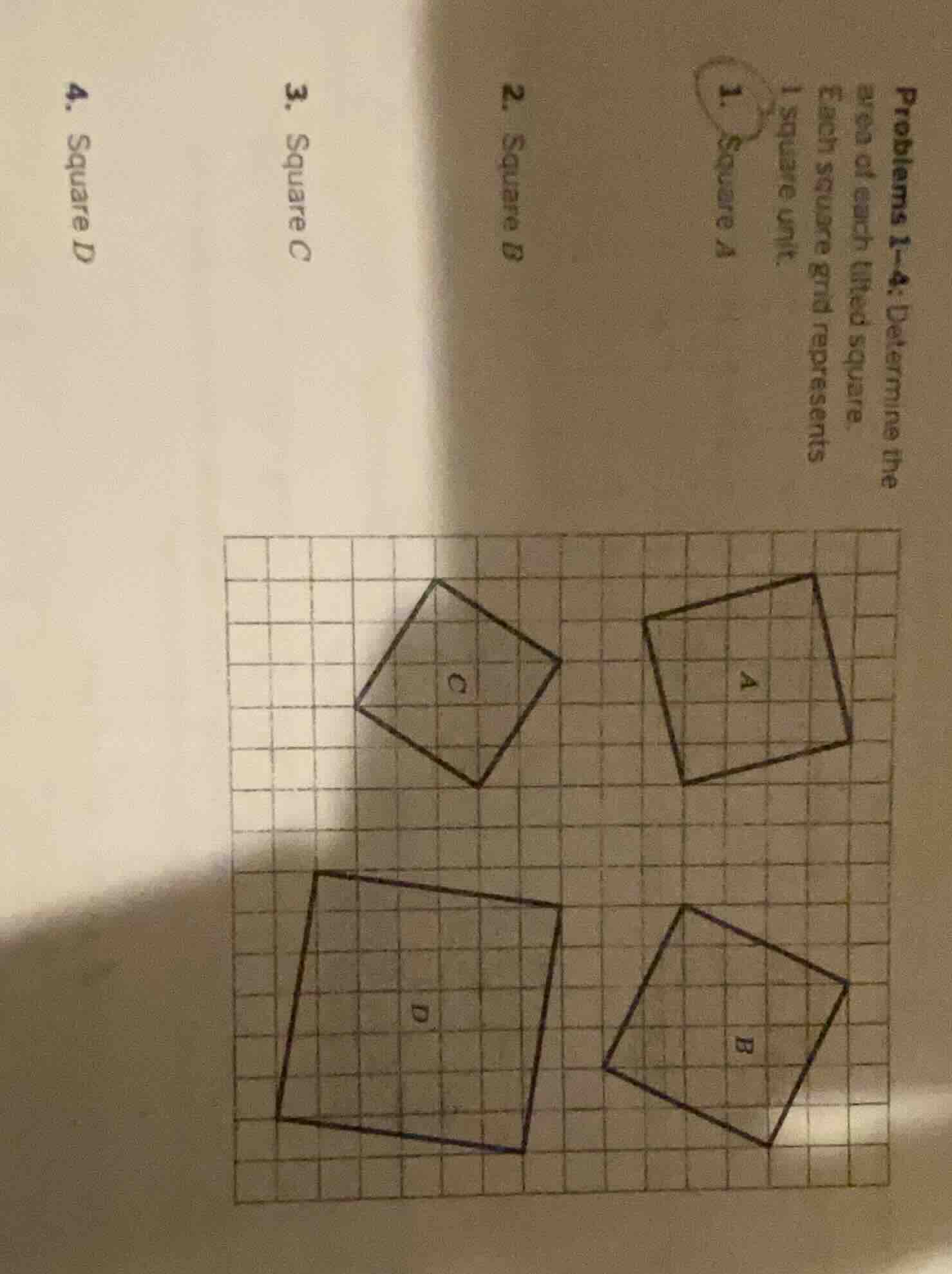
problems 1–4: determine the area of each tilted square. each square grid represents 1 square unit.
- square a
- square b
- square c
- square d
To determine the area of each tilted square, we can use the grid method (counting full squares and using the Pythagorean theorem for partial squares) or the Pythagorean theorem (since each square is tilted, the side length is the hypotenuse of a right triangle with legs equal to the horizontal and vertical distances between vertices).
1. Square A
Step 1: Identify the right triangle legs
Looking at Square A, the horizontal and vertical distances between the vertices (along the grid) form the legs of a right triangle. Suppose the horizontal leg is \( a = 4 \) units and the vertical leg is \( b = 2 \) units.
Step 2: Calculate the side length (\( s \))
Using the Pythagorean theorem:
\[
s = \sqrt{a^2 + b^2} = \sqrt{4^2 + 2^2} = \sqrt{16 + 4} = \sqrt{20}
\]
Step 3: Calculate the area (\( A \))
The area of a square is \( A = s^2 \), so:
\[
A = (\sqrt{20})^2 = 20
\]
2. Square B
Step 1: Identify the right triangle legs
For Square B, assume the horizontal leg is \( a = 3 \) units and the vertical leg is \( b = 3 \) units.
Step 2: Calculate the side length (\( s \))
Using the Pythagorean theorem:
\[
s = \sqrt{3^2 + 3^2} = \sqrt{9 + 9} = \sqrt{18}
\]
Step 3: Calculate the area (\( A \))
\[
A = (\sqrt{18})^2 = 18
\]
3. Square C
Step 1: Identify the right triangle legs
For Square C, assume the horizontal leg is \( a = 3 \) units and the vertical leg is \( b = 2 \) units.
Step 2: Calculate the side length (\( s \))
Using the Pythagorean theorem:
\[
s = \sqrt{3^2 + 2^2} = \sqrt{9 + 4} = \sqrt{13}
\]
Step 3: Calculate the area (\( A \))
\[
A = (\sqrt{13})^2 = 13
\]
4. Square D
Step 1: Identify the right triangle legs
For Square D, assume the horizontal leg is \( a = 5 \) units and the vertical leg is \( b = 3 \) units.
Step 2: Calculate the side length (\( s \))
Using the Pythagorean theorem:
\[
s = \sqrt{5^2 + 3^2} = \sqrt{25 + 9} = \sqrt{34}
\]
Step 3: Calculate the area (\( A \))
\[
A = (\sqrt{34})^2 = 34
\]
Final Answers
- Square A: \( \boldsymbol{20} \) square units
- Square B: \( \boldsymbol{18} \) square units
- Square C: \( \boldsymbol{13} \) square units
- Square D: \( \boldsymbol{34} \) square units
(Note: The exact leg lengths depend on the grid spacing. If the grid has 1-unit squares, count the horizontal/vertical distances between the square’s vertices to find \( a \) and \( b \).)

Snap & solve any problem in the app
Get step-by-step solutions on Sovi AI
Photo-based solutions with guided steps
Explore more problems and detailed explanations
To determine the area of each tilted square, we can use the grid method (counting full squares and using the Pythagorean theorem for partial squares) or the Pythagorean theorem (since each square is tilted, the side length is the hypotenuse of a right triangle with legs equal to the horizontal and vertical distances between vertices).
1. Square A
Step 1: Identify the right triangle legs
Looking at Square A, the horizontal and vertical distances between the vertices (along the grid) form the legs of a right triangle. Suppose the horizontal leg is \( a = 4 \) units and the vertical leg is \( b = 2 \) units.
Step 2: Calculate the side length (\( s \))
Using the Pythagorean theorem:
\[
s = \sqrt{a^2 + b^2} = \sqrt{4^2 + 2^2} = \sqrt{16 + 4} = \sqrt{20}
\]
Step 3: Calculate the area (\( A \))
The area of a square is \( A = s^2 \), so:
\[
A = (\sqrt{20})^2 = 20
\]
2. Square B
Step 1: Identify the right triangle legs
For Square B, assume the horizontal leg is \( a = 3 \) units and the vertical leg is \( b = 3 \) units.
Step 2: Calculate the side length (\( s \))
Using the Pythagorean theorem:
\[
s = \sqrt{3^2 + 3^2} = \sqrt{9 + 9} = \sqrt{18}
\]
Step 3: Calculate the area (\( A \))
\[
A = (\sqrt{18})^2 = 18
\]
3. Square C
Step 1: Identify the right triangle legs
For Square C, assume the horizontal leg is \( a = 3 \) units and the vertical leg is \( b = 2 \) units.
Step 2: Calculate the side length (\( s \))
Using the Pythagorean theorem:
\[
s = \sqrt{3^2 + 2^2} = \sqrt{9 + 4} = \sqrt{13}
\]
Step 3: Calculate the area (\( A \))
\[
A = (\sqrt{13})^2 = 13
\]
4. Square D
Step 1: Identify the right triangle legs
For Square D, assume the horizontal leg is \( a = 5 \) units and the vertical leg is \( b = 3 \) units.
Step 2: Calculate the side length (\( s \))
Using the Pythagorean theorem:
\[
s = \sqrt{5^2 + 3^2} = \sqrt{25 + 9} = \sqrt{34}
\]
Step 3: Calculate the area (\( A \))
\[
A = (\sqrt{34})^2 = 34
\]
Final Answers
- Square A: \( \boldsymbol{20} \) square units
- Square B: \( \boldsymbol{18} \) square units
- Square C: \( \boldsymbol{13} \) square units
- Square D: \( \boldsymbol{34} \) square units
(Note: The exact leg lengths depend on the grid spacing. If the grid has 1-unit squares, count the horizontal/vertical distances between the square’s vertices to find \( a \) and \( b \).)