QUESTION IMAGE
Question
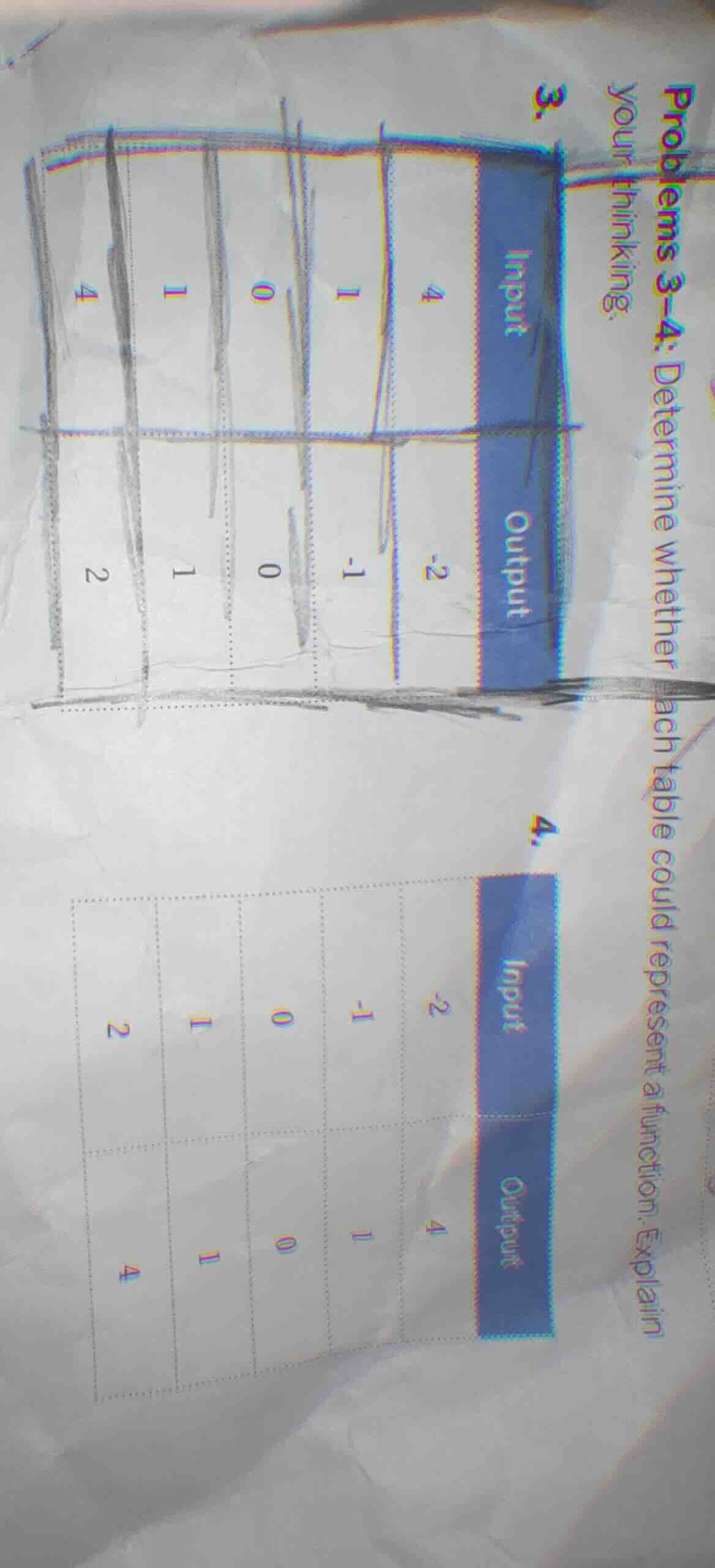
problems 3–4: determine whether each table could represent a function. explain your thinking.
3.
input: 4, 1, 0, 1, 4
output: -2, -1, 0, 1, 2
4.
input: -2, -1, 0, 1, 2
output: 4, 1, 0, 1, 4
Problem 3:
Step1: Recall function definition
A function is a relation where each input has exactly one output.
Step2: Check Input-Output pairs
Input values: \(4, 1, 0, 1, 4\) (wait, no, looking at the table: Input column has values (let's list them properly: first row input: 4, then 1, 0, 1, 4? Wait, no, the table for problem 3: Input row: 4, 1, 0, 1, 4? Wait, no, maybe the columns are input and output. Let's list each input and its output:
- Input \(4\) → Output \(-2\)
- Input \(1\) → Output \(1\)
- Input \(0\) → Output \(0\)
- Input \(1\) → Output \(-1\)
- Input \(4\) → Output \(2\)
Wait, no, maybe the table is:
| Input | Output |
|---|---|
| 1 | 1 |
| 0 | 0 |
| 1 | -1 |
| 4 | 2 |
Now, check for each input: does it have only one output? Input \(1\) has two outputs: \(1\) and \(-1\). Input \(4\) has two outputs: \(-2\) and \(2\). So by function definition (each input maps to exactly one output), this is not a function.
Problem 4:
Step1: Recall function definition
A function is a relation where each input has exactly one output.
Step2: Check Input-Output pairs
Input values: \(-2, -1, 0, 1, 2\)
Output values: \(4, 1, 0, 1, 4\)
Now, list each input and its output:
- Input \(-2\) → Output \(4\)
- Input \(-1\) → Output \(1\)
- Input \(0\) → Output \(0\)
- Input \(1\) → Output \(1\)
- Input \(2\) → Output \(4\)
Each input has exactly one output. So this is a function.

Snap & solve any problem in the app
Get step-by-step solutions on Sovi AI
Photo-based solutions with guided steps
Explore more problems and detailed explanations
s:
Problem 3:
The table does not represent a function. Because the input value \(1\) is associated with two different output values (\(1\) and \(-1\)), and the input value \(4\) is associated with two different output values (\(-2\) and \(2\)). A function requires that each input has exactly one output.
Problem 4:
The table does represent a function. Because each input value (\(-2, -1, 0, 1, 2\)) is associated with exactly one output value (\(4, 1, 0, 1, 4\) respectively). Even though different inputs can have the same output (e.g., \(-2\) and \(2\) both map to \(4\), \(-1\) and \(1\) both map to \(1\)), the key is that each input has only one output.