QUESTION IMAGE
Question
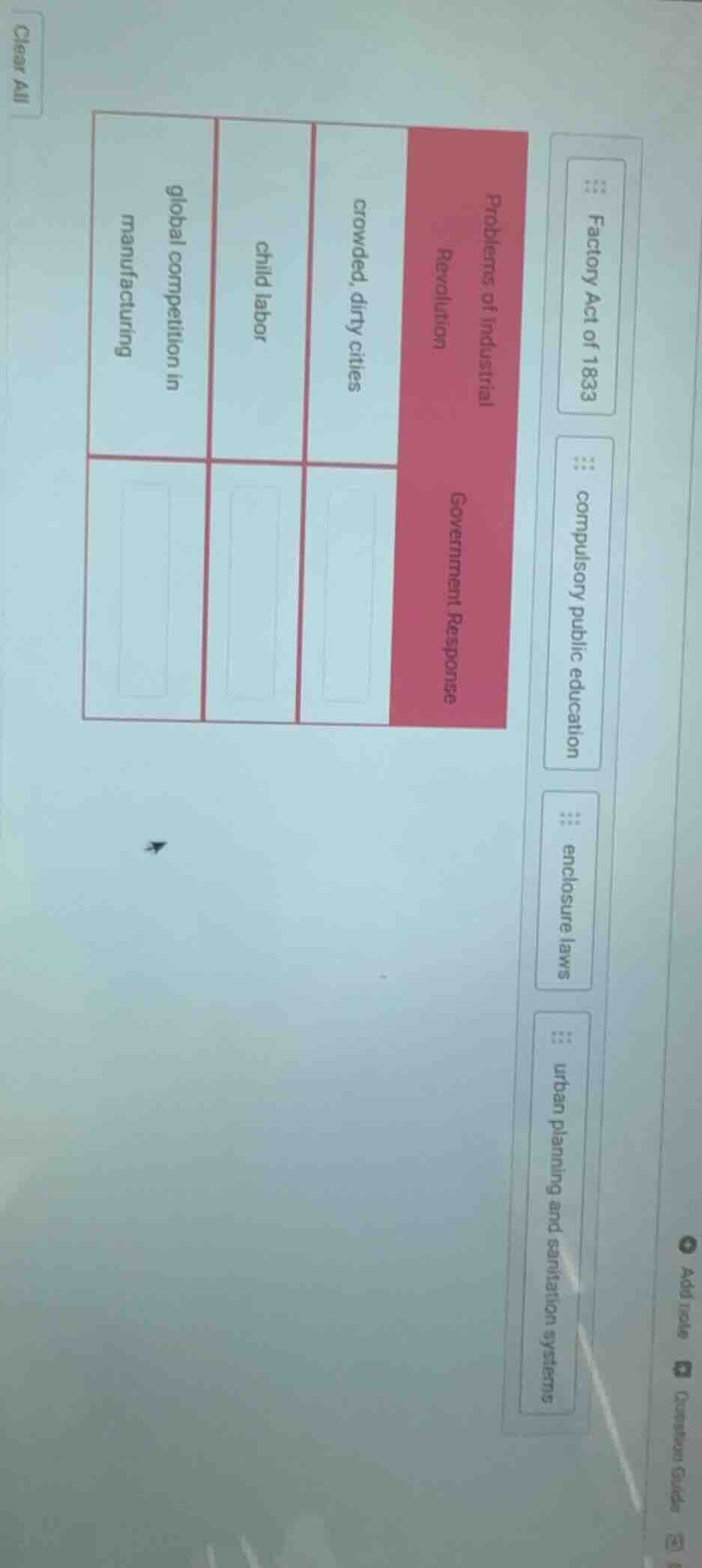
problems of industrial revolution: crowded, dirty cities; child labor; global competition in manufacturing. government response: empty cells. right side items: factory act of 1833; compulsory public education; enclosure laws; urban planning and sanitation systems.
To solve this problem, we need to match each problem of the Industrial Revolution with the appropriate government response:
1. Problem: Crowded, dirty cities
- Explanation: Crowded and dirty cities were a result of rapid urbanization during the Industrial Revolution. Urban planning and sanitation systems were implemented to improve living conditions in cities by addressing issues like overcrowding, poor hygiene, and lack of proper infrastructure.
- Match: urban planning and sanitation systems
2. Problem: Child labor
- Explanation: The use of child labor was a major issue during the Industrial Revolution. The Factory Act of 1833 was a government response aimed at regulating working conditions in factories, including restrictions on child labor (e.g., limiting working hours for children, improving safety).
- Match: Factory Act of 1833
3. Problem: Global competition in manufacturing
- Explanation: Enclosure laws (though primarily associated with agricultural changes during the Industrial Revolution) and other economic policies, or more directly, enclosure laws reshaped land use and labor, but for global competition in manufacturing, enclosure laws (or other trade/industrial policies) – however, more accurately, enclosure laws forced rural workers into cities, fueling the labor force for manufacturing, which then faced global competition. Alternatively, compulsory public education (to improve workforce skills) – but more precisely, enclosure laws (as they transformed agriculture, pushed people to cities, and supported manufacturing growth which then faced global competition). Wait, correction: For global competition in manufacturing, the government response is less direct, but among the options, enclosure laws (they contributed to the industrial workforce by enclosing common lands, pushing peasants to work in factories, thus boosting manufacturing which then competed globally). Alternatively, compulsory public education (to improve worker skills for global competition). Let’s re-evaluate:
Wait, let’s recheck the options:
- Factory Act: child labor (correct).
- Compulsory public education: to improve education (matches child labor? No, child labor was addressed by Factory Act; public education is to educate children, reducing child labor by requiring school). Wait, maybe:
Child labor → Factory Act (regulates child labor).
Crowded, dirty cities → urban planning and sanitation (improves city living).
Global competition in manufacturing → Enclosure laws (they led to more efficient agriculture, released labor for manufacturing, which then competed globally). Or compulsory public education (to train workers for global competition). Let’s clarify:
- Compulsory public education: A response to child labor? No, public education ensures children go to school instead of work, so it’s a response to child labor (by reducing child labor through mandatory education). Wait, maybe I mixed up. Let’s re-express:
- Crowded, dirty cities: Need urban planning and sanitation → urban planning and sanitation systems (correct).
- Child labor: Need laws to regulate child labor (Factory Act) or education (compulsory public education to keep kids in school). Wait, the Factory Act of 1833 specifically regulated child labor in factories (e.g., minimum age, working hours). Compulsory public education is about mandatory schooling, which also reduces child labor (by requiring children to attend school). But the options are:
Options (right side): Factory Act of 1833, compulsory public education, enc…

Snap & solve any problem in the app
Get step-by-step solutions on Sovi AI
Photo-based solutions with guided steps
Explore more problems and detailed explanations
(Table Format):
| Problems of Industrial Revolution | Government Response |
|---|---|
| Child labor | Factory Act of 1833 |
| Global competition in manufacturing | enclosure laws (or compulsory public education – see note) |
(Note: If “compulsory public education” is intended for global competition (to train workers), adjust accordingly. But historically, enclosure laws are more linked to the labor force for manufacturing, while public education is for workforce skill development.)